
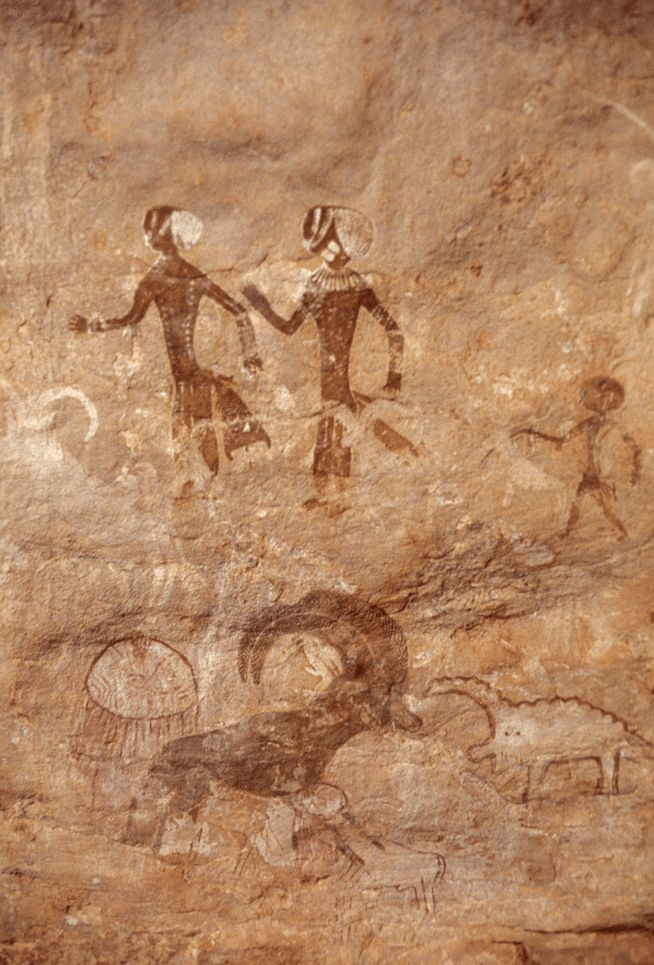
The veneration of horses among early shamanic societies likely arose because horses produce a significant amount of manure, and certain mushrooms, known as "coprophilous" fungi, attach to their dung to reproduce. These fungi are called coprophilous because they rely on their hosts to excrete them in manure, which acts as fertilizer, thus spreading their spores. The fungi, known as Panaeolus, include species that contain psychoactive alkaloids like psilocybin. Worship rituals for sacred animals were not due to the animals themselves but rather because they "produced" sacred mushrooms through their dung. This is an extrapolation of Terence McKenna's original "stoned ape" theory.
To be more precise, the distribution of psilocybin mushrooms does not completely overlap with that of horses, at least not in Eurasia. The original theory suggests that the original sacred animals were cloven-hoofed animals, such as reindeer, rather than equine single-hoofed animals like horses. The supposed evidence of psilocybin mushrooms comes from rock paintings in the Sahara, which was then, allegedly, a savannah rather than a desert. However, Africa is not lacking in equines. There is the donkey, and one doesn't need to go as far as the zebra. At that time, the donkey was domesticated from the wild ass in roughly the same geographical regions. Donkeys produce manure just like horses, and of course, more than sheep and cattle.
Equines (Equidae, horse-like) sometimes rummage through their own dung. It is likely that early shamans observed them eating dung and wanted to do the same. A similar claim has been made about shamans who observed reindeer digging through their own urine, which was supposedly psychoactive after consuming Amanita mushrooms. All of these studies are, of course, speculative but make a lot of sense.
In the Hebrew Wikipedia article on "Coprophagy," it is written: "Large animals leave behind undigested food in their feces, a common trait among herbivores, leaving a relatively large amount of food for dung-eaters." In their 1991 paper "Coprophagy in Animals," Soave and Brand noted: "It has been reported that foals of thoroughbred horses eat feces in response to the mare's pheromone. A foal will consume some of the mother's feces about half the time she defecates. This behavior occurs between the second and fifth week after the foal's birth. Coprophagy also occurs in adult horses on a low-protein diet." A similar behavior is described by Haupt and Crowell-Davis (1985).
Savannah plants tend to have low protein content, so equines in the savannah often need to consume large amounts of food to meet their required protein and mineral intake. One of the ways they enrich themselves, it seems, is by eating their own dung…
הצטרפו לרשימת התפוצה שלנו
כתיבת תגובה