
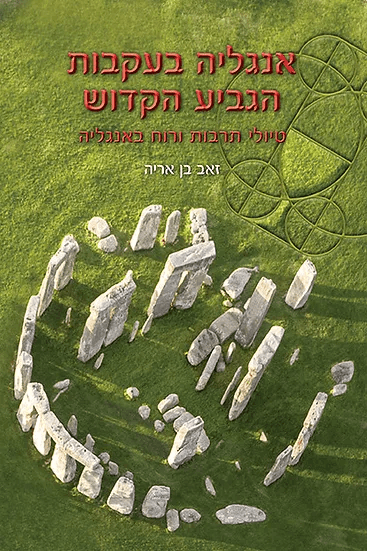
I’m not particularly fond of New Age ideas or alternative theories in the style of Graham Hancock. However, I do appreciate theories that touch on shamanism and altered states of consciousness, which is why I find value in exploring Paul Devereux’s theory regarding the essence of ley lines in Neolithic sites across ancient Britain. (An excerpt from Zeev Ben Arie's "England, on pursuit of the holy grail". also in his weblog)
In general, ley lines are a phenomenon where sacred sites on a map seem to align in straight lines, even if, on the surface, there appears to be no connection between them. One of the most famous lines is the St. Michael or Mary Line, which connects in a straight imaginary line places such as the Stella Maris Monastery in Haifa, Delos, Delphi, and two tidal islands off the North Sea coast—Mont-Saint-Michel and St. Michael’s Mount. Similarly, ley lines are allegedly found in the cursus tracks that link Neolithic sites in the Stonehenge and Avebury complexes, which has led alternative researchers to believe that this alignment was intentional because these sites sit on energy lines beneath the earth. This energy, possibly some kind of magnetic field, is said to create a unique spiritual atmosphere ideal for ritual activities. Perhaps this is why magnetic flux is called “induction,” as the presence of an electromagnetic field is a force that, when you are within it, you can feel—even if you don’t know how to explain it.
As this concept drifted into occult and pseudoscientific interpretations, those wishing to maintain a serious approach to research sought to align it more with mainstream scholarship. This is where Paul Devereux’s perspective comes in. He suggested that these lines are not necessarily tied to physical energy but rather to shamanic experiences. In other words, ley lines are a type of sacred geography that originated from the experiences of shamans, who had out-of-body experiences that manifested as linear or geometrical movements. Straight lines were believed to assist spirits on their journey to the afterlife: a straight path facilitates movement, while a crooked line or labyrinth traps them. Straight motion, in general, symbolizes perfect movement and emphasizes cosmic order. Trapping straight motion prevents it from continuing its perfect trajectory. This concept has various applications—not just for capturing souls or spirits (like in the labyrinth of the Minotaur or the Hypogeum of Ħal Saflieni in Malta) but also in the interaction of architecture with sunlight. The sun, symbolizing cosmic order, emits straight rays of light, which are a message from the “ether.” When these rays are captured, the blessing is momentarily contained. Some structures feature architectural designs that trap a ray of sunlight at a specific moment of the year—often during solstices or equinoxes.
Devereux also supported the idea that Neolithic sites were constructed to create acoustics that generate sound waves at a specific frequency, stimulating the brain’s right hemisphere, which is responsible for intuition, emotion, and transcendence, while allowing the left hemisphere to rest—resulting in a spiritual experience. This frequency, 111 Hz, is considered the “divine frequency,” and it is said that many temples from that period resonate it through their walls. For example, temples in Malta, some of which are located at ley line intersections, exhibit this phenomenon. Others, like Ħal Saflieni, are designed as labyrinths that, perhaps, trap the spirits within them—for reasons that may have served specific purposes.
הצטרפו לרשימת התפוצה שלנו
כתיבת תגובה