
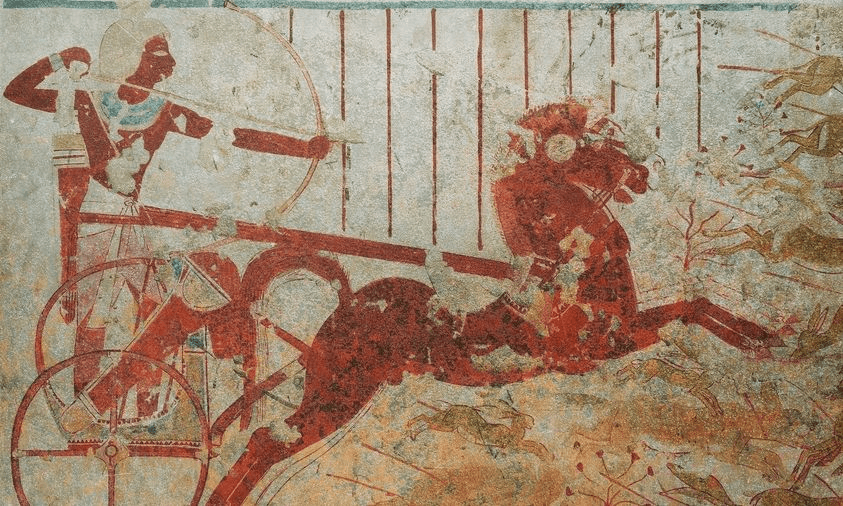
High-tech worship appears to have been in the Bible among the Israelites towards the philistines' technology. In the Bible, the Israelites are often described as a technologically backward nation after their enemies. The Gentiles come from cultures where blacksmithing were widespread and developed, and the tools of war were chariots with metal wheels and horses. Among the Israelites, on the other hand, in order to fight, they cut their secateurs into brittle spears and fight with wooden and bone tools. And it is clear – the Gentiles are fighting in the name of idols of wood and stone and arrogance, and the Israelites are fighting with God's blessing, when in fact they are not winning, because they are technologically inferior. The one who fights and wins is God, the Almighty, who by his will presents miraculous victory to the Israelites, and by his will, without ritual cooperation on the part of the Israelites, they will be absolutely destroyed.
The Book of Judges speaks of Sisera in particular and the Canaanites who generally live in the valleys as having an iron chariot: "they could not drive out the people who were living in the valley because those people had iron chariots" (Judges 1:19). 1 Samuel in chapter 13, and of course in many other places claims that the origin of the art of blacksmithing is with the Philistines: "Not a blacksmith could be found in the whole land of Israel, because the Philistines had said, Otherwise the Hebrews will make swords or spears" etc. In fact the Israelites had to bring reinforcements from outside when they wanted to blacksmith metals, through the Kenites who were said to be excellent iron potters. Oholiab, son of Ahisamakh, also knew this art, but it is known about the Danites that they were in mutual relations with the Philistines (Samson) and according to Yigael Yadin they were sea peoples themselves. Yael, the wife of the Kenite Chever, was friends with Sisera because the Kenites were colleagues or because they learned the art of blacksmithing from their Canaanite neighbors. Or, the Philistines. Adam Zertal claims that Sisera was a mercenary from the Shardana tribe, the Sea Peoples.
Most scholars claimed that the origin of the name Kenites is from "Kana", a metal factory. Chaim Rabin, on the other hand, claimed that the meaning of the name is from the phrase "to know clearly". In Hellenistic Egypt these two things, technology and wisdom, were tied together in the cult of Hermes-Thoth through the Hermetic Corpus, a mixture of mysticism and alchemy. Likewise in the Bible, the whole motivation of dealing with the types of weapons and the fact that the metal is assigned only to the worship of God, is hermetic. In other words, the metallurgical knowledge is knowledge that God used to establish world orders and create. God is the original Kana, who is on the one hand "God is jealous" (Exodus 20:4), and on the other hand, "he created heaven and earth" (Genesis 14:19). The action of the "kana" (hebrew: kinian, ownership) was the action with which God created the world, "The Lord owned me as the first of his works, before his deeds of old" (Proverbs 8:22) And "kana" is also the way to achieve "Gnosis" i.e Wisdom of Sophia: "The beginning of wisdom is this: Get] wisdom. Though it cost all you have, get understanding" (Proverbs 4:7)
By pouring metal castings into each other, one becomes the other through a transformation/transition – when the same transformation is the emphasis in religious worship, whether it is a turning of the heart and repentance, or whether it is a transition to other levels of consciousness. Dionysus in ancient Greece is considered the god of transformation, when in his worship the wine symbolizes the spiritual transformation of the mind, the wine that grows on the land of Terra Rossa saturated with metals, red as copper.
The Philistines come from the Aegean culture, and were Indo-Europeans who were known for their metal tools and the massive use of horses. Their religion included myths related to death and resurrection, where the background to death is the incorrect use of technology, that is: the god of war covets the tools produced by the god of wisdom, and uses them unwisely which ultimately causes unwanted killing (the victim is usually love and human harmony). Killing is rectified through resurrection and the cyclical order in which the undead make rounds between the world of the dead and the world of the living. Technology is a double-edged sword and has the power to create worlds and destroy them, technology is the "Logos".
This myth about the wise use of technology is what underpins religions. In the twentieth century, it is embodied in the form of the so-called "philosophy of technology", meaning the moral implications of science. Hans Jonas, for example, is a philosopher who came from practicing religions that sanctified the right way to use knowledge in ancient times (Gnostics), to the same practice in modern times. When the biblical theologian consistently refers to the metal as a reproach except if it is related to the worship of God (then, the metal is a noble thing: Rish Lakish said: The world was not fit to use gold. And why was it created? For the Temple. Genesis Rabbah 16:2), he tries to claim that only he has the right solution to use technology morally.
P.S: Since trade in the Mediterranean flowed eastward, it was brought the new metal tools from the west. Independent and powerful enough kingdoms, which lay on the coast, could enjoy this luxury. Internal and weak kingdoms, like Israel, and probably barbarian kingdoms deep in Europe, not. They saw these tools as giving a tremendous advantage on the battlefield, a magical thing, or at least a blessing given by the god of war for the enemy. A kind of cargo cult
P.S: Since "Kana" and "Kaneh" are basically of the same liguistic root, that is to say the cannabis (the so to speak "kaneh bosem") or any other psychoactive Kaneh are "technology of the mind"
הצטרפו לרשימת התפוצה שלנו
כתיבת תגובה