
-
The volcano cult of the ancient Israelites
Israel Knohl publishes a new book in which he compares two stories of receiving the Torah. The first is receiving the Torah from a source of water (a spring), which in the Torah is mentioned as water of "Massah and Meribah" (Exodus 17, also: Exodus 15 as "Marah"). The second is receiving the Torah near a smoke-filled mountain located in the "the field of Edom". Some differences are evident between the two stories, except for the place where the covenant was given. According to the differences, it can be seen that the earlier tradition is the tradition of giving the Torah near the water fountain, and only at some point did the Torah begin to be presented as if it was given on a mountain (the name of the book is accordingly "From the fountain to the mountain"). What was that stage? Knohl points to the eighth century. Then literacy was expanded, then the kingdom of Israel was also destroyed and population migration to the south began, and with it also passed the stories that adapted themselves to the political and religious reality of that time.
This conclusion is no stranger to the conclusions of other books published in recent years such as "The Bible Unearthed" of Israel Finkelstein. The myth as we know it was presented to create a common identity between the two parts of the people after the destruction of the Northern Kingdom, and due to the fact that some of the religious commandments were new to their ears, the myth was presented as if it was given to an individual in Sinai, because the masses were not able to come into direct contact with God.
According to Knohl, the story about the sweetening the water immediately after the splitting of the Red Sea, which appears in Exodus 15, and is supposedly the founding myth of the nation of Israel, is reminiscent of the stories about Elijah and Elisha. After Elijah ascends to heaven, Elisha crosses the waters of the Jordan, and later "heals the waters" and they remain "healed until this day" (2 Kings 22:22). Which proves that this tradition is a northern tradition.
Although Knohl disconnects himself in each book from his hypotheses in the previous books, it is impossible not to mention Knohl's previous book ("Hashem") in which he claimed that the original location of Mount Sinai was Mount Hermon. If we see in the sources of the Jordan the geographical scenario of the receiving of the Torah, it is easy to place the spring and the volcano in question in the same area. According to Josephus in the Jewish wars, the source of the Jordan is in an underground passage that goes from a place now called "Lake Ram" directly to the Banias. The Ram Lake is at the foot of an dormant volcano which is actually the westernmost branch of what is called "Harrat al-Sham", a mountain that is now called "Mount Ram".
Harrat al-Sham is a huge volcanic field that stretches between Syria and northern Saudi Arabia along the Arabian desert and is called the "Black Desert" after the black basalt soil of volcanic origin in it. Although the volcanoes are all dormant, we see that volcanoes in Saudi Arabia, which are also related to the movement of tectonic plates on the Syrian-African rift, were active in the last millennium. In Hejaz there is a concentration of such semi-active volcanoes, and it is known about several eruptions in the area that occurred in the seventh century AD shortly after the time of Muhammad, and who knows if not due to the connotation of Moses with smoky volcanoes, Muhammad became a type of second Moses.
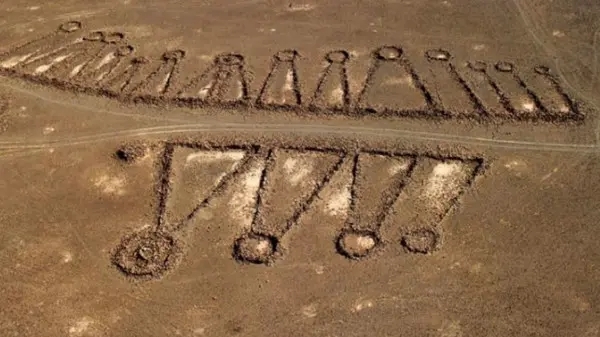
Another interesting thing that exists in these basalt deserts is the so-called "desert kites", huge man-made traps that allowed ancient hunters to drive herds of deer into their necks, thus trapping them and killing them en masse. They are called kites due to the shape in which it was built "neck". These kites required cooperation between large amounts of humans and since in the desert culture it was "every tribe for itself", they were actually a rare opportunity for cooperation between tribes. It was easy to put this thing under a religious framework, and indeed in many of these desert kites rock paintings (petroglyphs) were discovered that hint that they also had a religious meaning, either because they symbolized peace and unification between the tribes, or because the ancients saw hunting itself as a gift from the gods , and in the buildings themselves a kind of a hunting magic. In any case, their use contributed to the near extinction of the hunted deer. And so, after the fauna changed, the need to use them became unnecessary, what's more, the desertification that occurred caused the temperature to rise and make life in the area unbearable. (By the way, the flora of the place is rich in acacia trees…)
What does this have to do with Knohl? Not related except that Knohl claimed that the Israelites actually immigrated from the Hauran of south syria (and not from Haran of Turkey). "Hara" in Arabic is a volcanic field, حَرّة. Most volcanic fields contain "holes" (Hebrew: Hor), basalt pores. This is probably the name of the Hauran, the holes in it. In the volcanic fields in Saudi Arabia, such as in "Ḥarrat Khaybar", there are many such "kites", and researchers speculate that these are burial complexes of cults that worshiped deer. What brings us back to the basalt fields of the Golan Heights is a circular burial complex that is slightly reminiscent of the buildings in Khaybar, "Rujm el-Hiri". Here it is already a wild hypothesis, but it may actually be a remnant of a "desert kite" that became a place of religious worship, and was built in advance at the foot of a volcano (in our case Tel Saki).
By the way, I would like to mention another dormant volcano in the area of the sea of Galilee – mount Arbel. According to Elchanan Reiner, this place is the same volcano where Joshua ben Nun is buried, and it is also the burial place of the sons of Jacob, Shimon and Levi. Nabi Shuʿayb, the holy place for the Druze (where according to them Jethro, Yochebed and Zephora, Moses' wife, are buried), and according to the myth there is a footprint of Moses, so to speak, is found there. Reiner says that the story of this footprint is related to the myth of an earthquake that happened immediately after the death of Joshua, and that this earthquake has eschatological significance because it is supposed to be the same earthquake in the latter days that is associated with the second coming of another Joshua, Jesus. This area is also the area that is supposed to be Mount Megiddo, where there were various wars of Israel, such as the war in Sisera and the war of Joshua against Jabin, king of Hazor. There, it turns out, there was also another battle that at the time was considered Armageddon, the battle of Saladin and the Crusaders…
-
Anglo Saxon beer consumption during the low middle ages
Hannah Caroe is a doctoral student in archaeobotanics at Oxford, and she wrote her thesis on the malting process and the processing of grains into beer in the middle of the Anglo-Saxon period in the Middle Ages (about 680-830 AD) according to archaeological findings in the earliest malting complex identified so far in Anglo-Saxon England, in the town of Sedgeford in north-west Norfolk.
The average Englishman drank one gallon of beer per day. Very. Much. Perhaps more than any nation throughout Europe in those days or ever. And not because beer was more sterile than drinking water, but simply because the ancient English were very fond of beer, studies show that drinking water was relatively drinkable, but when there is an opportunity to drink something tasty, like children today, juice is always better. And by the way children, even English children in the Middle Ages drank beer in a somewhat watered down version. A good host was considered to be someone who had a bad mouth smelling of beer. Those who made the beer were not only monks in the monastery, the beer was made at home. Surnames in the Middle Ages imply that the role of brewing the beer belonged to the women. In any case, beer consumption permeated all levels of Anglo-Saxon society, both producers and consumers were from all levels of society and this was not a status symbol of any kind. Both religious and secular consumed the beverage, and there were also those who blamed the fall of England at the hands of the conquerors from the east on their hard consumption of the beer. Beer and wine were traded or given to each other as gifts, salaries and prizes, just as today you bring your host a bonbonnière with a bottle of wine.
The beer in the England of the middle ages was not the same as today's beer, even though the malting and fermentation process is similar. They wouldn't use the same grains and wouldn't cook with the same plants. But the findings show that the English used what was available and adopted the crops of the place and the time without fanaticism towards this or that ingredient. They used local materials, and did not depend on trade to bring "good raw material". Since they took what they had, the tastes were also diverse, because that's what nature and chemistry give. The mixture they used was gruit. Namely, the plants in which the beer was soaked and boiled, before they were converted to hops in the ninth century in central Europe, and we are talking about the centuries before that. The groat consisted of a mixture of plants such as Myrica gale, fruits, honey, cinnamon, alder bark and even fresh eggs or fish…
"Malting, Brewing and Beer in Anglo-Saxon England. Mid Saxon Sedgeford: A Case Study" by Hannah Caroe, could be found here as part of "New Perspectives on the Medieval ‘Agricultural Revolution’", eds. Helena Hamerow and Mark McKerracher (Liverpool University Press, November 2022).
-
The evolution of the sacrifices: from blood sacrifices to a spiritual sacrifice
This week's Torah portion "Vayikrah" deals with sacrifices. The sacrifices and especially the blood sacrifices formed the center of the two religions of the ancient world, the Greek religion and the Jewish religion. There is a similarity and of course there is a difference between the two religions. The difference is clear, the nature of the slaughter which is supposed to be "kosher" only for the Jews and the specific animals they sacrifice. The similarity is evidenced (albeit at a much later stage, and from a polemical approach) by the emperor Julian the Apostate, when he writes "The customs of the Jews are similar to the pagans, except that they recognize only one god. This thing is unique to them and foreign to us. But we share the rest of the things – halls, temples, altars, drivers of purity, and certain laws in which there is no difference between us – and if so, only in marginal details".
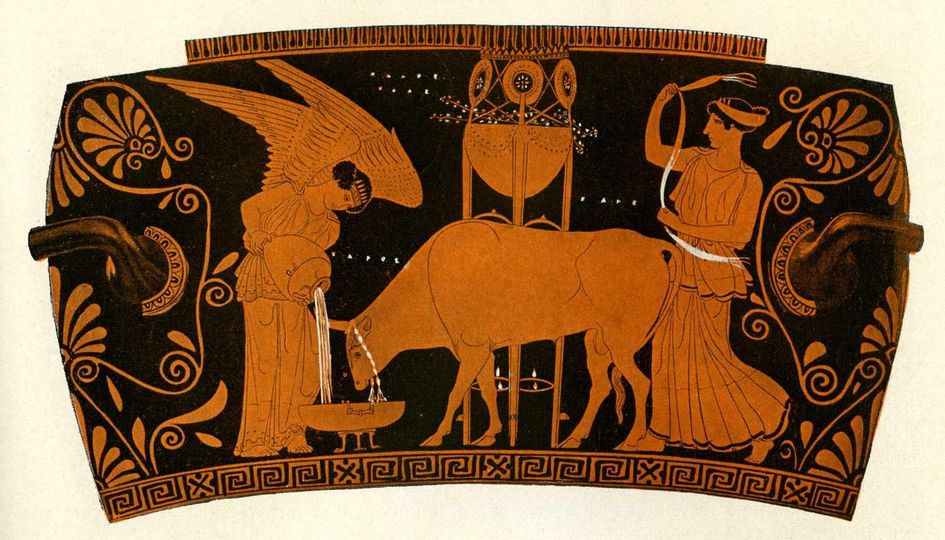
Among the Greeks, the sacrifice offered was usually something called "thusia" (θυσία), a ceremony that included partial burning of the sacrifice, after separating the parts that can be "read" (i.e: liver for divination) and the parts that are eaten in a festive manner. Something similar to the Jewish "shelamim" sacrifice ceremony (Leviticus 3). This ceremony was mainly aimed at the worship of "Olympian" gods and was done during the day.
Among the Greeks, there was also something that paralleled the "olah" sacrifice (Leviticus 1), in which the whole animal is completely burned. This thing is called sphagia (Σφαγία), after the sphagion, a vessel designed to collect blood. Something perhaps similar to the "sprinkling bowl" ("mazrek") described in the Sacrifice of the "shelamim". The mazrek is so called because it was used to collect the blood that the priests threw (that is, sprinkled, "zarak") on the horns of the altar, but in both cases it is a receptacle. The princes of Israel are told in the book of Numbers that they donated silver "mazrek" or "mizrak" (that is, bowls). In Solomon's temple it is said that there were copper and gold "mizrakot". The reason they had to collect the blood is because there was a special emphasis on cutting the main artery, what is called in Judaism "the tube and the esophagus". The Greeks would pierce them and the squirt would pour directly into the vessel.
Sphagia was usually sacrificed before going to war. This Greek sacrifice is called Holokautein (ὁλοκαυτεῖν), which means "holo" from the word "whole", and "kaustos" from the word "burnt". In Latin "holocaustum" and later in English "holocaust". This sacrifice is of Chthonic origin, and was usually sacrificed to these gods, such as for example the gods of the underworld. It is therefore understandable why it is said that in archaic times a human being was sacrificed, but because of the reluctance to sacrifice human sacrifices it was changed to an animal. In this there may be a parallel to the worship of the Moloch (as described in 2 Kings 3), and this was abominable in the eyes of the "civilized" nations. Among the Jews, we also see the conversion of the human sacrifice into an animal, in the story of Binding of Isaac where Abraham took the knife ("Maachelet"), a word that was supposedly also taken from the Greek, where the knife with which the sacrifice was slaughtered was called "machaira" (μαχαιρα). This is how it was with the Greeks, the conversion of a human sacrifice into an animal.
Following the destruction of the Temple, the Jews stopped sacrificing because there was obviously nowhere to and how to, and converted their sacrifices with prayers. But did they do it under practical circumstances, or simply because they were influenced by the Neoplatons who, at exactly the same time, began to despise blood sacrifices?
We see Porphyry, a vegetarian Neoplatonist, abhors blood sacrifices and explains the logic of this approach in his essay On Abstinence from Eating Animals". Porphyry bases his theory on Theophrastus in his book "Peri Eusebeias" ("On Piety"). He claims that the true priest to the supreme God is none other than the philosopher, who worships his God, above all, with the moderation of his spirit (σωφροσύνη) that allows him to approach God with a pure body and a fresh soul. "The mind of the wise man is the true temple" The wise man turns his heart into an altar, on which stands the true statue of God, his intellect. Vegetarianism is also a tool that allows the philosopher to detach himself from the masses participating in the sacrifice of the polis. Whoever eats meat, will participate in the blood sacrifice ceremony. Those who are vegetarian will give it up.
Porphyry, following Theophrastus, distinguishes, however, between the animal sacrifice among the Jews and the sacrifice among the Greeks, and he obviously means "thusia". And I am quoting from Guy G. Stroumsa's book "La fin du sacrifice : Mutations religieuses de l'antiquité tardive": The sacrifices of the Jews are not at all similar to those of the Greeks, because the Jews do not eat the meat they sacrifice to their God, but burn the animal entirely. But the Greeks are careful not to imitate them in this! Because the Jews are a "race" of philosophers: their sacrifices are opportunities to connect with the divine, "and they dedicate the night to observing and reading the stars, and calling to God in their prayers". Although the Jews offered blood sacrifices, they did not do so because of their lust for flesh, like other gentiles, but because they had no choice. The famine, writes Porphyry following Theophrastus, pushed humans to cannibalism which became human sacrifice, while the original sacrifice of mankind were only from the plant. Blood sacrifices represent a later stage than human sacrifices.
What is the purpose of the victims? "We must unite with God, become like Him and offer Him as a holy sacrifice our ascension, since it is the service of our soul and its redemption. This sacrifice is embodied in the equanimity of the soul and in the contemplation of God," writes Porphyry. Iamblichus, another Neoplatonic philosopher, although he disagrees with Porphyry about vegetarianism, still agrees that superior beings do not need sacrifices at all. In his book "On the Mysteries of Egypt" he claims that only the lower gods, the material, require sacrifices. The blood sacrifices represent the material aspect of the worship, alongside the spiritual aspect that exists in it; the dual composition of man, both material and spiritual, is the reason for this ritual duality. Along with the blood sacrifices there is another type of sacrifice, more spiritual. Spiritual sacrifices These are the ones sacrificed by the philosophers, who ascend to the One, above and beyond the multiplicity of divinities: a small elite that exists beyond any law. Blood sacrifices, on the other hand, are committed to the "hoi polloi", the people of the polis who need a lawgiver (chapter 22).
Towards the end of the fifth book, Iamblichus discusses the prayer that accompanies the sacrifice (chapter 26). The purpose of prayer is to bring us closer to the gods, to establish contact with the divine. The sacrifice and the prayer complement each other. Union with the gods is also at the center of a small treatise, "On the Gods and the World", which presents the main beliefs of later paganism and was written by Sallustius. For Sallustius, temples are nothing but exact replicas of the heavens, reflecting unattainable heavenly powers. Despite this, in these temples there is no use for the gods (and what use can they have?), but for us, since there we can unite with them. Blood sacrifices represent our lives, which we sacrifice symbolically. Prayers that are not accompanied by sacrifices are empty words without any value, while when they are said during the sacrifice they become "living words". The soul of the sacrificed animal ascends in some way to heaven, together with the words of the prayer in which we seek to unite with the gods (chapter 16). -
The messianic meaning of the temple tax
I just thought it would be nice to continue the tradition of the alternative weekday sermon. Since last week's Torah portion of "Pekudei" talks about the total donations to the Tabernacle and what they did with them, this time we will discuss the Eschatological meaning of the "the temple tax" (and since the eschaton is psychedelia, then about its psychedelic meaning).
The portion of "Pekudi" basically summarizes the process of building the tabernacle which began with the commandment to the Israelites to give a donation to the tabernacle. When the commandment was made, they made sure to emphasize that the donation was actually a "ransom" or "atonement" (ransom in hebrew is "Kofer" which is also as "Kaparah", atonement). The donation was actually intended to prevent the donors from being harmed on the day of the withdrawal, "When you take the census of the children of Israel for their number, then every man shall give a ransom for himself, that there may be no plague among them when you number them" (Exodus 30:12)
The orthodox commentators tend to interpret this as if it is forbidden to number the children of Israel just like that, and that if they are numbered without coordination with God or a direct instruction from Him, God brings plagues. This happened when the devil incited David to name the children of Israel, then it turned out that David sinned and the punishment he received was a plague that happened later that killed seventy thousand people from Israel. That is, the linguistic root of P.K.D is from the word censes, to count how many military draftees there are in a nation.
But P.K.D is not just to number. But also to "redeem" (or: "command"), to release from suffering, or simply to return later and fulfill a promise. It is told about the barren women that God redeemed them, it is told about the Israelites in Egypt that God redeemed them. Usually this redemption comes after a remembrance, God remembers that he promised, and although it took a long time, he always keeps his word.
After the sin of the golden calf it was said "And now go, lead the people to the place of which I spoke to you. Behold, my angel will go before you, and in the day of command, I will and command for their sin" (Exodus 32:34). In the Sanhedrin 102a they interpret the verse that all the calamities that befall the people of Israel are due to the sin of the golden calf. Accordingly, we see that Jeroboam, who was "the commander of Joseph's house", built calves, and Isaiah calls the destruction of the kingdom of Israel "a day of command". Ezekiel 38 calls the war of Gog and Magog by this name. Zechariah says that the latter days (chapter 14) will include also a great plague. Meaning: The role of this donation that God is asking for is to save the people of Israel from that plague in the latter days, that is, the person who donates receives a protection amulet against the plague and becomes one of those chosen ones who will be saved in the last judgment and will be directed to a safe haven in heaven as part of the "Rapture" until the disaster is over.
The donation is the charity or rather the "righteousness", the choice of the people to choose the path of righteousness and be righteous, specifically in Judaism they talk about the relationship between the people of Israel and God as a kind of loan and deposit, so that the commandments are actually the deposit and observing the commandments is that donation.
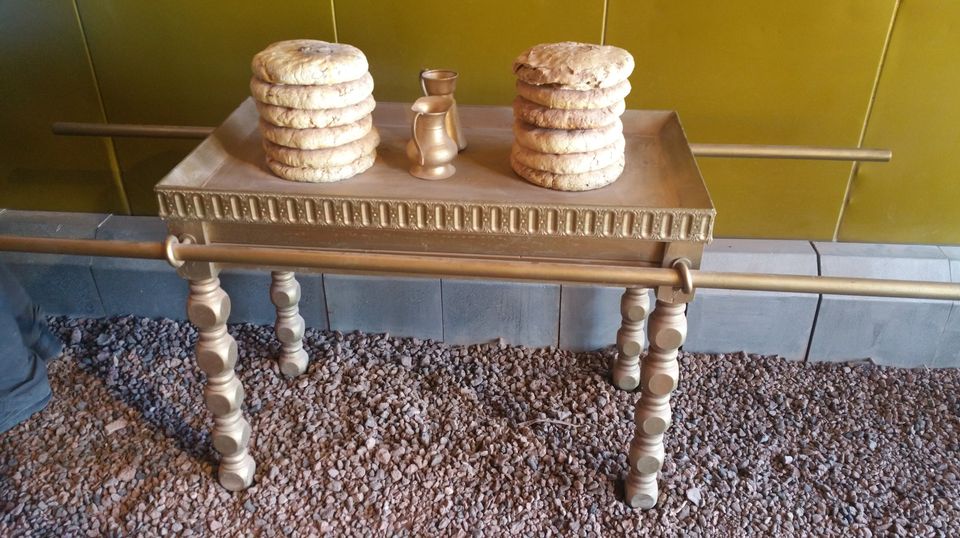
Since we are a group of sacred plants, I want to briefly mention what Dan Merkur said and may shed more light on the matter of the deposit/command and the plague. The verse "If you listen to the voice of God and do what is right in his eyes and listen to his commandments and keep all his laws, I will not put any disease on you that I put in Egypt, for I am the Lord who heals you" (Exodus 15:26), comes immediately after the sweetening of the bitter water in the Marrah And before the manna affair. These two acts are actually the foundations of the Jewish worship, which is built around the ceremony of restoring the manna as the ergotic Showbread, in the style of what was in the Mysteria at Eleusis. Merkur shows how plagues in the Bible are usually mentioned in the same context with what can be understood as the sacrament of the ergot, in which the angel of God appears with a drawn sword in his hand. And hence: the plague that will be in the latter days near the coming of the Messiah, is nothing but a code name for a revelatory trip, which can actually come in any experience with this LSD. Usually there is a very clear preparation and order of instructions to bring about a revelation, but sometimes accidents happen and the resulting trip is bad, or alternatively the experimenter suffers from ergotism. The promise is actually to get the best trip.
-

Chia seeds in meso-american culture
Today, the chia is considered a superfood, partly due to myths such as those spread by the book "Born to run", about the Iskiate drink that is made using them and allows wild Mexican tribes to run an ultra-marathon of 80 km. But this myth has earlier origins, they say, from the pre-Columbian period. The meaning of the plant's name in the Mayan language is "strength". Pre-Columbian cultures believed that these seeds truly had supernatural power, warriors used chia as their main source of fuel during conquests. The chia was the basis of the diet of the ancient Americans, they made oil, flour, drink and of course medicine from it. The fact that these are seeds made it possible to keep them for a long time even during the winter days when the grain does not grow. According to the reports of the colonialists, it was the third most important crop after corn and beans. Chia was used as a currency, the Aztecs would pay their priests with "chia coins", and bring it as an offering. They would sacrifice it in religious ceremonies. When the colonialists arrived the locals tried to bribe them with chia, but the fact that chia was used for religious rites made the colonialists assume that it was idolatry and a satanic plant. So they banned its use and brought it to nearly extinction, except in the isolated areas, where it was preserved, until it was rediscovered.
-
Esther as the myrtle of Ishtar
Purim Special: about the origins of the name Esther and the Persian connection, from the book "The Book of Esther Unmasked" by the Iranian linguist Dr. Thamar Eilam Gindin.
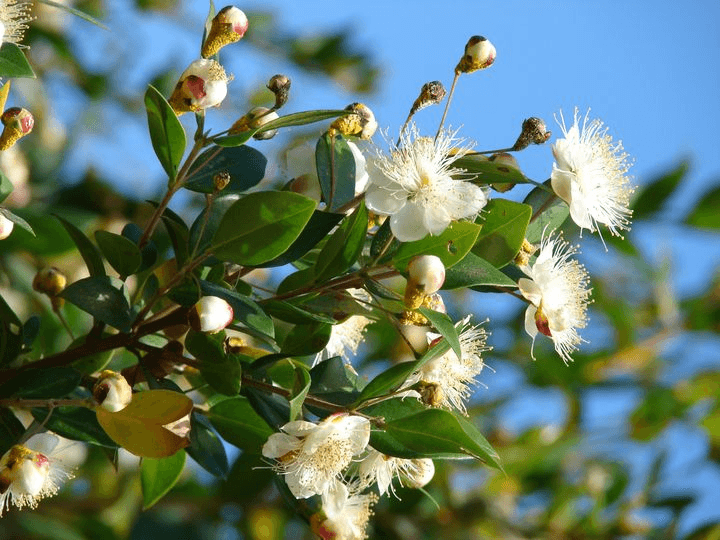
Esther is also called Hadassah (myrtle), or rather according to the boo of Esther 2:7 her original name was Hadassah, and her secondary name is Esther "Hadassa is Esther". In ancient Persian culture, smell had a special importance. According to Herodotus, when the news reached Susa that Xerxes had conquered Athens, the Persians were so happy that they filled the streets of the city with myrtle branches, burned incense, and of course held ceremonial feasts. Myrtle has a fine aroma due to the myrtle oil found in it. Even in the Sukkot's four species, the myrtle is considered a species that has no taste but has a smell. In the "second translation" of the Book of Esther, it is explained that Esther's name was Hadassah: "is symbols with the myrtle whose scent perfumes the world".The flower itself was used in all cultures of the ancient world in rituals of life and death, and also after death: starting with a blessing on the myrtle at circumcision ritual and ending with placing the myrtle on the grave. The Jewish Sages claimed that the strong smell of the myrtle drives away the stench of hell (a very Iranian thought!), and in Yalkuy Shimoni it is written that "when a righteous person comes to heaven, they clothe him with eight garments of clouds of honor … and put eight myrtle in his hand … and put him in a place of water, surrounded by eight hundred kinds of roses and myrtle" (Genesis Rabah, paragraph 20). Isaiah 55:13 promises: "Under the nettle will grow a myrtle", and in tractate Megillah 10b they interpret: "Under the nettle – under Vashti. .. a myrtle will grow – this is Esther the righteous, called Hadassah".
The myrtle was associated with the goddesses of love and fertility. The statues of Venus were decorated with myrtle wreaths, and the women who worshiped her also flaunted with myrtle. The connection to fertility is also preserved in Judaism and the Babylonian Talmud, Shabbat 110a, It is said that "they used to bring myrtle and palm branches to rejoice the bride and groom". And of course Esther herself is named after the goddess of love and fertility. Babylonian indeed, but surprisingly Ishtar's name is strictly Persian. The E in the name Esther is a prosthetic Aleph, meaning an E that was added so that there would not be a bunch of consonants at the beginning of the word (invalid in hebrew). When it is ommited, a "ster" or "star" is left, in Old Persian stāra. This is a word common to all Indo-European languages, with r-l alternating among them: astro-, êtoile, stella, star, and in the Hittites language ḫaster.
-
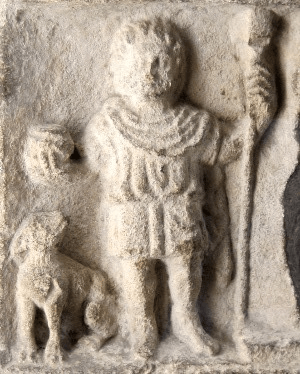
The cult of the dog?
Italy has many volcanoes, although the active ones are in the south, but also in the center in the area of Rome and Lazio there are many dormant volcanoes, some of which have become crater lakes. Therefore it is not surprising to see the local peoples worshiping the gods of the underworld and volcanoes, we see this in the Roman god Vulcan, Pluto or Dis Pater, and also among the Etruscans the god called Soranus.
The ancients saw the bowels of the earth as a sacred place, it can be explained in all kinds of ways, but for the purpose it matters less. Mount Soracte, which is now called Monte Sorrate, is a mountain where there are many natural caves, which, being the bowels of the earth, were considered the doors of the underworld. The fact that this mountain stands out above the Tiber valley and passes near the Via Flaminia, the main road that led from Rome to northern Italy, made it revered among all the surrounding cultures. And so the Etruscans also adored it and built temples to Soranus on it.
Servius, a Roman grammarian who commented on Virgil's writings, said that once on one of the occasions when the Etruscans offered their sacrifices to God, they separated the internal organs of the goats they slaughtered in order to use them in divination, and without noticing, they noticed that some wolves infiltrated the compound and stole the organs. The priests who saw the organs as sacred things chased after the wolves in order to get back these "teraphim" from them, but the wolves were faster than them and escaped into one of these caves. The priests entered the caves, and since they were in the bowels of the earth, they were exposed to poisonous gases and died. Their friends saw that they had died and they also came to capture the wolves, but they also died. And the following, again, and so on and so forth. The Etruscans asked their gods what the meaning of the case was and received a message according to which the death happened because the priests dared to chase the wolves. The priests' atonement will be, the message said, when they behave like wolves – live like them and imitate them. This means that they will live on the spoils, and at the same time they will walk on the coals carrying the goats' internal organs as the wolves did. Since then, the priests of Soranus were called "the wolves of Soranus", "the Sorani harpies". Apparently these wolves are an incarnation of the three-headed dog Cerberus who guarded the gates of Hades, since later incarnations of the same god of the underworld in Roman mythology, when they met the Celts, depict this god walking around wearing a wolf skin cloak accompanied by a fearsome hound dog and holding a hammer.
This god is called Sucellos Silvanus, and is an incarnation of a Celtic pagan god simply called Sucellos. Julius Caesar claimed that the Celts believed they were descendants of the same god of the underworld, whom Caesar identified with Dis Pater. And there are those who believe that he is himself an incarnation of a slightly more familiar god of the Celts called Cernunnos or "the horned god", who in Celtic mythology has many roles, including the god of the underworld. Being also the god of hunting, he is usually depicted accompanied by two companions, the deer and the wolf.
What is interesting is that Virgil himself claims that the temple on Mount Sorrate was used in the Imperial Roman period as a mountain sacred to Apollo. From finds in the province of Roman Britannia it can be seen that Apollo was united with the Celtic hunting god Cunomaglos, whose name means "Lord of the hounds", or "Lord of the wolves", cuno in Celtic means wolf. As we have already mentioned, also in Greece Apollo was a wolf god and was called Apollo Lycaeus. We also know that Apollo is the brother of Artemis, the Greek goddess of the hunt, so such a connection makes sense. One of the functions of Cernunnos is also the patron of hunters, and probably the horns on his head symbolize a hunting ritual or hunting magic. The other side of the hunting ritual is obviously to put on a wolf skin, since one of God's companions was also the wolf. Indeed, says Derek Gow in his book, the Celtic chiefs would sit on wolf skin mats, attach helmets made of wolf heads to symbolize courage, and also train their dogs together with wolves in order to teach them to be fearsome.
In fact, the beginning of the dog trade and their cultivation was in the British Isles, and at that time they began to cultivate and breed dogs in order to improve them and their qualities. We see contemporary Roman writers refer to the British dogs as fast and strong, war or hunting dogs specially trained for that purpose. It is told about the soldiers of Julius Caesar who fought with dogs wearing spiked collars and armor in the Gallic Wars. Gaius Marius 50 years before him is also described as having fought with war dogs as part of his war with the Cimbris and Teutons. It turns out that there is also a relatively dark side to the admiration of the ancient European peoples for wolves, the artificial selection in the breeding of purebred dogs…
-
The Solomon's temple as the gnosis
King David is considered to be the archetypal figure of Messiah, and his son Solomon is the one who built the Temple. Hur is considered the son of Caleb and Ephrath (1 Chronicles 2:20), and the grandfather of Bezalel. David himself is considered an "Ephratian" man (1 Samuel 17:12) and according to tractate Sota 11b he is of Caleb's ancestry. According to what can be understood from the writings of the Chronicles and is also assumed in Tractate Sota, Caleb ben Jephunneh is Caleb ben Hezron and therefore the grandson of Peretz (the archetypical Messiah). This is how you can actually see that the choice of Bezalel, the descendant of Caleb, is actually an attempt to parallelize between Caleb and David and with Bezalel and Solomon. Both built the temple, both were "wise men of heart". Both symbolize this high spiritual level achieved by the "knower" who has acquired wisdom.
It is said of Solomon, "And he was wiser than all men" (1 Kings 5), and in the vision he had in Gibeon (1 Kings: 3) he asks God to "give your servant a hearing heart to judge your people to understand between good and evil" and therefore God promises him " Behold, I have done according to your words, Behold, I have given you a wise and prudent heart, the like of which was not before you, and after you there will not be another like you". In this story we see an explicit reference to the "wise men" who built the tabernacle, and especially Bezalel. Also the distinction between "good and evil" is a reference to Eden.
There are many parallels between the temple and especially between the Holy of Holies and the Garden of Eden, the first and foremost among them are the cherubim, which in the book of Genesis are said to "guard the way of the tree of life" (guard is the same word for perserve in hebrew, "shamar"). Of course, in the apochrypal books this comparison is explicitly stated, as in the book of Jubilees in chapter 3, where it is explained why Eve could not enter heaven until she was cleansed from the impurity of childbirth, because it is forbidden to enter the temple in impurity. It is said of Enoch in chapter 4 there that his role was to judge in heaven, "and he was taken from among men and we brought him to heaven to greatness and honor and there he writes judgment and law for the world" – this is also how Solomon's request for expertise in judgment is described, and this is how, in the judgment, Solomon's wisdom is also described, "And all Israel heard the judgment which the king judged, and they respected him because they saw that the wisdom of God was in his midst to make a judgment" (1 Kings 3).
It is said about the Wisdom in Proverbs 3, "It is a tree of life to those who hold it". It is said: "Blessed is a man who finds wisdom and a man who got understanding". It is said of the wisdom that it is more precious than pearls, precious metals and gems, and it is emphasized that it is exactly the building block with which God created the world, "The Lord in wisdom founded the earth and established the heavens in understanding". The fact that the Holy of Holies is forbidden to enter except for the High Priest on Yom Kippur indicates that a person without wisdom is not allowed to enter the Holy, but once he has acquired wisdom and reached the level called "High Priest", or "High Priest on Yom Kippur", he is allowed because this is his return to the Garden of Eden.
To finish with the subject of sacred plants, I will mention that when the priest enters the Holy of Holies, he burns incense. The burning of this incense is likened to eating from the tree of life, as in Levi's Testament it is said of the righteous who will be honored in the end of days: "And then God will raise up a new priest to whom all the words of God will be revealed, and he will bring true judgment on earth when the time will come… and he will open the gates of the garden Eden and remove the sword that frightens man and let the saints eat from the tree of life." (Testament of Levi 12)
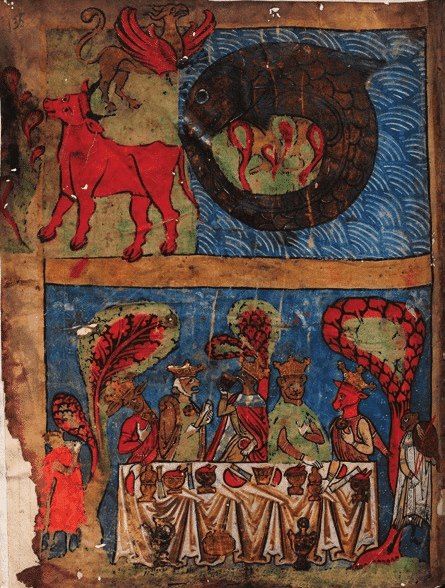
If you look at the description of this eating from the tree of life in the Jewish myth, you can find the description of the feast of the Leviathan (among other things: Baba Batra, 85a). It is described there that in the future to come the righteous will eat at a feast from the Leviathan and the Behemoth (aka "the wild bull"). The Leviathan is the one who is described in the book of Isaiah (27:1) as a snake, which echoes the serpent in the Garden of Eden that represented the forbidden knowledge and the eating of the fruit of the tree of knowledge.
In the book of Ezekiel, the prophet twice describes the figure of the "Ophanim", whose appearance is like gems. One time he claims that one of their faces is the image of a bull (chapter 1) and the second time he claims that the image of the bull is the image of a "cherub" (chapter 10). From this it can be understood that a cherub is actually a bull, and I am not talking at all about the Akkadian "karabu" (aka "lamassu"), which is actually a winged bull. The fact that at the Feast of the Leviathan they will eat wild bull, makes us understand that what the righteous will eat in the future is the fruit of the tree of knowledge, which is symbolized by a serpent, and the fruit of the tree of life, which is symbolized by cherub. The tree of knowledge is not fundamentally different from the tree of life, and even modern bible critics believe that it is actually a description of the same tree. And so actually the feast of the righteous for the future to come should be all about eating the wisdom itself, or internalizing the thing in their bodies.
Again, I would like to leave to your wide imagination what is missing in this equation, of what you eat and as a result of which you reach a higher consciousness. The "Kaneh".
-
The tabernacle building as the gnosis
The following post is not directly related to sacred plants except for one thing: I am talking about the verb "Kanah" and its role in achieving higher consciousness. Combine the two with what you know about "Kaneh" and let yourself understand my meaniing.
In last week's Torah portion "Vayakhel" (Exodus 35) the work of building the tabernacle is told. And the bible makes sure to say two things. The first, that the person who participated in building the tabernacle was a "wise man". The second: that the role of the wise hearts was to "make" a "craft" for "work". And so the verse says: "And Bezalel and Oholiab and every man of wise heart whom God gave wisdom and understanding to know how to do all the craft making of the sacred work for all that God commanded" (Exodus 36:1)
These three verbs are all hebrew words that mean doing a work: "Assah", "Melacha", "Avoda". This is a wordplay and a reference to what we would call "gnosticism" or "hermeticism". The whole craft of building the tabernacle is a metaphor for mental training, and reaching a high level of consciousness. The "knower" is generally described as a miner of various minerals, gems and metal ores such as gold, silver and copper. The same minerals are described in chapter 2 of the book of Genesis as those that dwell between the rivers that come out of Eden. "And the gold of that land is good, there is the crystal and the yellow stone". In the work of the tabernacle, it is said of Bezalel, the chief craftsman, "And the Spirit of God filled him with wisdom, understanding, and knowledge, and in every work and thought of wisdom to make in gold, and silver, and copper".
When God finished creating the world, it is written "And God rested on the seventh day from his work that he had made, and rested on the seventh day from all his work that he had done. And God blessed the seventh day and sanctified it, because on it he rested from all his work that God had created to do". Since there was no one to work the earth, God created the plants and man himself, whom he placed in the Garden of Eden "to work and preserve it".
We understand that actually the "doing" of the "craftwork" is an imitation of God's action during the creation of the world. Every time you do these things, and "work", you are actually participating with God in the re-creation of the world. This is basically the logic behind acquiring the wisdom and higher consciousness in question. When you acquire wisdom, you "purchase" (acquire, "Kanah") it and thus in fact reproduce the creation of the world, and we see that the book of Proverbs in chapter 8 uses the same verb to describe both the creation of the world and the acquisition of wisdom: "Kanah". "The first thing you have to do in order to receive a wisdom is to purchase it and with all your wealth you will purchase understanding", "The Lord purchased me in the beginning of his deeds, the beginning of his works since then", or as the the Rabbi Malbim defined it "wisdom is the form of all worlds".
The word "form" in hebrew is derived from the word for "creation" ("Yatzar"), and it should also be noted that God created man with the verb "create" (Genesis 2:8). The word "treasure" is also derived from the same Hebrew verb ("Otzar"), which is known to be used to describe a significant concentration of minerals. The same verb is also used in Proverbs 8, "There are those who love me and I will fill their treasures". That is, the reward of those who give love to God is the treasures. In chapter 2, the author of the book of Proverbs uses the same verb to indicate God's work, "to preserve the ways of judgment and the path of his followers will be guarded", precisely because the role of man is as stated to work and perserve. (the hebrew word for "preserve" is "Natzar", christians or "Notzrim" are those who were said to perserve the testament). We understand from this that this "work of God" is a kind of role given to man immediately after his creation, which he must do in order to rise above and return to the its origin.
Now you see everything I say is strictly orthodox, but the question is how do you interpret the concept of what God's work is. Orthodoxy will say that worshiping God is keeping the commandments, the Gnostics will say that worshiping God is simply to perserve the knowledge, the gnosis, or the affinity for what is called "pistis sophia". There is no significant difference between the two, to be honest.
As mentioned, God created the world with the verb "make" (or "do", "assah"), and indeed we see a direct connection between the Sabbath and "doing work" – as it is said "And the seventh day, is a Sabbath solely to God, you shall not do any work". The Torah does not deny but rather emphasizes the connection between Sabbath and the building of the tabernacle. The portion of "Vayakhel" begins with the commandment "Six days you shall work, and on the seventh day you shall have a holy Sabbath, complete rest for God." In Tractate Shabbat (of the Mishna) it is said that the 39 works that are forbidden on Sabbath are actually the same works that were necessary for the construction of the tabernacle. The "Gnostic idea", which as mentioned is also reflected in Orthodox Judaism, is that the Sabbath is actually a reflection of the perfect world as it was at the moment God finished creating the world. That is, the moment a person reaches his spiritual perfection and brings "the Messiah", that is, the reality in which he is in perpetual peak of consciousness, is the moment when there will be "a day that is all Sabbath" (again, an orthodox interpretation for the days of the messiah). The goal of the "knower" is to repair the damaged world and return the world to its original, perfect state.
In order not to overload this article, I would like to divide the post into two and in the next part bring into the story King Solomon, who is considered to be the one who wrote the book of Proverbs and not for nothing, and was both the wisest man and also built the temple.