
-
the evolution of the rooster through domestication
On Shabbat tractate of babylonian talmud 30b it is said: "Rabban Gamaliel sat down and preached: [In the days of the Messiah] a woman will come who will give birth every day, as it is said (Jeremiah 31:8) 'She will conceive and give birth together'. Same disciple mocked him, and said, 'There is nothing new under the sun'? So Gamaliel said to him, come and I'll show you the example in today's world. He went out and brought him a chicken". Rabban Gamaliel gave an example of a creature that even today lays eggs every day, and not only during its cyclical "ovulation time".
The fact that chickens are able to lay eggs every day and not just 10 times a year, was a wonder to our ancestors. What they didn't know was why they were doing it. It turns out that they do it as a result of selective breeding. Humans preferred to breed chickens that showed a shorter cycle, and continued this breeding until they reached the extreme state where a hen begins to ovulate shortly after it lays her barren egg once a day. In other words, and so claims an article published this week in Nature (see also) that traces the evolution of the domestication of chicken, chickens became so common solely because they became an "egg factory".
Humans probably "developed" the chicken because they seized an opportunity. Apparently all domestic animals domesticated from the wild for man's needs, everything that could expand man's food variety was a bliss. It turns out that the chickens, like mice, were actually "parasites" for agriculture. From the moment that the human economy allowed him to prepare his own food, the animals that were looking for food discovered the treasure and began to settle in the human environment. Mostly they were a nuisance, humans did not like the dirt and aggression of these animals. But unlike mice… humans discovered that chickens are delicious. So although they are annoying, at least you can eat them. And if you're going to eat them then why not make use of their products.
In fact, cats and dogs were also developed in this way. Since the agricultural economy became a gathering of carnivore and prey animals, carnivores also began to gather in the area. In some cases they competed with man for the prey, in this case man did not like them and drove them away (unless they could be tamed, like the dog). But in another part, they were used as a biological "pesticide" that was pleasing to man. Like for example the cats. It turns out that the roosters were also used as biological exterminators for insects and there was an interest in domesticating them. The social behavior of the roosters, which symbolize territory by calling at dawn, also made the roosters the "harbingers of the dawn" and thus man uses them to maintain a framework.
The rooster was originally domesticated in Thailand. As mentioned, it appears that with the beginning of agriculture. In the case of Thailand, the domestication of rice and millet. The researchers mark the middle-end of the second millennium BC as the time of domestication. From Thailand the custom spread to India, and reached the "West" through the mediation of the Indo-Europeans who moved along the Silk Road. Later on, the various empires, starting with the Persian and ending with the Roman, further spread the chicken, and its cultivation became more common. The transition of the chicken to the West was during the first millennium BC, and one of the indicators that it was not that common in the West, is the fact that in the Torah the birg sacrifices are only mentioned from the family of the pegions and the doves. Although later in the Roman period, the hebrew sages already found a reason why roosters were not used as sacrifices (due to their brash, fierce and promiscuous nature), but it is clear that this is a later interpretation that is more related to Stoic philosophy than to post-pagan theology.
And an extra Jewishness flavor: the rooster's ability to crow at dawn is in some way the foundation of the Kabbalistic myth about the "dawn rooster", which synchronizes with the nightwatch's shifts, wakes up from the shock of God's mourning over the exile of the Israelites, and then God cries, and his tears hit the sea and create a storm that causes giant waves (alternatively, a flame of fire to denote the colors of the rooster's feathers) beating his wings, he calls and his cry is heard in the throats of all the roosters of the world, shortly before dawn. This is the moment when God enters heaven to have fun with the righteous, and then a herald comes out and calls out and awakens the world. In fact, the flame comes out of the pillar of Isaac symbolized by the might (Gevurah) of isaac, and is the long arm of Gabriel. That is why the rooster is also called a (masculine) man in the Bible (i.e Gever), because he In fact, it is he who wakes up those who stand up for God's help to pray the main morning prayer right when the sun shines. This main prayer (Amidah) actually symbolizes the rooster, since the rooster reads in each of its "7 readings" verses from chapter 29 of the Psalms, in which there is the word "voice" 7 times and – 10 times the word "God" and together are the 17 blessings after the blessing in the standing prayer (total 19 which equals to 18+1).
-
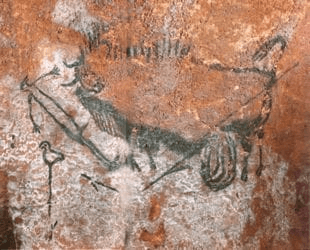
The shaman's "dream erection"
"A 15,000-year-old dreamer and the appearance revealed in his dream. A wall painting from the Lascaux cave in France apparently depicts a shaman, with a bird at his side, attacking his prey with spiritual weapons. One should pay attention to the shaman's erection, a characteristic phenomenon of a dream-sleep"
From: Dreaming, Julia and Derek Parker. Mirchell Beazley 1985. Hebrew Translation: Amos Carmel, 1988.
You can pay attention to the following details in the picture: a man with an erection lying on his back, a stick with a bird on it, a wounded bison with its entrails protruding from its belly and a broken spear. The suggestion of the shamanism ceremony is by Horst Kirchner. The phenomenon of dream erection was discovered in 1965 by Charles Fisher. The bird represents the soul leaving the body, like the image of the "ba" in ancient Egypt.
-
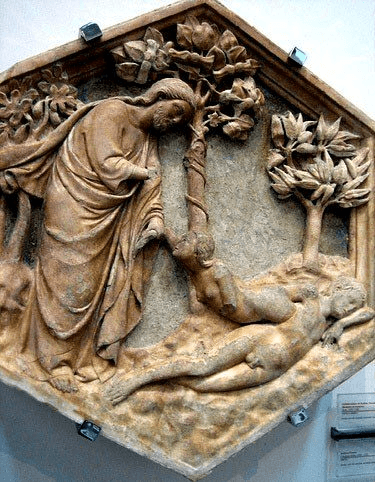
the ecstasy of Adam
Another "proof" that Christianity was in its beginning a psychedelic religion: in the scene of the creation of woman from the man's rib (Genesis 2:21), it is said "and God made adam fall asleep and he slept and took one of his ribs and closed flesh under it". However, the Septuagint translates the word "fall asleep" as "ecstasy" (ἔκστασις), that is, God cast ecstasy on the man and he slept, and took one of his ribs, etc. The early Christians made of it a real party.
Epiphanius of Salamis in his book "Panarion" (Πανάριον) wrote such an interpretation was used by the Montanists, while calling them "Phrygians". The Montanists were a Christian sect that sanctified the experience of prophecy, which they believed was the spirit of truth promised to believers in Christ, and the gift of grace (charisma). The Montanists held according to Epiphanius in this interpretation that the slumber that fell upon man was actually ecstasy, and that if you wanted to imitate God, you must cast the same "slumber" upon yourself by means of anesthetic substances. One of the fathers of the church, Tertullian, turns out to have been a montanist himself, and described this slumber as a process in which while the prophet loses his senses, the divine takes over him. He describes the appearance of this loss of consciousness as "amnetia", fainting as a result of madness, probably something we would call epilepsy today. A person suffering from epilepsy was considered in ancient times to have been possessed by a demon, this is also how Epiphanius describes the Montanists.
The Montanists did come from Phrygia, but in this description Epiphanius intends to disparage them, reminding them that Phrygia was a center of idolatry. Phrygia was the center of the cult of Cybele and Attis, the priests of Cybele called "galli" performed under a trance a ritual of self-castration. What Epiphanius was actually trying to say is that the slumber that made it possible to remove the "rib" from him was, in the eyes of the Montanists, the same as the trance of the galli that allowed him to castrate himself.
"The Phrygians combine a lie with the truth, and rob the intelligence of the people who seek to bring meaning to their lives, they craftily formulate texts that will help them falsify their error, and to prove from these things that they are their lies, they claim that these things are written in the Holy Scriptures. Like 'goc casted ecstasy on Adam and he slept', but this is not true at all. The human case was not like that. Adam's ecstasy was a one-time event, a kind of divine anesthesia given out of God's love to Adam, so that he would not feel pain. God brought unconsciousness on man, in order to distract him, in exactly the same way that due to God's compassion and love for humanity, he also today gives man sleep and rest to distract him from life's worries and dependency on them".
However, it turns out that this interpretation did not remain completely unacceptable to all the fathers of the church. For example, St. Augustine writes "From this we conclude that the ecstasy into which Adam casted into when God threw him into a coma was given to him so that his soul in this state would come in the crowd of angels, and understand when entering the temple of God, what will happen in the future. When he woke up, he was like someone who was filled with the spirit of prophecy… and because of the ecstasy he was able to say what he said as a prophet under divine guidance.
-

Mushrooms as the divine semen
n Chapter 5 of "The Sacred Mushroom and the Cross", John Marco Allegro argues that our ancestors venerated mushrooms because they couldn't understand what caused them to grow. They saw no seed fertilizing them and, of course, had no concept of spores. This phenomenon was perceived as a kind of "virgin birth", and Allegro draws extensive analogies between Jesus and the psychedelic mushroom.
But that’s not the punchline I want to focus on here. The Talmud also expresses a similar sense of wonder about mushrooms, describing them as something that "neither is sown nor produces."
Since mushrooms grew after rainfall, ancient people believed that thunder was what fertilized the earth and caused mushrooms to sprout. This led them to worship the god of thunder. Carl Ruck, in Chapter 3 of his book "Entheogens, Myths and Human Consciousness", makes a similar claim: that pagan worshippers revered thunder because lightning storms resembled a cosmic act of intercourse between sky and earth, and lava erupting from a volcano looked like semen pouring out from a vagina.
In their early stages, mushrooms look like eggs (see attached image), and when they “hatch,” a viscous fluid flows from them—resembling either saliva or semen. Allegro claims that this is also the reason for the etymological link between spit and semen. His explanation—based on Sumerian linguistics—is admittedly beyond my understanding, but he asserts a connection between the Hebrew word for “smooth” or “slimy” and the idea of semen being spilled in vain ("The Hebrew word for 'smooth, slimy' derives from a Sumerian phrase meaning 'semen running to waste'").
Personally, I think he might be pointing to a similarity between the word rokh (spit) and the concept of ejaculation in vain, or perhaps even a link between the Hebrew word pitriyah (mushroom) and peter rechem (womb-opener), suggesting something that first breaks open the womb—the "hatching" of the egg, so to speak. Whatever.
Allegro also claims that in Talmudic language, the word “spit” served as a euphemism for semen. I couldn’t locate his source, but in Tractate Yevamot 24a, one of the signs that a woman has committed adultery is if “spit is found above the mosquito net”—clearly referring to some suspicious clear fluid. Similarly, Isaac Julius Preuss, in his book Medicine in the Bible and the Talmud (Magnes Press, Chapter 2, p. 128), writes: “Scripture often uses the term ‘spit’ to refer to something expelled from the body.”
In that same context, Allegro interprets the phrase “rīr ḥallamot” (ריר חלמות) in the verse from Job 6:6 – “Can that which is tasteless be eaten without salt? Or is there any taste in the slime of the purslane?” – as a reference to that same mushroom fluid. That is, ḥallamot refers to a mushroom, and the fluid is tasteless like spit.
More importantly, Allegro claims that the model of the Temple was designed as a model of penetrating into a sacred space—that is, the Holy of Holies was a type of womb. Once again, Carl Ruck agrees (Chapter 1), arguing that ancient rituals were conducted in caves, because a cave represented Mother Earth’s womb, and that burial was a symbolic act of rebirth for the soul.
Allegro expands on this idea of rebirth, claiming that the embalming ritual, in which the dead were anointed with various aromatic substances, was in fact a preparation for rebirth. He interprets the ritual as an analogy for ejaculation, the anointing of the corpse with the “seed”. According to him, this is also the etymological origin of the word for embalming in Sumerian [1].
Coincidentally or not, the same substances used for burial—according to accounts in the New Testament—were also ingredients in the holy anointing oil and the sacred incense blend used by priests to anoint kings. The reason, Allegro says, is the same: to prepare the anointed object for communion with the divine, or alternatively, to ensure that the god fulfills his part of the deal and grants his blessing to the land.
And here Allegro reaches his climax: he claims that the Hebrew word “kohen” (priest) derives from the Sumerian term “GU-EN-NA”, meaning “guardian of the semen.” I checked the Encyclopedia Biblica, and there it says that in Arabic kāhin means “soothsayer,” though that term is likely borrowed from Canaanite or Aramaic—thus, the true origin of the word remains uncertain.
[1] When the embalming of Jacob is described in the Book of Genesis, the embalmers are called “physicians.” According to Allegro, healing was originally a fertility ritual in which various substances were applied to people as a kind of instruction about “all things”—to quote 1 John. Jesus, in the Gospel of John, is recorded healing a blind man with spit. In the Epistle of James and the Gospel of Mark, the sick are anointed with oil as part of their healing. Allegro claims that the primary motivation for healing in this manner was not physical but spiritual healing, through the application of what he calls “semen”—namely, the priestly ritual of anointing with holy oil.
-
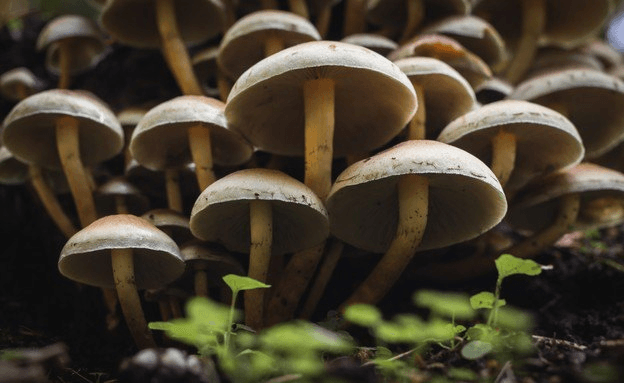
Mushrooms as a fertility symbol
Throughout history mushrooms have symbolized fertility in various cultures due to their rapid growth and reproductive abilities. And they became sacred symbols for various fertility gods. The fact that mushrooms would grow out of nothing made the ancients wonder. They thought that the mushroom, which is a plant, has no seeds and considered the formation of the mushrooms as a virgin birth. However, the appearance of the mushrooms after the rain made them think that the rain is the fertilization of the sky god mother earth, and therefore the moment when the insemination was missing in their equation.
Some saw in the lightning from the sky the divine seed, the fact that immediately after the lightning comes the thunder, marked in their eyes the moans of the divine orgasm. The fact that some of the mushrooms are phallic in shape added to this myth. Since a mushroom was considered a symbol of fertility, they likened the world to a mushroom. The fact that a mushroom hatches from a type of egg, made them imagine the creation of the world as hatching from a cosmic egg.
Another amazing aspect of fungi was that sometimes mushrooms would grow on substrates of decaying organic matter, and it was amazing how from the places of death life could grow. In their eyes, this symbolized the circle of life. Of course, since these mushrooms were sometimes psychedelic, it generally symbolized rebirth for them.
The link between mushrooms and fertility also exists in Judaism (and of course in Christianity. And I'm not talking about John Marco Allegro's theory or the fact that Peter was supposedly named after the mushroom i.e Pitriyah). Rebirth binds us to the Messiah. A person who is born again is a person who "wears the Messiah", and is "one in Christ". From the moment one lives in a messianic reality, revelation is considered the moment of birth.
In Tractate Shabbat 30b, they claim that the hebrew sages thought to shelve out the book of Proverbs because its words contradict each other, but they did not shelve it because this contradiction teaches us something great. In the book of Proverbs it is written, on the one hand, "Do not answer a fool as he is, lest you also become equal to him" (26:4), and on the other hand: "Answer a fool as he is, lest he be wise in his own eyes" (25:6). What we learn from this is that even though fools mock the words of the Torah, and it is better not to make them mock the words of the Torah, sometimes it is actually allowed and necessary, as demonstrated by the story of Rabban Gamliel who said several things, and each time some douchebag came and said that it could not be because the Bible says something completely different.
The story told by Rabban Gamaliel is that in the days of the Messiah, nature will change and all kinds of unnatural things such as miraculous fertility will occur as a matter of everyday life. The douche man asks: After all, it is written in the Bible that there is "nothing new under the sun", and this means that nature cannot change. Rabban Gamliel answers: Even today it happens, come and I will give you an example. The three examples in Rabbi Gamliel speak of miraculous fertility, the first time a woman who gives birth every day, the second a plant that produces fruit every day, and the third the soil that produces cakes and candies. Rabban Gamliel's proof that the third example still exists today is the mushrooms and truffles that come out as they are in one night, and wide and round as candies. Another example of mushrooms and fertility in the context of rain that "creates" mushrooms can be found in tractate Ta'anit 23a, where it is told about the "Honi the circle-drawer" who prayed for rain during a drought and immediately after it rained, "the wind blew and the clouds were scattered, and the sun shone, and the people came out to the field and brought them truffles and mushrooms".
-

Saffron as a sacred plant
The first known reference to saffron dates from around 2300 BC in the "Legend of Sargon of Akkad", a Mesopotamian work that describes the birthplace of the founder of the Akkadian Empire as "the city of saffron". Saffron was first domesticated in Greece in 1700 BC, according to a 2022 study. This is supported by both genetic findings and an ancient Minoan fresco depicting blue monkeys (or rather: children) picking saffron.
In Hinduism, saffron is considered one of the most sacred colors. Most of the gods in the pantheon were anointed with saffron, and Krishna liked to drink saffron in milk (in Hindu: kesar doodh केसर दूध). Agni's fire turns into saffron-colored flames, fire of this color is the purest form of light. This symbolizes God's blessing, or devotion. Worshipers of Agni wear clothes of this color in the fire ceremony, Yagna. They believe that it strengthens chakras and a host of energies, for the same reason they also use saffron to drown the bindi, the red dot on the forehead.
Not only in Hinduism it is considered sacred but in all Dharma religions. For example in Buddhism, in the Theravada stream (that is, in Southeast Asia). The color of the robes (Kāṣāya, कसाय) is supposed to be the color of saffron, which symbolizes simplicity and devotion to the spiritual path. Even if it is not always the color red, but sometimes orange or brown (also variations of saffron). And not always dyed with the original saffron pigment.
It turns out that even in Rome, saffron symbolized purity and prosperity, brides on their wedding day would wear orange scarves (flammeum) and matching slippers (lutei socci) whose color was supposed to be the color of saffron.
-
The Cause of Nadav and Avihu’s Death: Incense Smoke?
Dr. Sheila Keiter of UCLA suggests that Nadav and Abihu (correct: Avihu), the sons of Aaron, who died from the sacrifice of "strange fire", actually died from an overdose of drugs, i.e. poisoning. After their deaths, God warns that the priests must not consume wine before they serve in the tabernacle. A sign that this is related to drunkenness "Nadav and Avihu may not have understood the dangerous nature of their experiments," she writes.
-
The historical Amazons of Azerbaijan
According to findings of women's graves with weapons from 4000 years ago in Azerbaijan, it seems that the myths about the Amazons are true. The skeletons were found signs indicating the use of archery and horse riding. The weapons and jewelry in the graves indicate their social status. In the villages in the area of the discovery there are folk traditions about women disguising themselves as men in battle. In the episode about the treasures of the Caucasus in the upcoming season of the series "Treasures of the World" by Bethany Hughes, she is expected to expand on this.
-

The ergotic "gift offering"
Among the sacrifices in the temple there is one sacrifice that is generally considered an appendage, in part because it usually comes next to another animal sacrifice. Usually when we write about a sacrifice we also talk about an its "grain gifts and pourings" (Numbers 28-29), as if it were a part of the sacrifice itself. But in practice it is about another sacrifice, a sacrifice that is not at all from the animal but rather from the plant. We tend to forget about it, but it was probably the most central sacrifice in the worship, i.e. the blood sacrifices were not the center of the worship in the temple, but rather the "gift offering" (hebrew: Mincha").
It is common to translate the word Mincha as a "Gift". But we see that in a consistent manner in the Bible the Mincha is associated precisely with fragrance. Oil is poured on the offering and frankincense is put on it, when it is incensed "Isheh" ("incense burning"), it turns into a fragrant smell. We see that when Jacob ordered to bring down to Egypt the gifts of the land, he described it as a Mincha and specified to bring myrrh and honey, that is, something sweet, fragrant and oily. The manna was also like this, sweet and oily, although it is not described as fragrant, but it is written that if it is not used immediately, it is smelly. Also, in Yoma 75a, it is emphasized that "it is taught that women's jewelry came down to Israel with manna" meaning that the manna was perfumed and had a scent that women put on themselves to adorn themselves in honor of their husbands. The dose written in the Torah for making manna is an "Omer". Omer is also the name of the grain portion that is harvested in the period between Passover and the Pentecost holiday, a period in which there is a special issue with the way of processing that grain.
The manna is considered by Dan Merkur in his book "The Mystery of Manna" to be the center of the Jewish worship which is basically based on that "holy dose", meaning that what is written in the Manna passage is a kind of recipe for a special sacrament that is at the heart of the worship and everything that is done in the temple is a reproduction of its preparation. The manna is identified at Merkur's, as spikes that are infected with the ergot fungus, the initial stage of the fungus's development is in something that looks like honeydew and is sweet. The ergot would be ground and made into beer or bread, and as part of the processing process they would "purify" the fungus of its toxic components and leave the psychoactive component, which in the future will become what LSD was developed from. Those who ate the manna received visions and prophesied, and in fact what is done in the Jewish ritual is an attempt to reproduce these visions using a secret recipe kept among the priesthood. At first those who were allowed to participate in this ceremony were all Israelites, but later the ceremony became a mystery that only the priests were allowed to participate in. This ceremony would take place once a week on Sabbath during the eating of the showbread, and on a host of other ritual occasions such as for example in these incense burnings, including those during the gift offerings.
Variations of this ritual simulation, or "sympathetic magic" were also common among wider circles than the priesthood, such as the Passover celebrations. In fact, the commandment not to eat Chametz (leaven bread) on Passover is because leavening the bread was considered among the mystery guides to be a chemical process that impairs the psychedelic ingredient as found in the sacred recipe. Regarding the Mincha it is said that you must make it unleavened, as it is said in chapter 2 of the Book of Leviticus "You shall not make any Mincha offering that you offer to the Lord unleavened, for you shall not distill any leaven or any honey from it into the incense offering of the Lord". Some of the gift offerings are completely burnt, but there are cases where there are leftovers and they are eaten, as for example in the showbread. And these remains are defined in the Torah as "Holy of Holies", it is emphasized that precisely because they are part of the incense offering ("Isheh"), and for that reason they are also forbidden to bake leaven. This simulation of the recipe, and the only event in which the Israelites actually simulate the priests in this role play, are the reason why Passover has a special issue with the chametz.
There are two special Mincha sacrifices in which it is actually commanded to make them intentionally with leaven: two loaves of bread of the Pentecost and the breads of the "Thank offering". The reason is because these two offerings are actually offerings that symbolize the participation of the masses in the Holy, and the commandment to eat leaven actually comes to symbolize this buffer between the Holy and the Profane and is actually an intentional desecration of the Holy. The thank offering is the equivalent of what we demonstrated in a previous post here, "Thysia" (θυσία), that is, a sacrifice brought by an ordinary person, partly sacrificed as an equivalent of the jewish "Shelamim" and the rest is eaten. Along with the Shelamim, he also brings "thank bread", which, as mentioned above, symbolizes his very permission to participate in the "Holy Communion". The two breads of the pentecost are a kind of equivalent to the ritual that in the Eleusis mystery was called "Pelanos" (πέλανος), and were in fact special breads made from the harvest harvested in the "Rharian" fields, fields that were sacred to Demeter and considered to be the place where she conceived Plutus, the god of wealth. The mystery of Eleusis included a drink called kykeon which was an ergot beer seasoned with fragrant herbs (which closes the corner of smell for us, if we want to equate it to manna). Pelanos in Greek is called from the word for clay (πηλός), and the meaning is that it is a fried mash, or what is called in our language: pancake.
I mention the pancake because, in fact, the "counting of the Omer" is a period marked in the temple between two offerings of pancakes: the two pieces of bread on one side that seal it, and the offering of the Mincha of "Havitin" (pancakes) of the perpetual ("Tamid") evening sacrifice of Passover eve that opens it. Usually the Havitin offering is divided in two, with half of it offered in the morning offering and the other half in the evening offering. The "working hours" in the temple, that is, when sacrifices are made, are between these two offerings, which delimit the sacred time. So also in this case the two bread offerings demarcate another sacred time dedicated to the Omer. Immediately after the Havitin offering on Passover Eve, the Passover sacrifice is offered, in fact the Passover sacrifice is the only sacrifice that is allowed to be offered outside of "working hours", and is the exception. The reason is probably because he is the first to be sacrificed at that time of a consecrated the "Omer". As long as we are within that sacred time interval, the Omer is sacred. From the moment the offering of the two breads on the pentecost was offered, the Omer was removed from the sacred status and allowed to be eaten by the masses.
-
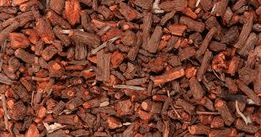
Plant-based red colouration of shell beads 15,000 years ago in Kebara Cave, Mount Carmel
Evidence of the use of a red organic pigment about 15,000 years ago was discovered in the Kebara Cave in the Mount Carmel area by researchers from the Hebrew University. This is the earliest evidence ever of the use of this color. While the use of red mineral pigments, such as ocher, is documented from the earliest period already more than 140 thousand years ago, colors of organic origin were known until today only from 6,000 years ago.
The people who used this pigment according to the findings were the people of the Natufian culture. The pigments found were on shell beads painted red in the Kebara Cave, located in the northwest of Ramat Handiv, Zichron Yaakov. The origin of the red color is in the roots of plants from the Rubiaceae family, and more specifically the Dyer's Madder (Rubia tinctorum)
The dye was extracted from the root of the plant and was obtained after soaking the root extract with various salts. Different layers of the root will produce different shades of red. Color can also be extracted from the fruit. In Qumran, it turns out, bones painted red were found, and it is speculated that the madder was used in the compound as a medicine. The earliest use of the madder, as mentioned, was recorded 6,000 years ago, on an Egyptian arrow quiver made of leather. Cotton dyed red from the madder plant was found in the tomb of Tutankhamun dating to 1,350 BC.
In the Gemara the madder is mentioned by name as "Puah", but some believe that she was also called "Kotza" (i.e "a thorn"). In the book of Ezra and also in the book of Nehemiah it is said about the Priestly divisions of the Kotz (aka Hakkoz), who were of the seed of Barzilai the Gileadite and were not priest of pedigree. Since Barzel (iron) is also red, there is a chance that the family name was also named after the color red. On the other hand, there is also a judge from the tribe of Issachar called Tola ben Puah and in the Great Midrash of Vayigash, his name is required "like the color Puah is, and it colors everything so that the tribe of Issachar colors the whole world with the Torah." Tola is of course "the scarlet worm" (worm in hebrew is Tolaat), a red color in itself. Issachar's symbol is the donkey, which is usually classified by its color as red, i.e. reddish brown, a horse and a donkey were generally considered to be animals that symbolize madness due to the running amok that charazterized them. The wine (which is usually associated with those animals) is also usually red in color, and is associated with this amok, or with any madness or a mental illness, these two things, at least in the ancient Greek religion, were associated with the god Poseidon – originally with horses and wine.