
-
was cannabis used at roman funeral ritual?
Archaeologists have found a pot containing cannabis-like seeds near Saltholme Reserve in northeast England. In previous works on the site, evidence of an agricultural settlement was found during the Roman period in Britain, and since it is the same layer, it is dated to that period. Several graves were also found in the area, which raises the hypothesis that, if indeed it turns out to be cannabis, then it was used as part of the burial ceremony. Perhaps the seeds were heated and the smoke inhaled as part of the ceremony. This is not binding, as the cannabis could have been for recreational or medicinal purposes. Probably because it is speculation this item still remains far from the headlines.
-
Essene Gospel of Peace
Edmond Bordeaux Szekely was a Hungarian psychologist of French origin, who promoted a lifestyle he called "biogenic", "creating life" and encouraged the consumption of unprocessed food, even when it was in its beginning and awareness of these things was minimal. He promoted the consumption of sprouted grains and nuts, and founded the "International Biogenic Society" together with the winner of the Nobel Prize for Literature, Romain Rolland. Rolland himself is considered one of the fathers of the spiritual non-religious way of living and coined the concept of "oceanic feeling", a religious experience of unity with the universe without the traditional religious feeling of faith. This anecdote will later explain why Szekely was looking for a spiritual foundation that proves the way of life he espoused, and found it in the form of "John's Gospel of Peace" known today as the "Essene Gospel of Peace". It turns out that after the discovery of the Dead Sea Scrolls, anything related to Essene is sexier, so once Szekely discovered that this thing could brand him better, he went for it.
"The Gospel of Peace" is an apocryphal Christian gospel that reveals details and stories that were not known about Jesus and his disciples. It was written by Jesus' disciple, "John". It is not clear which John this is because there were several Johns, and at that time it was still common to think that the John who wrote the "Revelations" was John ben Zebedee, who is actually the same one who wrote the Gospel according to John. John is a generic name for a "beloved" disciple of Jesus and therefore also very reliable. Apart from unknown details about Jesus and his lifestyle, the book states that the Essenes lived on a vegetarian diet which was remarkably similar to the diet promoted by Szekely. The diet was based on intermittent fasting and gathering sprouts and wild plants. It was used by the prophets and has ancient origins as far back as Moses. It was also used by the Pythagoreans, of whom the Essenes were a kind of authentic Jewish version, as Josephus and Philo also claim.
Szekely claimed to have found the buried manuscript of the Gospel in the Vatican Library, translated into Aramaic. Along with the gospel of peace, he also discovered the "Book of Revelation", which probably alludes to John's Revelation, since it was supposedly written by the same person, which supposedly added a touch of credibility to the discovery. After researching the sources of the books he discovered that the original Hebrew version of the "Gospel of Peace" exists and can be found in the library of the monastery in Monte Cassino. He claimed that he went there, read, and translated the books in several installments, with the first installment, which he claimed contained only one eighth of the material, published in 1936 and the second and third installments published 50 years later in 1974. According to him, these 3 parts are only one third of the total material. In the 1974 edition he also published the Hebrew text. On the cover of the book, a scroll was photographed, but not the scroll of the Gospel that he translated, but a photo of the Dead Sea scrolls. As mentioned, Essene is a sexier thing.
The fact that these are stories that were not known from other sources and were therefore a new discovery, put the book in the focus of attention of New Testament researchers. When they investigated Szekely's claims, they discovered contradictions, and to confirm them they needed proof, at least, of the existence of the source while examining by another pair of his eyes. But the source is not found. The Vatican Library denied that it had such a book, an Aramaic translation. In the records of the Vatican library, no visits by Szekely were found either, and certainly no access to the library's archives. Regarding the Monte Cassino library… it was not possible to locate the manuscript because the library was destroyed in World War II, which happened in between the publications. In retrospect, they claim that the book is a total forgery and that it is an invention from start to finish. However, the fact is that, in general, among revelatory cults, a vegetarian lifestyle is considered an almost necessary step in the spiritual purification of the body. So maybe it's not proof, but he had some initial incentive.
-
How did ancient cultures treat cats?
How did ancient cultures treat cats? What characterized cats in all cultures is the fact that they hunt pests in the household. They were not domesticated but their benefit was greater than the damage they did. Every culture has tried to balance the benefit versus the harm, and accordingly treat. The two main factors are: 1. What cats hunt, and who they protect from. 2. What is the food that humans consume, and do cats compete with humans for this food, or do they protect humans by preying on their competitors. For example, in the agricultural Egyptian culture, the cats hunted rodents that would destroy the granaries. The cats also kept away snakes that symbolized chaos and death for the Egyptians, and therefore cats were considered holy. Some cats are immune to snake venom, that was the belief (although this is not accurate, they are generally more resistant than other animals such as dogs). In the Persian culture on the other hand, where they admired birds (okay, not admired but still considered positive), they saw how the cats hunted them. The cats were considered impure, "Xrafstar", emissaries of Ahriman to spread suffering and evil.
-
Biblical leprosy in nothing but anal itching aka Pruritus Ani?
In the portions of "Tazria" and "Metzora" (Leviticus 12-15) we deal with a variety of skin diseases, and it seems that dermatology was a subject that occupied the priests, the witch-doctors of that time. This did not only characterize the Jewish religion, it appears that all ancient cultures were obsessed with skin diseases and especially itching. In ancient Egypt they used to see diseases as divine intervention and in order to be blessed they introduced sacred hygiene rules. That's why they also circumcized themselves, to avoid a condition of itching and redness following inflammation of the penis foreskin (balanitis). That's why they shaved their body and scalp with copper razors, to avoid a situation in which the lice cling to their body and cause them to itch. In ancient Greece, sick people would gather in the temple of Asclepius, which was a kind of hospital, Asclepieion, and hold an incubation ceremony there, which is actually a ritual lodging in a place after which a sacrifice would be offered. These two are apparently the pagan equivalents of the leper's purification ceremony mentioned in Leviticus.
Usually they would bring sacrifice in the shape or form of the disease that was bothering them, or alternatively the painful or itchy organ. This custom of an offering in the shape of the organ remains to this day in the customs of the Greek Orthodox Church, it turns out. It is claimed that this is also the reason why the Philistines brought "golden piles" ("hemorrhoids") as an atonement offering to the God of Israel after he struck them as it is written in 1 Samuel chapter 5, hemorrhoids. And here it is appropriate to explain what "hemorrhoids" are.
Well, parallels from both ancient Egyptian medicine and Greco-Roman medicine tell about the so-called itching of the anus (pruritus ani). Itching can come from a variety of reasons, and not only because sometimes people do not maintain sufficient hygiene. It could be psoriasis, diabetes, fungi, and maybe even a sensitivity or allergy to different substances from the plant. A recent example is caffeine, which of course was not available to our ancestors. This, in short, is probably what are called hemorrhoids.
In Egypt there were doctors who specialized in this field. And not only that Pharaoh himself had a personal physician to advise him on how to deal with this phenomenon. His personal procto-dermatologist is called the "Royal Anus Shepherd." A mixture of flour, onion, a plant called "mouse tail" mixed with honey and water, was supposed to be filtered and taken for four days to "cool the anus," according to Papyrus Ebers. Honey in general was a panacea for almost everything, and probably also for itching. Pharaoh's personal beekeeper also had a high status in the king's court. In short, hemorrhoids is considered an Egyptian disease and indeed we see in the book of Deuteronomy the curse to the people of Israel, what would happen if they did not keep God's covenant, "God will do to the boils of Egypt and hemorrhoids". In Leviticus 13 we see that a boil is one of the signs of leprosy, "a leprosy lesion is, like a bloom of boil" And perhaps even the word "leper" (Metzora) is a kind of cute nutricon that is mixed between the words "Egypt" (Mitzraim) and "bad" (or what is called in the Bible "bad boil" – "shchin ra", as in the book of Job or Deuteronomy 28).
We know the disease psoriasis, but it is important to note that when Hippocrates talked about psoriasis, he talked about itching in general, that is, it is the "psṓrē" (ψώρη). The most important thing to note is that when they talked about itching, they did not mention what we now call leprosy. "Lepra" (λέπρα) was considered a scaly lesion, but it was considered easy to heal and could have been just eczema. This type of what is probably called "leprosy" in the Bible, is probably called "snow white" leprosy, the color of the scales.
Keith Liddell in his paper "Skin disease in antiquity" also briefly refers to the anamnesis of the itch of the anus in ancient Rome, and comes to the conclusion that people contracted it mainly because they would bathe in public baths where they were reused their sponges. The sponges were washed in the water flowing in the gutter in front of the toilet before being returned to the shared bowl in the center of the bathroom. The high humidity in the bathhouses was a fertile ground for the development of various infections and of course fungi that really like these conditions (humidity and heat). Cornelius Celsus (25 BC–50 AD) recommended treating anal itching by applying hot hard-boiled pigeon eggs. In general, the Romans specialized in dermatological and cosmetic treatments, as a result of their attempt to prevent that itching. -
Eleusis' kykeon as a concoction of a milk and opium. A psychedelic reference to the kykeon without mentioning ergot
"Due to the expansion of the Eleusinian cult and its increased importance in Roman times, a number of structures were added to the Eleusinian sanctuary; the Lesser propylaea, decorated with poppy-capsules among other emblems of Demeter's cult, is one of them. Two poppy-capsules and their stems are carved on the front of a cylindrical cista mystica (the basket concealing the sacred utensils) carried by the Caryatid that stood in the propylaea porch; they are shown from above, flanking a vessel of the kind carried in the Eleusinian procession." An additional poppy-head shown from the side on the stem, and poppy flowers, are carved on the propylaea architrave-frieze.
Unless the poppy had a major cultic importance it would have had no part in the Sanctuary decoration; but, as neither written nor visual evidence conclusively point to a different function than of an attribute of fertility, any other interpretation of the poppy's role remains hypothetical. From Ovid's version on the Triptolemus myth, we learn that Ceres, while nursing him, gave him poppies to drink in warm milk to make him sleep; then she took him in her lap, stroked him three times with her hand, made three spells
not to be repeated by mortal tongue, and put him on the hearth embers to purge him from the burden of humanity. When he became of age, Triptolemos was the first to plough, sow and reap the crops from the turned up soil.
Was the potion of poppies and warm milk given to Triptolemus the same as the Kykeon offered to the initiates into Demeter's Mysteries? Does the depiction on the Caryatid cista mystica allow us to believe that it might have been? These uncertainties unfortunately will remain unsolved, as well as the question of whether poppy seeds were among the ingredients of Demeter's sacrificial gruel and cakes – pelanos and pemmata"
-
Narco Jihad
Although unlike drinking wine, there is no explicit prohibition in Islam to consume opium, but this thing is considered immoral in Islam. So supposedly the Muslims do not consume opium because it is immoral, but they encourage the production and distribution of opium, and perhaps precisely because it is immoral. The absolute majority of the world's opium is grown and produced in Muslim countries such as Pakistan and Afghanistan, and this cultivation is sometimes given a moral religious foundation, as if it is a "commandment" to provide this drug to unbelievers in Islam.
By supplying the drug to the unbelievers, they are God's messengers in honoring their hearts and causing them to behave immorally, such that would justify punishment from the hands of heaven. By undermining the moral fabric of Western society through drug addiction, the Western enemy is weakened, and Islam is promoted. This thing also crumbles the social cohesion and economic stability of the West, and it also has an indirect benefit: it creates dependency, and provides a fixed income whose profits can be redirected to other horizons – such as, for example, for the purchase and development of weapons.
This thing does return to the Muslim countries like a boomerang, because it turns out that even in countries where opium is grown, there is a huge proportion of addicts. As for example in Iran and Afghanistan where there are millions of addicts, in double digit rates. But this is what happens when the end justifies the means.
on the footnotes:
1. Now the philosophical question arises. Is it because drugs are a way to finance terrorism, drugs are a prohibited and immoral thing, or precisely because drugs are illegal, terrorism has taken over this ex-territory, while if it is legalized it will lose its sources of income?
2. In the 1980s, the US governments nurtured Pakistan in order to strengthen the opposition to the Soviet Union, which invaded Afghanistan in those days. This is how they also nurtured the Taliban. These two political entities have become the largest opium suppliers in the world, and a book published last year called "The Bomb, The Bank, The Mullah and The Poppies", claims that this trade is actually the basis of Pakistan's nuclear armament. Therefore, it is understandable that Iran as a terrorist supporter has also become rich through mediation in the network the smuggling of drugs to the West, and diverted its profits to nuclear development.
-
Something about the solar eclipse
The Mayans believed that during a solar eclipse, a cosmic battle took place in the sky. At the center of this celestial conflict were two prominent celestial beings: the sun, represented by the sun god Kinich Ahau, and Venus, symbolized by the god of war Chak Ek known as "The Great Star". The sun god symbolized order, and the war god symbolized chaos, so a solar eclipse symbolized the weakening of order. The fact that during a solar eclipse usually venus appears prominently next to the dark sun is considered by them to be exploiting the weakness of the sun god by the god of war in order to fight him, and consequently as a bad sign that the world is out of balance. For this purpose they had to assist the sun god and restore harmony to the cosmos. The ceremony included bloodletting of the aristocracy and especially the king and collecting the drops of blood that spilled into the fire as sacrifices to the sun god. This "blood of kings" was the highest form of sacrifice, intended to strengthen the god. The Mayans believed that the creator gods diluted their blood and mixed it with corn dough to create the first humans. In fact, they tried to imitate the act of creation.
-
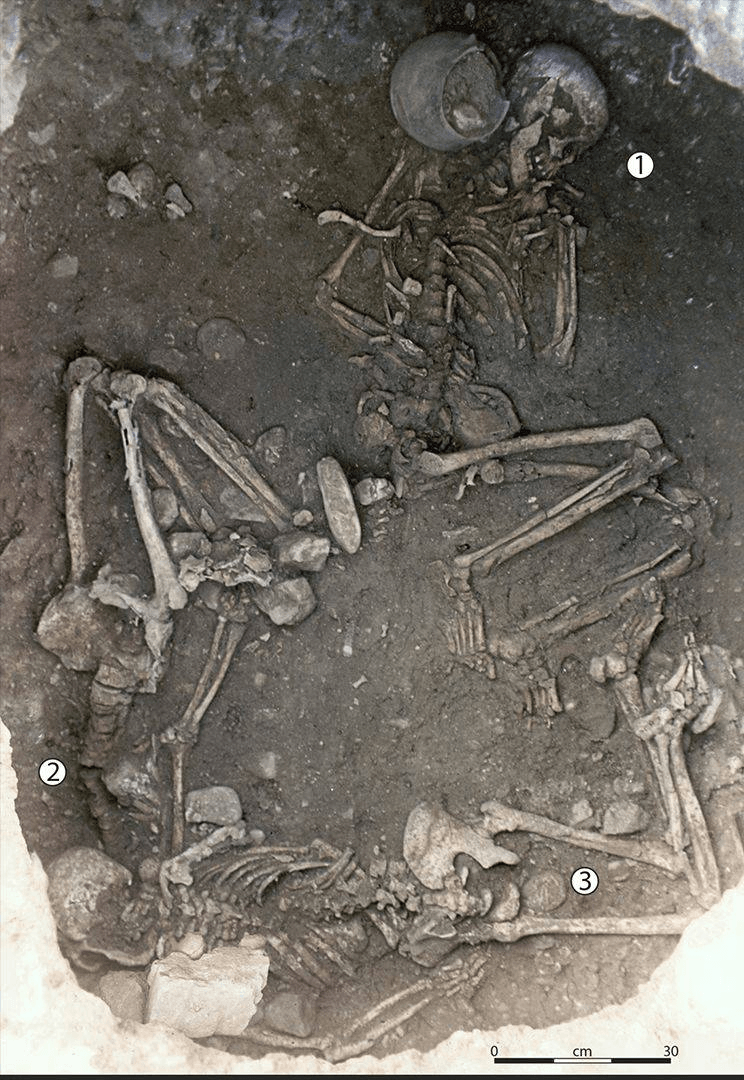
mafia uses execution methods that were used in religious ceremonies in the past
In Avignon in France, the remains of three women from the Neolithic period (5,500 years ago) were found, one of them died naturally and two of them were younger, executed as human sacrifices in a way that is currently used by the mafia. The method is called "Incaprettamento" and in which victims are placed on their stomachs with their knees bent, their necks and ankles connected by a rope, and any movement can cause self-suffocation.
Why does it seem that the method was used for a religious ceremony? Above the grave was a wooden structure that was aligned with the sun at the solstice and nearby some broken stones for grinding grain were found. Which suggests that the burial was part of a ritual related to agriculture. The fact that in different periods over the years (between 3,500 and 5,400 BC) remains were found that appear to have been made using this method along with other wall paintings from the Stone Age that seem to represent this execution as well, show that this custom has continued since ancient times.
This raises the possibility that the mafia uses execution methods that were used in religious ceremonies in the past, and they did not invent those brutal methods, it did not come out of nowhere.
-
Norman Ohler's "Tripped" Explores America's Post-War Drug Pursuits
In 2016, Norman Ohler published his book "Blitzed", in which he wrote about the way in which the Nazis used the drugs cocaine and amphetamine to fuel the war machine, and how in his last days Hitler's behavior was driven by a heroin withdrawal. This week he releases the sequel, "Tripped", which actually continues the story from the same point, and describes how the US continued exactly where the Nazis left off. That is, simultaneously with the development of the drugs and their introduction to scientific use, they were also introduced to military use. In some cases it turns out that the same people were behind the scenes, a host of scientists and officials who were taken in by the US after leaving Germany, before and after the war (as part of "Operation Paperclip").
First the American interest in drugs was after the division of Berlin into four zones of control. Berliners were drug addicts. In his first book, Ohler tells about the form in which crystal meth was legally sold in pills or chocolate. The Allies enforced a war on drugs, and in the American region Arthur J. Giuliani of the Federal Bureau of Narcotics is in charge of the matter. He was ordered to investigate the field in Germany, and bring home anything that might be "useful" to the United States. The Nazis investigated the use of mescaline, but at some point appropriated the invention of Sandoz Laboratories (LSD) and conducted "brain control" experiments with it. The Americans were desperate to acquire this "technology" and following the findings of the research, the MKUltra research project was born. The project was born less than five years later, when Prof. Henry Beecher from Harvard, carried out experiments on CIA prisoners in Germany, while he was assisted by former Nazi doctor Walter Schreiber.
Although these drugs also had medical benefits, in the end the Americans decided to outlaw them, due to its destructive effects that were discovered over time with the expansion of recreational drug use and the counter movement that developed as a result. Ohler suggests that the drugs' place was so central that even President Kennedy's 1963 speech calling for world peace was under their influence (claims Publishers Weekly).
-
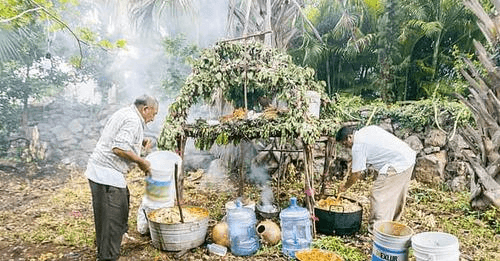
the rain cults of the maya people are explained through the geologic phenomenon of the yucatan peninsula, and the holy karst sinkholes that shaped the mayan ancient religion
Chaac is the rain god of the Mayans and was at the center of their worship, probably due to the fact that he rains water from the sky and the Mayans had an issue with water. The Mayans lived in the Yucatan Peninsula. The Yucatan Peninsula is a geological phenomenon. The peninsula consists almost entirely of a karst block, that is, of limestone that penetrates the water, and the meaning is that essentially all the rain that falls is absorbed by the infiltrated soil. As a result, there are almost no water reservoirs or streams in the area, and therefore an area without running water does not allow living conditions.
The Maya's dependence on rain was for a simple reason, it is the only source of water available to them, and it also maintained the only natural sources of water they could find. Geologically, rain that falls on the ground will behave according to the structure of the ground. If the structure is permeable, the water seeps through. Of course, there are also times when the rate of infiltration does not catch up with the permeability of the soil, and then floods occur. Over time, the only water left on the ground will be swamp water, which is non-potable water. So from this point of view the Mayans did not benefit from the rain, but from another point of view it made the rain particularly attractive.
When the percolating water meets with concentrations of carbon dioxide in the soil, an acid is formed that dissolves the limestone and creates underground cavities, which are called karst caves or simply "stalactite caves". Sometimes the layer of soil above these spaces is too heavy, then the soil simply collapses and sinkholes are formed. As the groundwater rises, these sinkholes fill with water. Sometimes to reach this water you have to crawl inside the sinkholes but sometimes the water is visible. These sinkholes are called "cenote", which is a corruption of a word in the Mayan language that means "well". This is how the Mayans saw the only place that could actually be a source of potable water for them. Therefore these places also became holy. Cities were built around cenotes. Temples were built in the cities. One of the well-known temples built around Cenote is Chichén Itzá, which was originally the center of the Mayan culture.
In the Mayan language, as mentioned, the Yucatan Peninsula is described as a place where the water is not abundant, which is called Ma'yaan Ja in their language. However, they would call these wells "the place where the water is", Máay Já. Indeed we see that the origin of the name of the Mayans is related to water. The ancient name of the Yucatan Peninsula was shortened by the Mayans to Mayab, there is a claim that the meaning of the name is "few", "not many" – and refers to not much water. As mentioned, the Mayans depended on the rain. The rain filled these wells, allowing the Mayans to have access to drinking water. But when they were in droughts, the wells dried up or rather their level dropped. This thing symbolized in their eyes a violation of the cosmic balance, and required a special form of worship from them.
To understand worship we must understand Mayan cosmology. Chaac was associated with the four sky gods called the "Four Chaacs" or the "Bacabs". Chaac probably symbolized the "fifth cardinal direction" which is the center of gravity between the four cardinal directions, the Axis Mundi. Each of these gods symbolized a different cardinal direction, and each of them had a different color – the east is red, the west is black, the south is yellow and the north is white. In the myth of the creation of the world in Popol Vuh, these four gods created the world after it was destroyed by the war of the 9 gods of the underworld against the 13 gods of heaven. Each one created a tree of its own color in its own cardinal direction, the Ceiba tree. The trees were called Yaxche. A fifth tree was planted in the center, symbolized by green. This tree connected the three worlds, and symbolized the harmony and balance between them. The top of the tall tree connected the earth with the 13 sections of heaven, and its prominent roots connected the earth with the 9 sections of the underworld. Every time the world went out of balance these gods had to be pleased, and therefore they used the tree as a direct channel to connect with them.
In the aforementioned drought, the balance was broken. The balance between the sky, which was considered the source of the rain, and the depths of the earth, which were considered the karst caves buried under the cenote wells. In years past, the Mayans held the C'ha Cháak ceremony. A festival in which four boys were chosen to represent each of them a different Chaac, who would croak like frogs and hold a service to please God. However, at the time of the drought, it would seem that the gods were not satisfied and therefore messengers should be sent to them in order for them to plead for mercy on man. For this purpose, volunteers were chosen who agreed to be human sacrifices, and these human sacrifices would be thrown into the cenote after their death. The cenote was considered the entrance to the underworld, and therefore a person who sinks into it, his soul is sent directly to the angry gods.
The victims would be dyed with a special pigment that is now called "Maya blue" (in Spanish: azul maya). The pigment is created by blending the indigo dye produced from the anil plant (Indigofera suffruticosa), and a heated Palygorskite clay soil. This clay was abundant in the soil, and especially in the walls of the cenotes (as scientists discovered in the 1960s). The Mayans also used this clay as a medicine, and generally considered it sacred to the god Chaac. In fact, this light blue color symbolized in their eyes the clear water, and whoever was painted with it was actually expressing submission to God.
Today, of course, there are no more human sacrifices. The Spaniards saw this custom as something obscene, and forcibly converted the locals to the Catholic Christianity. But it turns out that this ceremony is still held today, in a quasi-Catholic edition. Instead of praying to the god of rain, they pray to Christian saints, they use crosses, and their prayers are accompanied by Christian concepts and biblical verses. The article in the link describes such a ceremony