
-
Wolves worship in the indo-european religion
The Romanians also have a deep and ancient connection with wolves and "werewolves" that is worth reading about. The Dacians called themselves wolves and saw the werewolf as their protector.
In ancient Greece, there was a mountain called Lykaion or "Wolf Mountain", on the slopes of which a religious ceremony called Lykaia (Greek: Λυκαία) was celebrated. The ceremony was a mystery, a secret ceremony, and rumors said that they would hold a cannibalism ceremony there and undergo a transformation into werewolves. Anything that contains a reference to transformation, can be suspected of using mind altering drugs. And if you become a wolf, then you become the image of God, the wolf god. Supposedly Zeus was a wolf god, Lycaeus, and he was the patron of this ritual. Porphyry wrote that Aristotle's student Theophrastus compared the sacrifice "at Lycaea in Arcadia" with the worship of the Carthaginian/Canaanite ruler. Later there was also a cult of Apollo Lycaeus who was considered a wolf god. In Greek mythology, Apollo's mother took the form of a she-wolf in order to quickly escape from Hera, who was jealous of her (both were consorts of Zeus). Later in Roman mythology, the Romans gave the founders of Rome the honor of being the sons of a she-wolf probably in this context.
By the way cannibalism. Both the Jews (Apion and Democritus' "libel of the human sacrifice") and the early Christians were accused of being cannibals, and the claim is made at least about the Christians because they claimed to eat their god who is a man (Jesus). Today we understand it as the assimilation of "God", meaning the supreme consciousness, in their body, so that when we talk about cannibalism, we are probably talking about mind-altering rituals. Everyone becomes their own God. Whether it's a human or a wolf.
It is also worth a note that Benjamin's "emblem" is a wolf, as it is said "Benjamin a wolf will prey" (Genesis 49). The Jews used to call themselves "Wolf" or "Benjamin Zeev", but not in a religious sense, but probably more in the sense of calling their children by "universal" names like the Gentiles around them who, as mentioned, called their children by names that included mentions of a wolf such as Adolf, Ingo, Boris, Uwe, Ralf (of Rolf), Randolf (Randel) and in other Germanic cultures also Rollo (Normans) and Alarich (Goths). In short, stands at the foundation of multitudes of names.
-
The Anglo-saxon wolf worship
The English ancestors, by necessity of being Germanic, adored the wolves. They saw in them the power of the wild, and the guardians of nature. But it turns out that at some point, evidently a Christian influence, since Christianity saw the wolf and the wild in general as a symbol of evil, the admiration for the wolf decreased. The image of the wolf was damaged and the wolf was considered a carrier of diseases, attacking people, causing them to become werewolves, murderous and shape-shifting. And perhaps because the wolf is associated with the Berserker tradition that, as part of the drinking ceremony before going to war, they recieved their war frenzy power from Odin, and in this context they donned skins and fur. In other words, the image of the wolf was damaged not only because it symbolized the wilderness, but also because it symbolized idolatry and especially because Christianity was mainly pacifist and anything that was related to killing was considered impure. At least until the Crusades, when the term "holy war" was invented, and thus those who had a desire to murder, were channeled towards a religious mission that allowed them relatively easily to become righteous. Christianity served as a remedy against the wolf.
Let's return to England. It turns out that social and cultural pressures turned the wolf into an enemy, and in the 13th century a guild was even established whose purpose was to kill wolves. The wolves were considered to be those who prey on the herds, endanger women and children, and, as mentioned, transmit diseases. Killing wolves was considered a virtue, and was allowed to such an extent that anyone who encountered a wolf was free to kill it. And so the wolves almost disappeared from the English nature.
Environmental activists see this as an ecological disaster and are working to restore wolves to the wild, in this case the English. One of them, Derek Gow, is currently publishing a book that deals with the subject and seeks to emphasize the ancient affinity of the English to wolves. Among other things, he tells about the Wuffingas, whose literal translation is "the kin of the wolves". Before I tell about the role of the wolf in the Wuffingas culture I would like to tell a little about their background, so that the ends connect well.
The Wuffingas were a Germanic people who originally came from Jutland (southern Denmark) and ruled the kingdom of East Anglia in the early Middle Ages. The kingdom was founded in the sixth century by a king named "Wuffa" whose name means "little wolf", who united the peoples (folks) of the north and the peoples of the south, what is now called Suffolk and Norfolk. Later there were also other kings who combined the name "Wolf" (wolf) in their name such as for example King "Ealdwulf" or "Aldwulf", you can see how the name "Adolf" was derived from his name and the meaning of his name is "the majestic wolf". Aldwulf's son was named Ælfwald, which probably means "deer of the forests", and from which the names Eliot were probably derived. That is, the Anglo-Saxons saw nature and the wild as empowering and pastoral forces, as well as the animals that symbolize them.
The king who converted the Wuffingas to Christianity was called Rædwald, whose name means "ruler of the forest", and here it can also be noted that the word "wald" in the English language has two meanings, both forest but also power, or alternatively, a powerful ruler. It should be noted that the word for "old man" is also ald, and there is probably an etymological connection between old age and ruler. So, for example, Aldwulf's father was called Æthelwald, which means either "the noble forest" or "the noble ruler". Therefore, "Ælfwald" does not necessarily mean "deer of the forests" but rather "ruler of the deer". This is the opportunity to mention another name that uses this motif, "Alfred" which, according to what we understood, also means "Alf" or "El" which means deer or elk, and "Ræd" which means ruler or judge ("Chancellor").
It is believed that the Anglo-saxon saga "Beowulf" was written in the court of Ælfwald or Alfred. Beowulf literally means "god wolf" (bēow = diety of agriculture). A Norse nation in Beowulf who lived in the south of today's Sweden were called the Wulfings (or Ylfings), and are believed to be somehow related to the Wuffingas, and both have the element "wolf" in their name.
These "wolf peoples" saw the wolf as their totem animal that functioned as a mediator or messenger between the living world and the underworld of their ancestors. Rædwald, who, as mentioned, converted the local Angels (i.e englishmen) to Christianity, only converted the religion to semi-Christianity. The policy of the church was, if not to fully Christianize, at least to gradually bring the pagans closer to Christianity, or to give their folk legends a Christian touch, and let inertia do its thing. This is how we also see so-called Christian elements in Beowulf.
The Diocese in Canterbury was established in order to oversee the spread of Christianity in England, as the Saxons also had a tradition (even the continental ones), to semi convert to Christianity or to convert to Christianity only in appearance and then abandon Christianity. It turns out that there is such a tribal barbarian practice to adopt a religion for political or practical needs if it is required, and when it is not required to abandon this religion. This also happened among the Arab tribes in the generation after Muhammad, this is also evident from a description in the Bible, how generation after generation this story is repeated that the Israelites return to their home and worship idols and not God.
Another reason for the establishment of the diocese is of course due to the geographical distance from Rome, it was a relay station of the Roman faith and one of its major manifestations as described by Beda Venerabilis who wrote the "ecclesiastical history of England", is the controversy surrounding the date of the Easter celebrations. Due to the fact that the Celts remained semi-pagan, they still kept their own calendar and therefore Easter came out on a different date than that of the Roman diocese. Beda describes how only the Synod of Whitby in the seventh century settled the problem.
The findings of the ship burial in Sutton Hoo where King Rædwald was buried, and in it many luxury objects that allude to the worship of the god Odin with the wolves Geri (greedy) and Freki (ravenous) who guarded the borders of his kingdom forever against his giant enemies – only perpetuate his remaining pagan connection, and the fact that such ship burials and other descriptions that was found in Sutton Hoo are also mentioned in Beowulf, only supporting the claims made earlier regarding the form in which Germanic folklore was preserved among the English.
The one who is considered to be the last descendant of the Wuffinga dynasty was King Edmund, who succeeded to the throne of the kingdom of East Anglia at the age of fourteen in about 855. He was a devout Christian who was considered in his time to be "the model of good princes … a declared enemy of flatterers and informers … The peace and happiness of his people were his whole concern". In 865, a "great heathen force of Danes" led by Ivar the Boneless landed in England to form a permanent army of occupation.
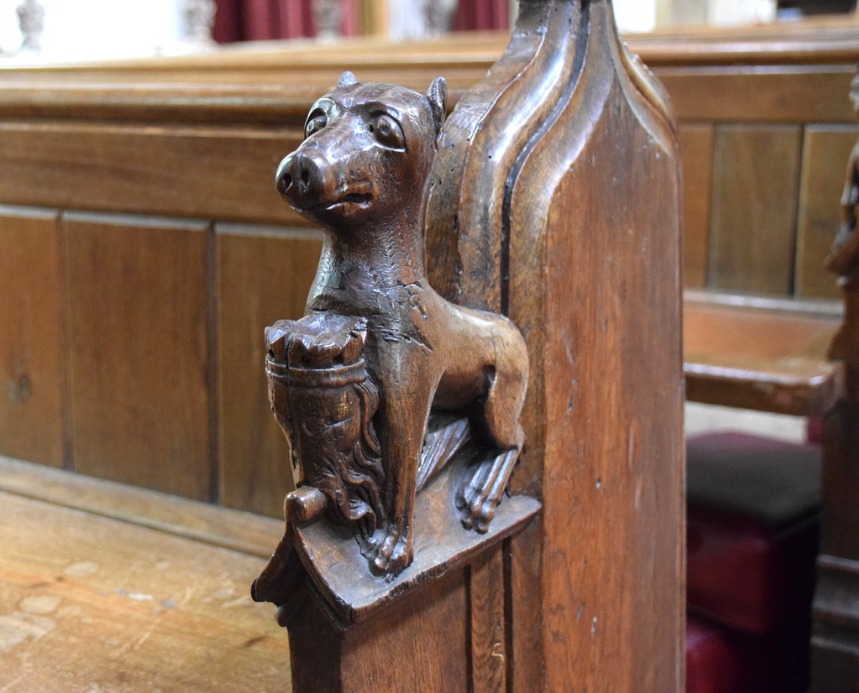
When Edmund was captured, he refused to surrender unless the Danes converted to Christianity and this Ivar refused to do. On November 20, the king was captured, tied to a tree, beaten and finally executed by a volley of arrows. His body was mutilated and his head was cut. When his followers returned and searched for his body, they discovered it without a head. They searched and then suddenly they heard a big wolf who supposedly called out in the Latin language, 'Here, here, here!' (in Latin hic hic hic). They followed the voice and found that the wolf was guarding the king's head. Miraculously, when his body and head were reunited, the people connected the two parts of the body and found that it was connected exactly and it hardly seen that the body had been mutilated, except for a small and insignificant red mark. Whole again, Edmund was buried in the monastery in the bury of St. Edmund. To this day there is a statue depicting this occurrence, which is carved and placed in the church of St Mary and St Lambert in Stoneham Aspal in Suffolk.
-
the oromo and the sycamore
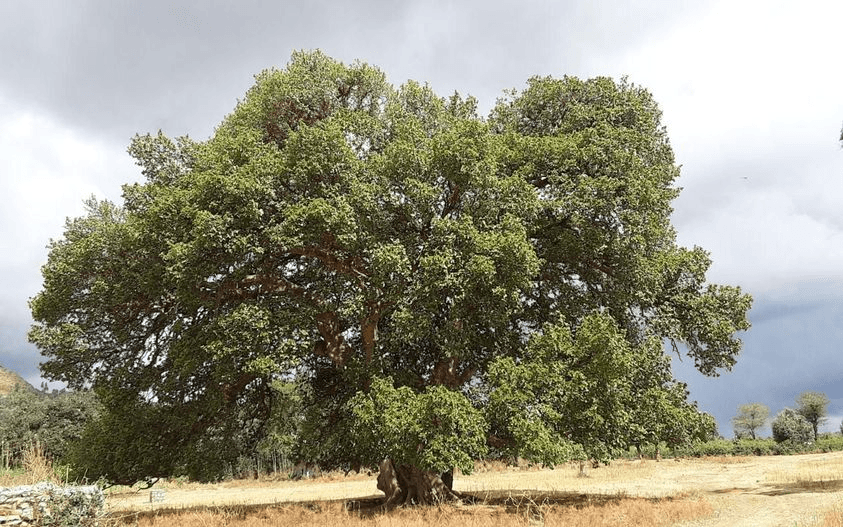
The Oromo people in Ethiopia worship the sycamore tree. The Oromo refer to this tree as the Odaa. For the Oromo, Odaa has spiritual and ecological significance as a site for political assemblies, religious worship and cultural ceremonies. In terms of politics, the sycamore tree played a key role in the traditional Oromo government system, known as the Gadaa. The Gadaa system is a complex political governing body based on a generational and age system, according to which all men born in a clear period of eight years are of the same age, and can rule in a generational rule of 40 years, after which the rule will pass to the members of the next generation. All the political ceremonies of the Gadaa and all the legal activities are held under the shade of the Odaa tree. The system of the Gadaa also reinforces a whole concept of preserving sycamore trees (and other sacred plants), the cutting of these trees is prohibited, and the traditional gathering places are considered sites that should be treated with reverence.
The Odaa tree also stands at the center of the local mythology and the story of the creation of the Oromo religion, the Waaqeffanna. At the cosmic point of the center of the universe on the primordial hill, man and the primordial bull were created under a sycamore tree. In fact, as in most Kushite religions, the tree is considered the source of life. In Egyptian mythology, a sycamore tree is also considered as such. Likewise in Waaqeffanna, the sycamore tree is the tree of life and immortality, a symbol of fertility and renewal. This is expressed in the fact that it can be reproduced using cut branches that develop roots, which symbolizes renewal and a reproduction of life. The tree is considered the abode of the spirits and in the Oromo culture it could be said that they consider the tree to be what we would call today "the center of an ecosystem". The tree sustains its environment at every stage of its life cycle, starting with its unripe fruits and ending with their ripening. Many types of plants grow under its shade, which, unlike other trees, develop a symbiosis with it and thrive under it instead of fighting it. The tree is always in a source of water, a symbol of fertility in itself. And regardless, it meets most of the Oromo's material needs, from food, through clothing, to everyday tools such as stools built from the logs of the Odaa tree, and ropes and sacks woven from fibers produced from the bark and roots of the tree.
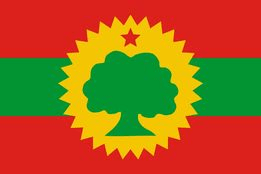
The most important thing about the sycamore tree, at least in the modern aspect, is that the Oromo took the colors of its fruits, starting from the green unripe stage and ending at the ripe stage, where the fruit turns from yellow to red, as their flag. The tree appears in the flag of the Oromia region, and the flag of the Oromo Liberation Front (OLF) is composed of these colors, with the Odaa tree framed by a yellow star, symbolizing Gadaa, the democratic system of Oromo rule. In fact, when the Ethiopian government tried to suppress the Oromo, it banned the gatherings of the Gadaa and outlawed them, this is probably the reason that this tree also has a nationalist and separatist meaning for the Oromo, and this protest also stands in the background of the civil war in Ethiopia, starting from the 1970s in the 20th century and actually in the present days.
-
early piercing in the Pre-Pottery Neolithic
11,000-year-old stone jewelry provides the earliest evidence of body piercing. Researchers from Ankara University excavated a pre-ceramic Neolithic site in eastern Turkey, Bunçuklu Tarla and found the remains of jewelry alongside skeletons. The jewelry, mostly made of limestone, obsidian or pebbles, was placed in part next to the ears and chins of the skeletal remains, suggesting that they were made for use in both ear and lower lip piercings. Since such jewelry was found on both male and female corpses, but only on adult corpses and not on children's corpses, it is believed that they were used as part of a rite of passage in which the teenager's ear or lip was pierced. And this mainly means that using jewelry is not only aesthetic but also social.
-
Sex toys were given as a donation to the tabernacle?
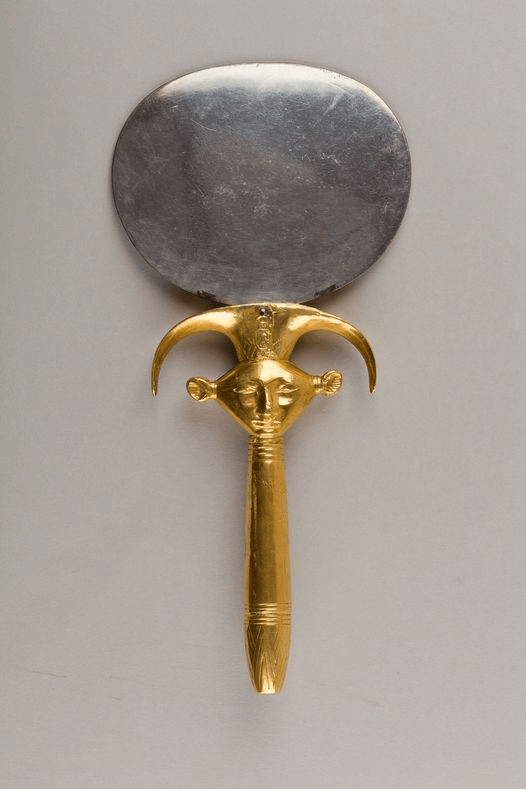
In this week's portion "Vayakhel" it is told about the donation of the Israelites and the building of the tabernacle, and it is said that the basin in the Tent of Meeting was built from the mirrors donated by the women who were gathering at the entrance of the Tent. The word for "gathering" is "Tzov’ot", which appears once more in the story of the two sons of Eli the priest, that used to sleep with the women that came to the temple. It is is easy to understand from the context that the women were involved in ritual activities, that is, ritual sex.
The mirrors symbolized femininity, fertility and the giving of life. We see that in the Egyptian language the word for mirror is ankh, mirrors were created in the shape of this symbol, and symbolized life and especially birth or rebirth. Accordingly Isis, who symbolized all these, was always equipped with this amulet which was placed in the buckle of her belt.
Of course, all of these are not in line with Judaism, and therefore the commentators and sages were eager to emphasize that this was to refer to those who come to pray (Onkelus Targum), or those who were modest enough to get rid of their mirrors because they no longer needed them (Jonathan's Targum). Why would they need them? While the Israelites were in Egypt, Pharaoh wanted to reduce the birth rate of the Israelites. What did the women do? They made up their face and beautified themselves in honor of their husbands in order to tempt them to have sex and thus increase the birth rate, so when the Israelites left Egypt, they left the land of Egypt "with their armies" (literal translation of "Tzov’ot", ot "Tzava"), as it is written in Exodus 12.
The more interesting thing is that the Levites are also written as they were "Tzov'ot". In the book of numbers, chapter 4, it is said that at the same time as the census that Moses and Aaron made of the Israelites in order to check how many military-ready preople there are among them, he also made a census for the Levites, all who came "to the service" to do work in the Tent of Meeting. Meaning, "Tzov'ot" means to serve in the tent of meeting. Likewise in chapter 8, it can be understood that "to serve the army" means to serve in the holy place.
What can be understood from this is two things: the first is that there is no dispute that the temple vessels were built from metals that before being melted down were used as sex toys, and there was no problem with this because it "raises to holiness" and it is also related to fertility. But the second, more important thing that I think can be understood is that before the tabernacle was built, the women's role was to "serve in the sanctuary", and what happened here was actually their being deprived of the role, and it was transferred to the Levites. It can also be understood as I understood in another post in the past, the Levites were nothing more than male temple prostitutes.
At this point, I would also like to mention Efi Meir's opinion in his book "The Untold Bible", about another sexual accessory that was used as raw material in the construction of the tabernacle. In our portion it is also written (Exodus 35:22) "And the people came upon the women, every generous person brought their jewels including rings and Kummaz, every golden vessel, and every man who donated gold to the Lord." We know that "coming upon someone" means a sexual intercourse, and from this it can be understood that what is described in the verse is that the Israelites donated various jewels, including something that is called "Kummaz", which they used to have sexual intercourse (or perhaps they donated them after sexual intercourse).
So what is Kummaz? Rashi claims that those who donated were actually the women, and that a "Kummaz" is "a gold piece of jewelry given against the ladybits, and our sages interpreted the name Khomez as the initials of the hebrew words for 'here is a place of fornication'". Efi Meir claims that it doesn't make sense, how exactly will the women put a piece of jewelry on the pelvis? It is also clear from the scriptures that those who brought it as a donation were the men and not the women. And from this he concludes that it is probably a cock ring, something that was customary in lewd cultures like the Egyptians. We have such precedents from other cultures in India and China, where they used such preparations for the purpose of maintaining an erection and increasing desire, or alternatively, the golden marble that is at the end of the Kummaz is actually supposed to increase the woman's pleasure. -
A revisited history of cacao domestication in pre-Columbian times
Not much is known about the domestication of cacao beyond the fact that the first to use it were the Olmecs who passed their knowledge to the Mayans, who used it in shamanic rituals (the literal translation of the scientific name of the cacao is "the food of the gods", Theobroma cacao). It is also known that the origin of cacao is in the Amazon, but how did it get to the Yucatan Peninsula? Unknown. Up to now. Analysis of ancient DNA remains from remains of ancient pottery as far back as 5900 years ago stretches the distribution of cacao much deeper into the past than previously assumed. The new study published in Scientific Reports outlines the trajectory of the spread, its origin and timing. The research shows that there are three ancient varieties that were spread equally among the different cultures. This points to the existence of a continuous trade between the Amazon and the various cultures on the coast of the Pacific Ocean and between the cultures of the coast and Mesoamerica.
-
8,600-year-old bread found
Researchers from Necmettin Erbakan University discovered that the remains found in an object discovered in Çatalhöyük were dough bread, from 8,600 years ago, which is considered the oldest known bread in the world. Coincidentally or not, Çatalhöyük is considered to be the oldest urban settlement in the world, and during the Neolithic period in question, about 8,000 people lived there.
-
Tattooing has held a long tradition in Christianity − dating back to Jesus’ crucifixion
In the Old Testament it is written that tattooing is forbidden, but they probably meant that in the context of idolatry it is forbidden, but if it is a tool for personal expression then there is no problem. And so, it turns out, early Christians would tattoo Christian symbols on themselves. They would see it as an expression of devotion.
Since tattoos in ancient times characterized the belonging of slaves to their masters, God's slaves would associate themselves with their master, just as it is described that "they would put marks on their foreheads". At the time there was no specific word to describe a tattoo and it was called a "sign", "signum" or "stigma", just like the stigma Jesus had. A tattoo was thus an imitation of Christ. There were those who did it precisely at the time of her pilgrimage, at the place of Jesus' death, Jerusalem. Sometimes when the angel of death ran amok, people were advised to put marks on their foreheads to gain protection, as in the plague in the Scythian steppes in the seventh century. There is testimony from Procopius of Gaza, that in the Holy Land there was an industry of tattoos, and many of the Christians in the Holy Land tattooed themselves with Christian symbols.
When the Christians came to Christianize the Celts in Britain, they saw that many of them were full of body paintings. The church saw the desire of the Celts to tattoo themselves, but knew that the tattoos were for idolatry. So the church allowed the tattoo, if the tattoo is for the Lord's purpose.
Tattoos remained a relatively common phenomenon until the end of the Middle Ages but then, in the Renaissance, tattoos began to be considered as of something that belong "uncivilized" people – whether they were peoples in colonies, criminals or simply poor and common people. At the same time, many European intellectuals saw Catholicism as more of a superstition than a true religion, and since Catholicism supposedly encouraged people to get tattooed, they treated the phenomenon with disdain. However, among Eastern Christianity the phenomenon is prevalent to this day. In the Coptic Church, it is still customary to tattoo crosses in baptism ceremonies. Also in the Ethiopian Church. There are Christians in the Holy Land who testify that they have in their possession kits that were used to tattoo pilgrims even in the last hundreds of years.
-
Archaeologists have revealed a major production Tyrian Purple site in Tel Shiqmona
A study by researchers from the University of Haifa published in the journal of the Tel Aviv Institute of Archeology: During a significant part of the Biblical Iron Age, starting from approximately 1150 BC until 600 BC, Tel Shiqmona (Haifa coast) was not used as a residential settlement as believed In the past, but as a center for the commercial production of Tyrian purple, scarlet and crimson dyes (biblical Techelet and Argaman) from the snails that were there. During the first half of the ninth century BC, around the time of king Ahab, the Israelites took control of the place and built a fortress there, which put the dye market in frenzy. The place was managed by Israelites and Phoenician hirelings worked there.
It should be noted that in the Torah it is written "Zebulun will dwell on the coast of the sea and he will dwell on the coast of ships and his stern on Sidon", although in the book of Joshua it is understood that his settlement was not on the coast. However, due to the tradition of the "Treaty of Issachar and Zebulun" it is common to think that Zebulun was a tribe that engaged in maritime trade and became rich, so that according to tradition the Zebulun tribe was indeed involved in the production of the Tyrian purple, for the seashore. Rabbi Yitzchak Isaac Herzog, who was the chief rabbi of Israel in the early years of the state, and in his youth was a doctor at the University of London, also concluded the same. In the 1930s, Rabbi Herzog published a study which claimed that the biblical Techelet is indeed the excrement of the Hexaplex snail.