
-
The Lasting Impact of Tobacco on Human Bones
Archaeologists from the University of Leicester examined human remains buried in Britain between the 12th and 19th centuries, revealing the profound impact of tobacco on bones. Tobacco leaves leave traces on the bones of smokers, traces that not only last throughout their lives but also remain for hundreds of years after their death. Now, it is possible to infer a person’s health not only through dental analysis but also through bone analysis, and the results are not encouraging.
If smoking affects soft tissues and organs, such as an increased risk of lung, bladder, and throat cancer, as well as strokes, coronary artery disease, and gum inflammation, it has now become clear that tobacco itself causes changes in the molecular structure of the bone, leading to lower bone density and an increased risk of fractures. In short, they argue, there is no benefit in tobacco for humans at all. So why was it used?
It was once thought to be a miracle cure, believed to treat a variety of ailments, including headaches, rheumatism, and even respiratory diseases. It was used by inhalation, smoking, or chewing for medicinal purposes. European doctors were inspired to use tobacco as a remedy after observing its use by Native Americans. Native Americans smoked tobacco in spiritual ceremonies, inhaled it to treat certain diseases, and even applied it to wounds. The most well-known use of tobacco was during peace ceremonies and conflict resolution between Native American tribes, in which the plant was smoked in what is known as a "peace pipe."
-
Citrus = apple?
Is the "tappuach" in the Song of Songs actually referring to the etrog? In the Aramaic translation of the Song of Songs, the verse "As an apple tree among the trees of the forest, so is my beloved among the sons" is translated as, "Just as the etrog is lovely and praiseworthy among barren trees…". In Genesis Rabbah 16:7, Rabbi Abba of Acco holds that the fruit of the Tree of Knowledge, often referred to as "the apples of the Garden of Eden", and similarly in that same Aramaic translation of the Song of Songs, is indeed the etrog. "Rabbi Abba of Acco said: It was an etrog, as it is written, 'And the woman saw that the tree was good for food'. He said: Go and see which tree has both its wood and fruit that can be eaten? And you will find none but the etrog". In other words, the "apple" described in the Song of Songs as having a pleasant fragrance ("the scent of your breath like apples") is the same fruit that, in the ancient Near East, was considered to be fragrant and purifying — the etrog. The etrog was an important fruit in purification and religious ceremonies in the ancient Near East, primarily because of its aromatic oils and purifying properties. Pliny the Elder also referred to the etrog as the "Assyrian apple", "Malus Assyria." Theophrastus called it the "Persian apple," "melea persike", or the "Median apple," "melea medike". In all cases, they were referring to what was called in Sanskrit "bijapura" or "mātuluṅga" — a fruit known for its essential oils and medicinal properties, making it a symbol of purification, believed to protect against plagues.
In the palace of Ashurnasirpal in Kalhu, there is a relief depicting two winged eagles holding in their hands a cone-shaped object and a bucket, and some suggest that this was an etrog used in purification rituals, with the bucket containing water to release the etrog’s oil. Perhaps these are the same seraphim that Isaiah saw — could the tongs and live coal they held be the same objects? In the Book of Kings, it is said of the cherubim that they had "palms and flower patterns", and in Ezekiel, it is written, "It was formed of cherubim and palm trees, a palm tree between cherub and cherub". This leads us to think that by the 9th century BCE, the etrog was already considered a purifier in Assyria, and it is reasonable that this Assyrian influence reached Israel by the 8th century BCE. After all, an Assyrian delegation from Tiglath-Pileser is mentioned in the Bible as having arrived in Judah. While there is archaeological evidence of etrog cultivation only from the 5th century BCE, we cannot know for certain whether the etrog was not already part of the Assyrian myth in earlier periods, as some miraculous fruit that came from the East, known for its fragrance and purifying properties. It is possible that a few samples reached Judah in earlier times when the fruit was still considered rare.
This is further discussed in the article by Dr. Norma Franklin of the University of Haifa on "The Torah" website.
-
Saliva spit wine, an outcome of duplication of a gene AMY1
A new study conducted by the University of Buffalo and the Jackson Laboratory (JAX) reveals how the duplication of a gene known as salivary amylase (AMY1) helped shape human adaptation to starchy foods, leading to a dietary shift from non-starchy to starchy, or even starch-rich, foods. The duplication occurred in two stages: the first following the invention of fire, and the second in parallel with the agricultural revolution. The question is what caused what—did human adaptation to starch-rich foods lead to the agricultural revolution, or did the agricultural revolution accelerate human adaptation to starchy foods? It turns out that after the beginning of agriculture, an additional evolutionary adaptation took place. That is, natural selection favored individuals with more copies of the AMY1 gene, as they had better starch digestion abilities, particularly in an era when the diet became more reliant on starch-rich crops. Thus, the genetic change emerged as a response to agriculture. However, as the theory suggests, agriculture may have been driven by a craving for alcohol, and this gene duplication could illustrate that very well.
The enzyme salivary amylase can break down starch into simple sugars, a process that makes these sugars accessible for fermentation when mixed with cooked grains. The amylase in saliva breaks down the starch into smaller molecules of maltose and glucose through hydrolysis, which can then be utilized by yeast for fermentation. In the past, alcoholic beverages were made using this method. Both in the Americas and East Asia, people would chew grains to mix them with saliva and activate the amylase, then spit the mixture into a fermentation vessel. The yeast in the mixture would use the sugars created during the breakdown process, resulting in a fermented beverage. Sometimes this process involved the entire village population, and the preparation of the intoxicating porridge became a social institution. The alcohol produced in this way was low in alcohol content. In East Asia, the drink produced was called Kuchikamizake (literally: "mouth-chewed sake"). It was only later discovered that other enzymes could be used to expedite the process, such as mold enzymes from Aspergillus oryzae (koji kin), which are still used today to make miso and soy sauce.
-
Child slave for the Alcohol industry of late bronze age
In the Early Bronze Age, there was high demand for goblets and pottery in the Kingdom of Ebla, mainly due to feasts where alcohol was consumed. To meet the need for increased production of these vessels, the kingdom began employing children from the age of seven in workshops as a cheap and easily controlled labor force, training them to produce uniform goblets. The research, led by Dr. Akiva Sanders of Tel Aviv University, was covered in an interview with Ynet, where he is quoted: “We see that more goblets begin to be produced for feasts. As these feasts became more frequent, and with alcohol being consumed, naturally, goblets would break — creating a need to produce more. Not only did the kingdom increasingly rely on child labor, but they also trained these children to make goblets as similar to each other as possible. This phenomenon is also observed in the Industrial Revolution in Europe and America: it is very easy to control children and teach them specific movements to create standardization in handcraft.”
-
The Numerology Behind the Number of Bulls Sacrificed During the Festival of Sukkot and the hidden greek connection
Sukkot is a unique festival, not only because it lasts seven days but primarily due to its distinctively abundant sacrificial offerings compared to other festivals. While on a typical holiday, one or two bulls, a ram, and seven lambs are sacrificed, sometimes with a single goat for sin offering, on Sukkot, each day’s sacrifice is a “jumbo” offering—two rams, fourteen lambs, a goat for a sin offering, and a decreasing arithmetic sequence of bulls, starting from 13 down to 7, over the span of seven days, totaling 70 bulls. This immediately raises the question: what is the purpose of this abundance, and what is the significance of the number 70? This number is clearly symbolic, so the question becomes: what does it mean, and is there a deliberate message?
The hebrew sages attempted to explain this by attributing the bulls to the "seventy nations", yet this reasoning is less than convincing due to its inconsistencies. Prof. Meir Bar-Ilan, in his book "Biblical Numerology" (2006), meticulously outlines these issues and concludes that without a doubt, the number 70 holds numerical significance, as does the fact that it’s a decreasing sequence. Since the sages overlook this aspect, their interpretation cannot suffice as a full explanation. So, what is the real explanation? Bar-Ilan suggests that the descending series symbolizes the purpose of the festival—atonement for the possible sins of the community, a ritual that systematically diminishes sin until reaching completeness, represented by seven. The purpose of atoning during Sukkot is to encourage God’s forgiveness for unknown sins as Israel is judged for rainfall, the ultimate blessing for the land, on "Hoshana Rabbah", the festival’s climax, with the seventh day offering seven bulls.
Bar-Ilan explains that the number 70 signifies totality, much like the number 22, which encompasses everything from aleph to tav (or alpha to omega). This is because 70 is a product of 10 and 7, where 10 represents the people, and 7 represents divine perfection. In Jewish terms, 10 symbolizes a “minyan” or a communal quorum, while 7 represents sanctity or purity. Thus, 70 unifies the divine and human realms, embodying the collective spirit of Israel, a concept echoed in Jewish mysticism as “God, the Torah, and Israel are one”
In numerology and religion, numbers represent “spiritual levels,” each with a dual aspect—the sacred and the profane. Hence, the 70 bulls symbolize the potential for collective atonement and the community’s ability to transform sin into holiness. The descending sequence, as mentioned, illustrates the gradual reduction of sin until its final eradication, which is Bar-Ilan’s main thesis.
Initially, this may seem like a beautiful “d’var Torah” fit for a holiday table. However, there are deeper Pythagorean roots to this mysticism, connecting numerology to religious meaning. Bar-Ilan briefly outlines this, particularly in relation to how, for later Pythagoreans, the number 10 was problematic because it was considered imperfect and thus symbolized humanity, in contrast to the divine 7. However, beyond these anecdotes, he does not elaborate on the Pythagorean basis of biblical numerology, which is his focus. He mentions that Maimonides, following Aristotle, mocked those who sought symbolic meaning in biblical numbers, arguing in The Guide for the Perplexed that “anyone who occupies themselves with inventing reasons for any of these particulars [regarding why this offering should be a lamb, that one a ram, and that their number should be a particular count] is engaging in a great delusion, adding more folly rather than eliminating it. Anyone who imagines that these details have reasons is as far from the truth as one who imagines that a commandment as a whole is not for a practical benefit”ץ Aristotle, notes Bar-Ilan, derides the Pythagoreans in his book Metaphysics, and perhaps also in his lost work on the Pythagoreans.
Yet Bar-Ilan does not accept Maimonides’ rejection of numerological interpretations, arguing that throughout the Bible, even in places unrelated to commandments but rather to straightforward reports on the number of sacrifices offered by various individuals or kings—in this case, Solomon—the number of sacrifices appears to be typological. It’s hard not to believe that there was intent, if not in the exact number sacrificed, then at least in the number recorded. In all cases, there are multiples of 7 or multiples (even powers) of 10. Naturally, he also references the classic rabbinic interpretation of the 70 bulls as evidence that even they were aware of the symbolic significance of these numbers.
In the past, I mentioned the parallel between Shavuot and Sukkot and the Eleusinian Mysteries, both major and minor. It turns out that numerology also supports this. As mentioned, there is a parallel between Shavuot and Sukkot. Both have sets of sevens, and various arithmetic operations on these sevens culminate in a peak moment called “Atzeret”. This is the name of the Shavuot festival as well as the eighth day. Generally, the number eight is unique only because it is the number that follows seven. In every instance where Judaism uses this number, it emphasizes the completion of the preceding seven. Both festivals illustrate the completion of sevens: a descending arithmetic series in Sukkot, with an additional day, or a squared progression of seven plus one in Shavuot.
However, the arithmetic series of Sukkot is somewhat more unique than just a descending sequence. Mathematically, this is an equation where the unknown is 7: a descending arithmetic series of 7 terms that ends with 7 and sums to 10 times 7. The equation is essentially an arithmetic series whose sum is x(2x – 1)/2 = 10x (following the sum of an arithmetic series). The only natural solution to this equation is 7. This emphasizes a deeper relationship with sevens, likely highlighting Sukkot’s precedence over Shavuot. Bar-Ilan spoke of the atonement process during Sukkot. This was probably also the case in the Greater Mystery. Originally, a 20-kilometer march took place from Athens to Eleusis, a lengthy journey during which participants underwent more complex purification rites, including passing through a narrow, deep water source. After the ritual immersion, various offerings, mainly from plants, and animal sacrifices, particularly pigs, were offered.
During Sukkot, there were numerous water rituals, as well as a grand procession (Simchat Beit HaShoevah). Each sacrifice included a specified number of “issarons” items (hebrew: one tenth) which were measures of grain offerings. Bar-Ilan points out an additional arithmetic sequence described in the Talmud, in Menachot, concerning someone who vowed to bring a grain offering without specifying its exact quantity. According to the lenient opinion, they bring the minimum required—a single offering with the maximum number of issarons (60). According to the stricter opinion, they bring a series from 1 to 60, totaling 1,830. If they didn’t specify the type of offering, they would bring this sequence five times, totaling 9,150. I mention this to emphasize the role of grain offerings. For Jews, the pig is taboo, and the cow holds the highest sanctity, making it the preferred sacrificial animal.
-
Insights from Raqefet Cave and the Natufian Era
Professor Dani Nadel researched Raqefet Cave for years during the first decade of the 2000s, yielding numerous findings on the burial practices at the site. He published these in a series of articles, the latest of which appeared in 2018 and reports on stone mortars found alongside Natufian graves, bearing signs of beer production. These signs include starch residues from wheat, barley, and oats that underwent fermentation. The mortars also showed signs of wear from grinding and fermentation, indicating that the beer was intended for ceremonial use as part of burial rituals. In previous studies, Nadel reported many stone and bone tools and animal bones with butcher marks, suggesting these were remnants of funerary feasts, distinct from typical settlement waste. This conclusion was based on the concentration of remains found within a burial pit, suggesting they were occasional feasts rather than ordinary meals. The series of burials at the site spans about 2,000 years, dating from approximately the 10th to the 8th millennium BCE.
In his book "The Immortality Key", Brian C. Muraresku expands on these discoveries as part of his quest to trace the earliest uses of consciousness-altering substances in ritual settings. He concludes that these rituals were designed to facilitate journeys to the realm of the dead, connecting the living with their deceased to create a bridge between worlds. Muraresku links Raqefet Cave to other significant sites, such as Göbekli Tepe in Turkey, which provides evidence of a “death cult” with group ceremonies involving ritual beverages that altered consciousness. Although Raqefet Cave is the oldest known example, he also discusses similar sites like the Necropolis of Las Ruedas from the Iberian period and Mas Castellar de Pontós from the Greek period.
At the Necropolis of Las Ruedas in Spain, findings suggest unique funerary rituals involving psychoactive beer, consumed by elite warriors during ceremonial feasts, likely to assist their souls on a journey to the “Beyond.” Beer residues were found in a vessel called a ״kernos״ (a type of seven-branched vessel) used in these ceremonies. These rituals also included the "devotio" tradition, where soldiers sacrificed their lives for their commanders, believing in divine protection. At Mas Castellar de Pontós, archaeological finds suggest the use of tools and equipment for producing fermented beverages. Since it was a sanctuary dedicated to Hecate, it’s likely that these vessels were ritualistic. One of these containers even contained ergot residues. Muraresku ties all these points together, concluding that a cultural continuum existed, where the tradition of intoxicating beer use passed from the Natufian period through later Middle Eastern and Mediterranean cultures, even reaching Greek and Roman societies. This continuum, he claims, began over 12,000 years ago, with Muraresku grounding his theory in the findings from Raqefet Cave.
Professor Nadel will discuss these topics in his lecture as part of the “Temple of Consciousness” series. His specific lecture will be held on 11/13 at "Hanasich Hakatan" café in Tel Aviv. Since the series covers “sacred plants”, Prof. Nadel has clarified that his lecture will not only address beer but also (and on this he has much more to share) the identity of the plants placed in the flower burials within the Natufian cemetery—again, the earliest known evidence of a tradition that still exists today!
P.S: It is important to note that Prof. Nadel will not be able to prove or disprove anything as long as he has not read the publications. However, he will certainly present Raqefet Cave and the studies conducted on the relevant findings: burial practices and alcoholic beverages.
-
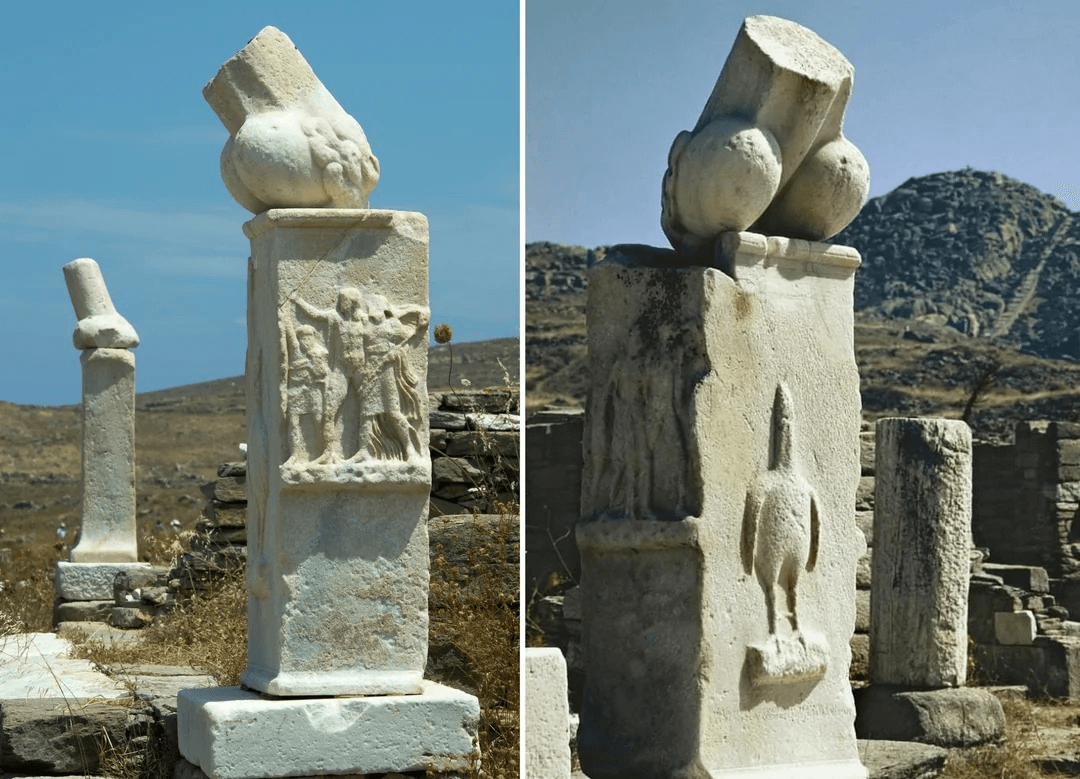
The phallic statues of Stoibedeion
The Stoibedeion is an ancient monument on the island of Delos in Greece, dedicated to the fertility god Dionysus. The Stoibedeion consists of a rectangular platform on which stood a statue of Dionysus, flanked by two figures portraying the Papposilenoi—representations of Silenus, the mentor and tutor of Dionysus (Pappos = like "papa," father). Silenus is characterized as an old, hairy, bald figure with a large belly, flat nose, and donkey ears. Each of the Silenus figures holds a giant phallus, a male symbol of fertility carved in stone. The southern column features a central scene with a relief of a rooster, whose upper portion is elongated and also shaped like a phallus. On either side of the rooster-phallus are figures representing Dionysus and his divine entourage: a maenad, one of his frenzied female followers, and Pan, a half-human, half-goat satyr. An inscription on the southern column mentions the name Carystios, who around 300 BCE donated the column as a tribute to Dionysus and the ecstatic festivals in his honor. So, why is Dionysus associated with both fertility and intoxication? The answer likely lies in the fact that the substances used for intoxication were also used as aphrodisiacs. One of them, of course, is wine. Another example of an intoxicating aphrodisiac can be found in the Song of Songs, where the mandrakes (dudaim) are mentioned.
-
Ancient Christianities and the role of magic
A new book by Paula Fredriksen deals with the first 500 years of Christianity. Chapter 7 focuses on pagan practices within early Christianity and the struggle against them. It describes Christian exorcism rituals that, from the outside, might have appeared similar to pagan ones. This ritual often involved commands directed at demons and healing through whispers invoking the name of Jesus, along with symbols associated with him and his crucifixion—primarily the cross, although symbols at that time were neither standardized nor officially recognized. Priests or bishops would dictate a series of verses and prayers, believing that this would compel demons to leave the afflicted individual. The attributed power of the ritual stemmed from the supremacy of Jesus over demons. Protective amulets were distributed, and materials such as oil and incense were used. The fact that the source of authority and power was Jesus, and in general, the monotheistic framework, made these rituals “Christian,” as in pagan rituals, the source of these powers was external—various daimones, spirits, or local forces, rather than God himself. Demons were viewed as rebellious forces against God, and the invocation of “protective spirits” was essentially an attempt to summon God’s glory and his superiority over these rebellious forces. When faithful Christians would turn to “bypassing” forces like angels, saints, or various intermediaries, it became problematic in the eyes of the Church. The Synod of Laodicea (4th century) prohibited priests from carrying amulets or using magic and attempted to limit rituals or the use of amulets outside the framework of officially defined sacraments. The Church sought to clarify that Christian faith relied on prayer, sacraments, and direct mediation with God, rather than “magical manipulations.”
In Canons 34-36, it is stated: “No Christian shall forsake the martyrs of Christ, and turn to false martyrs, that is, to those of the heretics, or those who formerly were heretics; for they are aliens from God. Let those, therefore, who go after them, be anathema. Christians must not forsake the Church of God, and go away and invoke angels and gather assemblies, which things are forbidden. If, therefore, any one shall be found engaged in this covert idolatry, let him be anathema; for he has forsaken our Lord Jesus Christ, the Son of God, and has gone over to idolatry. They who are of the priesthood, or of the clergy, shall not be magicians, enchanters, mathematicians, or astrologers; nor shall they make what are called amulets, which are chains for their own souls. And those who wear such, we command to be cast out of the Church.”
-
coca plant arrived to Europe in the early 1600s
Traditionally, it was believed that the coca plant first arrived in Europe in the 19th century, brought by explorers and traders who carried samples from North and South America. Spanish colonizers were familiar with the plant as early as the 15th century, but it did not become a significant trade commodity in Europe until the 19th century, when it began to be distributed as a medicinal substance and for other uses. A new study suggests that the coca plant was present in Europe as early as the 17th century, nearly two centuries before previously thought. Toxicological analysis of 17th-century human remains found in Milan, Italy, revealed active components of coca, indicating that it was consumed in some form in Europe during that period.
In the early 19th century, the use of the coca plant in Europe focused on medicine—primarily for pain relief and treatment of various ailments. Cocaine, the active compound in the coca plant, started being used in medicine as an analgesic and even as an anesthetic for minor surgeries, until it was found to have addictive and problematic effects. Evidence from the 17th century suggests that coca use was likely for stimulation and coping with physical challenges. The usage probably was not for official medical purposes (it was not included in the hospital's pharmacopeia) but rather for personal or folk purposes, possibly for recreational use or to ease hard labor.
-
Ancient Phrygian Sacred Sites Uncovered at Midas Castle
During excavations at the Midas Castle in Eskisehir, Turkey, archaeologists uncovered remnants of structures from the Phrygian period, dating back to approximately 800 BCE. The findings include ancient ovens, an open hearth, and rock-carved basins—all serving as evidence that the site was used for ceremonial events, such as ritual feasts and animal sacrifices. Additionally, a statue of the Phrygian goddess Matar Kubileya, the goddess of nature and fertility, was revealed. Ancient Rituals Uncovered at Midas Castle, the Phrygian goddess, is identified with the Greco-Roman goddess Cybele. "Matar" means "mother," while "Kubileya" likely refers to one of the goddess’s aspects, possibly associated with a mountain or the earth.