
-

The Symbolism and Uses of Water and Urine in Different Cultures
Water symbolizes the prima materia in many cultures—the primordial substance from which the world was created. Water is also considered the universal solvent, capable of transforming matter by dissolving it and enabling it to take the shape of its container. Therefore, water has been seen as a symbol of life, purification, and renewal in all its forms—be it birth, rebirth, or cleansing from impurity. This symbolic role extends to the spiritual: consuming a drink can purify not only the body but also the soul. This often applies to substances with psychological effects, such as wine or, in the Indian context, soma.
We mention soma because of an intriguing connection. Urine, while considered a type of water, has an ambivalent status. On one hand, it is viewed as waste; on the other, it is seen as a substance that has undergone refinement. Thus, if urine is processed within a pure and elevated body, it is no longer waste but rather regular water enhanced by that body’s qualities. This is why the urine of a child is regarded as purifying: the child is untainted by societal corruption. In Ayurveda and Indian culture, the urine of children, cows, and especially priests held special value. People would drink the urine of priests after they had consumed soma. Gordon Wasson even suggested that such urine remained psychoactive after excretion, though this detail is less relevant if we focus on the notion of urine as “distilled water” refined by a sacred body.
In any case, the idea here is that urine represents waste expelled from a pure body, much like manure is waste that contributes to soil fertility. Generally, this reflects the broader concept of transforming something impure and offensive into a source of growth and vitality—turning negative forces into creative power.
In the ancient Indian text Shivambu Kalpa Vidhi, urine is described as “divine nectar” capable of curing a wide range of illnesses. In Eastern traditions more broadly (including China and Mongolia, as well as Indo-European cultures in general), urine was attributed medicinal properties and was even consumed for its healing effects. Initially, religious uses of urine were more widespread due to these perceived benefits. Today, such practices are mostly confined to tantric practitioners and yogis, who describe urine as “holy water” or “the fountain of youth.”
Specifically, cow urine, known as gomutra or gōmēz, holds a sacred role in Zoroastrianism and certain sects of Hinduism. Some healers would position sick individuals near a cow’s hindquarters so that its urine could flow directly onto their faces, emphasizing its sanctity and healing properties. Over the years, many practitioners of Ayurvedic and allopathic medicine have used cow urine successfully to treat patients, and this practice persists even today.
For instance, the “Water of Life Foundation” in India and the Chinese Urine Therapy Association promote urine therapy for health maintenance. According to the Xinhua news agency, over three million Chinese consume urine to maintain their health. In India’s Gujarat state, nearly 300,000 people are active participants in urine therapy, with over 30,000 active users in Mumbai alone.
In 2015, a cow urine distillery was inaugurated in Rajasthan, India, at a cost of 40 million rupees, to produce products such as Gocleaner. Indian government offices reportedly use cleaning products derived from cow urine as they are considered environmentally friendly.
Sources:
Ruth Nezer, Journey to the Self, pp. 152-153, Modan, 2004
Tony Scazzero, Drink Your Own Water: A Treatise on Urine Therapy, 2012, Llumina Press, Chapter 8
-
Silk and Spirituality: Unveiling the Ritual Significance of Ancient Sericulture in China
Researchers from the China National Silk Museum and the Sichuan Research Institute of Cultural Relics and Archaeology have published a groundbreaking study in Scientific Reports revealing the first archaeological evidence of silk’s cultural and religious significance in ancient China. Before silk became a major export commodity, it played a central role in rituals and may even have been associated with a dedicated deity.The evidence was discovered at the Sanxingdui site, located in Sichuan Province (Yangtze River Basin), dating back to the late Shang Dynasty (1600–1100 BCE). The findings include eight sacrificial pits containing valuable artifacts such as jade, bronze, ivory, and gold. Using innovative scientific techniques, researchers identified mineral residues and silk remnants on these artifacts and ash layers. Proteomic analysis confirmed that the silk was derived from mulberry silk (Bombyx mori), indicating early sericulture practices, which involved cultivating mulberry trees to feed silkworms.
The silk was found wrapped around valuable objects, including jade and bronze, suggesting its integral role in religious ceremonies. The researchers propose that the use of silk reflected the belief system of the Shu people, who regarded it as a bridge between the earthly and spiritual realms.
-
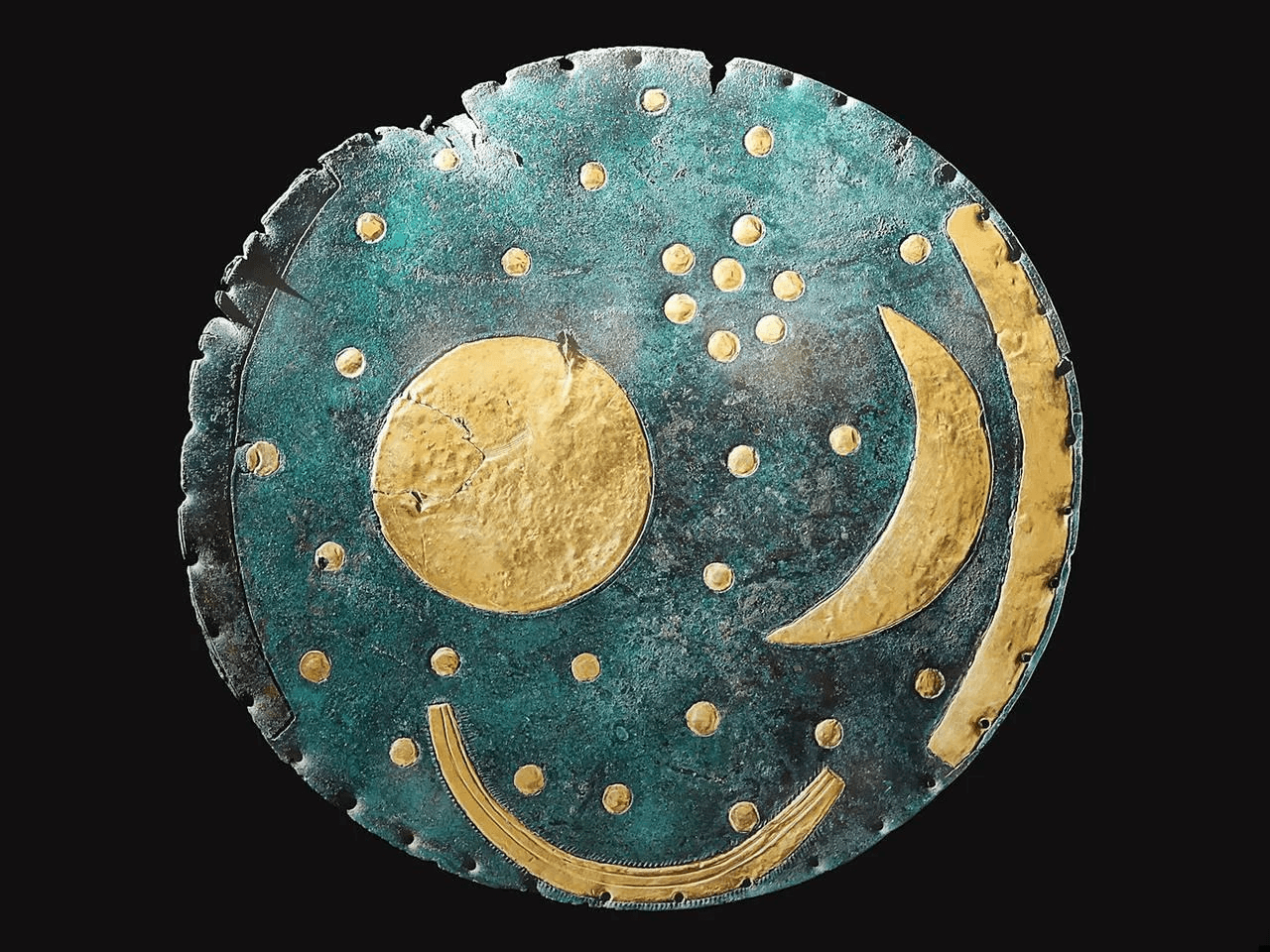
The Nebra Sky Disc: A Bronze Age Masterpiece of Astronomy and Metallurgical Ritual
The Nebra Sky Disc is an archaeological artifact from the Early Bronze Age (approximately 3,600 years ago) discovered in Germany. The disc was unearthed in 1999 on Mittelberg Hill near the town of Nebra in Germany, alongside swords, axes, a chisel, and spiral bracelets. Measuring approximately 31 cm in diameter and just a few millimeters thick, the disc is adorned with gold inlays representing celestial bodies such as the sun, moon, and stars, including the cluster known as the Pleiades. The disc represents the earliest recorded depiction of the astronomical sky in human culture, reflecting the advanced astronomical knowledge of the Únětice culture, which flourished in Central Europe during that era.A recent study published in Scientific Reports traces the manufacturing process of the disc, revealing a level of sophistication in its creation that challenges the notion that this culture was less advanced than the supposedly more “developed” civilizations of the known world at the time. The process involved a combination of casting, forging, and heat treatment—far more complex than the use of simple tools. This indicates exceptional technical expertise and advanced metallurgical knowledge. Unlike the functional artifacts found alongside it, the disc has no practical utility, yet its production required immense effort, suggesting it served cultural or spiritual purposes. The disc also demonstrates astronomical understanding, with some researchers proposing that it was used to create a calendar, while others argue it was a ritualistic object dedicated to celestial worship.
Whether or not the culture was advanced compared to others, the disc provides evidence of metallurgical ritual, implying that its creator was likely a “technological priest,” with the production of such an artifact holding religious significance.
Mythologies worldwide are filled with references to such technological priests. For example, Hephaestus forged Zeus’s thunderbolt and Achilles’ shield. Zeus, the god of the skies and ruler of the cosmic order, was specifically associated with the planet Jupiter. According to the Iliad (lines 18.478-608), the outer circle of Achilles’ shield depicted the heavens, the sea, the earth, the moon, and the stars.
In various ancient cultures, such as Mesopotamia and Egypt, metalworking was often linked to astronomical and astrological rituals. For instance, the seven planets were associated with seven metals: the sun with gold, the moon with silver, Venus with copper, and so forth. This analogy reinforced the sacred and cosmic significance of metallurgy in these societies.
-
The Soma/Ayahuasca analogy
I apologize in advance for writing a book review about a book I haven’t actually read. The book in question is The Tawny One: Soma, Haoma, and Ayahuasca by the British scholar Matthew Clark (from the University of London). Unfortunately, I couldn’t get my hands on this book (even though it’s available on Kindle for $18). What I’m writing here is primarily based on reviews I’ve read and an article Clark published in 2019 in the Journal of Psychedelic Studies, which was released after the book (published in 2017) and likely covers the same topics, perhaps even more extensively.
Clark’s main claim is that soma/haoma, the ritual drink of Vedic and Zoroastrian religions, was not derived from a single plant, as previous theories suggested, but rather was a mixture of psychoactive plants. He compares the drink to ayahuasca from South America, which combines MAO inhibitors with DMT-rich plants, and argues that soma/haoma functioned as an “ayahuasca analogue.” Clark proposes that this mixture was intended to produce psychedelic experiences in religious rituals, highlighting the physiological, cognitive, and spiritual effects of the plants.
While earlier research tried to identify soma/haoma as a single plant, such as ephedra, Amanita muscaria, or even cannabis, Clark shifts the discussion by proposing a multi-plant approach. He relies on textual evidence from the Vedic and Avestan scriptures, which suggest that soma/haoma was described as a drink prepared from various plants. This approach resolves contradictions found in previous attempts to identify the “real” plant behind the drink.
Another innovation in Clark’s work is his comparison of soma/haoma to rituals in other cultures, such as ayahuasca in South America and the kykeon in Greek mystery rites. Clark argues that psychedelic experiences were central to religious rituals across the ancient world and that soma/haoma was part of this global tradition. According to him, similar botanical knowledge was likely available in Central Asia during the Bronze Age.
Vedic accounts describe soma as a drink made from stems with nodes (parvan), which were crushed and dissolved in water. Clark emphasizes that in both the Vedic and Avestan corpora, soma/haoma is occasionally described as having “many kinds,” strengthening the multi-plant hypothesis. To demonstrate the possible connection to ayahuasca, Clark shows that plants like Syrian rue (Peganum harmala) and Desmodium gangeticum could provide similar psychedelic properties. He also mentions that some grasses, such as Kuśa, might have served as DMT sources, while MAO inhibitors could have come from plants like Tinospora cordifolia.
The ayahuasca analogue hypothesis represents a significant shift in the discussion around soma/haoma, moving from the identification of a single plant to examining plant mixtures. Although this hypothesis is not definitively proven and remains controversial, it offers a broader framework for studying the roles of psychoactive plants in religious rituals. The critiques of this analogy focus on its reliance on comparative culture rather than deep textual interpretation, and its comparisons are seen as culturally irrelevant to India and Persia. Additionally, the lack of comprehensive chemical research on the mentioned plants limits the ability to substantiate his claims conclusively. And yet.
-

The sacred bee
Bees have inspired mystery due to their unique way of life within the hive. They live in complete darkness, and much of their activity remains hidden from human eyes. Even today, with advanced technologies, our understanding of the inner workings of the hive is limited. This sense of mystery is heightened by the perception of the hive as a kind of “inner sanctum,” inaccessible and shrouded in secrecy, where wondrous processes unfold.
Bees are seen as mediators between the material and spiritual worlds. Through their movement from flowers to the hive and their ability to transform nectar into honey, they symbolize a journey from the pure to the tangible. In various mythologies, the buzzing of bees was likened to the voices of souls, and they were regarded as messengers bringing knowledge from other realms. In Welsh culture, for example, bees were considered direct envoys from paradise.
Bees have also been associated with wisdom due to their unique traits and contributions to humanity. In Greek culture, bees were considered “the birds of the Muses,” bestowing the gift of speech and eloquence. A famous legend tells of bees settling on the lips of the infant Plato, symbolizing his future eloquence and divine wisdom. Their organized lives and industriousness were seen as exemplary models of intelligence and skill, serving as inspiration for humans.
Bees and honey were also symbols of purity, owing to their exceptional qualities. Honey, which does not spoil, was used in embalming rituals, healing, and as offerings to the gods. Bees themselves, as creatures that do not disturb the ground but rather hover above it, reinforced their spiritual status as pure and untainted beings. Beeswax, used to create candles for temples and churches, further emphasized their connection to divine light and purity.
All these impressions, drawn from observations of bees’ behavior, transformed them into sacred entities, and their products became consecrated and used in rituals. For example, in ancient Egypt, honey was central to the “Opening of the Mouth” ceremonies, during which mummies and statues were fed to symbolize the soul’s journey to the afterlife. Beeswax was used in temples for rituals of light and purity. Christianity carried on this tradition, employing beeswax candles in all religious ceremonies.
In Greek and Egyptian mythology, honey was considered divine nourishment that contributed to the lives and strength of the gods. The belief in bees and honey as tools for connecting with the divine is also evident in shamanic rituals and beliefs about healing and prophecy. In Greek mythology, nymphs fed Zeus honey during his childhood, saving him from Cronus. Honey also appeared as the drink that tricked Cronus into regurgitating his children, enabling Zeus to seize control of the world and establish a new order. In Egypt, Ra’s tears were said to transform into bees, reinforcing their connection to the divine. These and other stories imbued bees with a mythic significance of life preservation, healing, and the establishment of a cosmic order.
According to the new book by Mor Kadishzon, "A Trip to the Hive, A Cosmological View of Bees and Humans" —now published by Magness press.
-
The Case for Religious Use of Psychedelics: Beyond the Medical Model
Dr. Paul Ryder, founder of the Congregation for Sacred Practices (CSP), writes in an article for Lucid News advocating for the adoption of the religious model over the medical model when engaging with psychedelics.
The medical model focuses on reducing symptoms in conditions such as depression, anxiety, and PTSD, reducing psychedelics to a limited clinical role while overlooking their spiritual and communal potential. In contrast, the religious model integrates dimensions of sacredness, community support, and connection to nature, enabling a deeper form of healing than what a sterile clinical environment can offer.
The religious model is also more accessible. The high costs associated with the medical model often prevent vulnerable populations from accessing it. In the religious model, there are no such barriers. Under the Religious Freedom Restoration Act (RFRA) of 1993, individuals interested in joining a church that incorporates psychedelic sacraments can do so without restriction. Furthermore, religious use emphasizes community and mutual support, unlike the medical model, which focuses on the individual patient and often exacerbates feelings of isolation.
-
The Evolutionary Impact of Agriculture: Vitamin D, Lactose Tolerance, and Genetic Adaptations in Early European Societies
Late-night thoughts, and I apologize in advance to those more knowledgeable in nutrition, seeking tips and corrections. From what I've read, the transition of European society from nomadic hunting to agriculture contributed to genetic changes manifested in lighter skin and lactose tolerance. I understand this is related to the amount of vitamin D in the farmers' diet and the fact that Europe has cloudy and wintry weather, leading to less sun exposure. To compensate, presumably by chance, the further north and closer to the sea, the more the European economy became dependent on fatty, vitamin D-rich fish.
The shift to agriculture significantly changed the lifestyle and genetic characteristics of the European population. This effect could have been even more pronounced if not for the passage of time and the intermingling of European populations, which softened the impact of genetic drift. Nevertheless, these genetic changes can still be identified, as demonstrated by the research published in Nature Magazine.
Agriculture allowed people to settle in fixed locations, establish villages and cities, and develop complex communities. Instead of relying on hunting and gathering, farmers cultivated grains, legumes, and domesticated animals, leading to a carbohydrate-rich diet. However, their reduced reliance on hunting and meat consumption led to decreased sources of vitamin D. To compensate, they began consuming dairy products. The human body is tolerant to lactose only in infancy, with tolerance diminishing thereafter. Those who continued to consume milk needed favorable genes enabling "lactase persistence". Genetically, populations with a shortage of animal products, especially during times when the land did not yield sufficient crops, turned to dairy products. Those who managed to adapt and survive developed this tolerance.
There are two types of vitamin D: animal-derived (D3) and plant-derived (D2). Plant-based vitamin D tends to break down more quickly, making animal-derived vitamin D more effective in raising and maintaining blood vitamin D levels. Milk, being an animal product, contains more vitamin D than the "poor" diet of plant-based agriculture. However, dairy products naturally contain less vitamin D than meat, so even those who consumed dairy still suffered from vitamin deficiency.
To compensate for this deficiency, the body began developing lighter skin pigmentation to allow more efficient vitamin D production under reduced sun exposure. Melanin, the pigment responsible for skin color, acts as a filter for UVB rays from the sun. In darker skin, higher melanin content reduces UVB penetration, decreasing vitamin D production. Conversely, lighter skin has lower melanin content, allowing more UVB penetration and increased vitamin D production.
In these regions, the cold climate led to clothing covering most of the body, further reducing sun exposure. This caused people in colder areas to become even lighter than the "default" lightness.
Vitamin D plays a central role in the proper functioning of the immune system. It helps regulate immune cell activity, contributing to an effective immune response. Vitamin D deficiency can weaken the immune system, increasing susceptibility to infections and diseases. Agriculture introduced new diseases, and vitamin D deficiency made the population vulnerable, leading survivors to develop special immunity to these diseases. This immunity likely developed with the onset of agriculture and was influenced by genetic drift, where diseases claimed many who hadn't developed immunity, leaving a population with a higher frequency of "resistant" genes.
I pondered whether there's a connection between blood vitamin D levels and tolerance to psychoactive substances. The only finding is that those with vitamin D deficiency develop intolerance to opioids, increasing pain sensitivity and leading to higher consumption of painkillers. However, there's no evidence linking agricultural society's diet to opium addiction, and generally, no indications of widespread opium addiction in antiquity, despite awareness of its excessive use dangers. Had I found any evidence, I might have speculated whether the nature of rituals and the quality of substances used were related to dietary habits. But that's advanced knowledge. Besides, the use of psychoactive substances was prevalent, according to hypotheses, long before humanity turned to agriculture.
My reason for contemplating this topic is to examine whether the chronic deficiency of vitamin D had any mental or cognitive effects on people and whether this led them to seek “remedial” solutions. There are, of course, studies that support this notion. For example, the well-known research on depressive individuals in the Arctic Circle who experience prolonged periods without sunlight during the months when the sun doesn’t rise. It is also known that people with vitamin D deficiency have a higher susceptibility to schizophrenia and other mental illnesses. The question remains whether there is a link between vitamin D levels in the blood and tolerance to psychoactive substances, and, more broadly, whether there is a circumstantial connection between the development of religion and the changes in human lifestyle. This is the thread of my thoughts. -
Kuntillet Ajrud as a tree worship site
Kuntillet Ajrud, located in northeastern Sinai approximately 50 kilometers south of Kadesh Barnea and about 12 kilometers west of the ancient desert trade route Darb el-Ghazza (the Gaza Road), is considered a unique archaeological site due to the array of extraordinary findings discovered there. Excavated between 1975 and 1976 by archaeologist Ze’ev Meshel, the site's structures are dated to the 8th century BCE. The presence of a sanctuary suggests it hosted Israelite worship, but its specific purpose remains a subject of scholarly debate. Some argue that the site was not particularly unique but rather served as a caravan station managed by agents of the Kingdom of Israel, potentially collecting taxes or offering travelers a place to rest and pray in its sanctuary. However, the site’s layout and the findings within it do not fully align with the characteristics of a typical caravanserai, as indicated by the relatively small number of cooking vessels discovered and the abundance of inscriptions with religious content. These features suggest the site held greater religious significance.
In the absence of a definitive explanation, the site remains enigmatic, with its primary importance lying in references to the worship of Yahweh alongside his consort Asherah. This is notable given Yahweh’s association with monotheistic worship that condemns Asherah. The inscriptions have led scholars to suggest that the site reflects a period of syncretism, where Yahweh was still seen as having a consort, and her worship had not yet been stigmatized.
Nadav Na’aman offers an alternative explanation for the presence of Asherah at the site, suggesting that it does not necessarily denote a goddess or consort but could instead refer to a sacred tree representing her. This hypothesis could account for why the sanctuary was built slightly off the main trade route and may clarify the nature of the blessing inscriptions found at the site. Sacred tree worship often includes leaving mementos, such as tying threads to branches or carving graffiti-like inscriptions, both of which are well-documented in sacred ruins throughout the region and beyond.
Tree worship has been a feature of numerous cultures, including those in the Levant. The central structure at Kuntillet Ajrud lacks clear cultic implements, which aligns with the idea of Yahweh worship as aniconic (without a physical image). However, the large quantity of textile fragments and cloth discovered at the site may suggest they were used to cover a sacred tree or a ritualistic pole, reflecting practices common in ancient worship traditions. The layout of the site, including its central building where offerings and sacred items were stored, supports the idea of a cultic space where rituals were conducted outdoors near a tree or grove. Ethnographic parallels from the region underscore the longstanding use of sacred trees as focal points of worship.
The specific identity of the sacred tree, however, cannot be determined with certainty. Based on the local flora, plausible candidates include the terebinth (Pistacia), tamarisk (Tamarix), or acacia (Acacia). Worship of the terebinth is attested in the Bible and supported by archaeological evidence from across the ancient Near East, where it was regarded as a sacred tree linked to fertility goddesses. Tamarisk branches found at the site, alongside the biblical account of Abraham planting a tamarisk and invoking the name of Yahweh, further support the tamarisk’s sacred status. Abraham planted the tamarisk in Beersheba, a location that emphasizes the presence of a well in its environment. The literal meaning of Kuntillet Ajrud is "The Mound of the Wells," and it stands out in its area as a solitary water source. Could Beersheba and Kuntillet Ajrud be one and the same, and Abraham is credited for establishing the temple? The Bible describes gatherings under tamarisk trees for significant events such as royal assemblies or burials, a role similarly attributed to the terebinth, suggesting a shared symbolic importance. The tamarisk’s resilience in arid conditions and its role as a source of sustenance in the desert—possibly even the biblical manna—further enhance its plausibility as the sacred tree.
As for the acacia, it is frequently mentioned in the context of constructing the Tabernacle in the wilderness and is among the most common trees in the region. Benny Shanon’s theory linking the acacia’s psychoactive properties (due to DMT in its bark) to religious experiences offers another layer of speculation. However, no direct evidence ties acacia to the site.
In conclusion, the idea that Kuntillet Ajrud was an open sanctuary centered around a sacred tree remains a hypothesis, albeit a compelling one. The site’s combination of unique artifacts, religious inscriptions, and absence of traditional cultic implements lends weight to this interpretation, but the lack of definitive evidence leaves room for further investigation.