
-
Non monitary use of money
Why Was Money Invented? Until now, the leading theories answering this question have been the Commodity Theory and the Chartalist Theory. The Commodity Theory posits that money was created to replace the inefficiencies of a barter system. The Chartalist Theory argues that money was invented by ancient states as a tool for tax collection and economic organization. Mikael Fauvelle from Lund University in Sweden offers a new argument: money developed organically out of the need to facilitate trade between distant and culturally distinct communities, rather than as a result of state policy or internal barter systems.
The connection between these cultures was belief—not necessarily shared beliefs, but a recognition of the cultural, and even sacred, value of the objects used as money. Fauvelle presents two examples: pre-Columbian California and Bronze Age Europe. In California, shell beads served as money, while in Europe, bronze ingots played this role. Fauvelle demonstrates that these items were not only used for trade but also held sacred value, playing a central role in burial rites, rituals, and social customs. Without being recognized as sacred objects in both cultures, trade may have continued to rely on bartering. The agreement on a shared currency demonstrates mutual benefits for both sides.
In addition, Fauvelle identifies two methods that helped control the value of money and prevent inflation—practices that could be seen as monetary tools but were, in fact, rooted in cultural and religious customs. In California, shell beads, which were considered currency, were buried with the deceased. Why bury coins with a person? One might argue that it symbolized status or served as provisions for the afterlife. While this may be true and may have reinforced social structures, its primary practical role was regulating the money supply.
Similarly, in Europe, archaeological excavations have uncovered numerous bronze ingots deposited in hoards and ritual sites, such as bogs. Why throw money into bogs? One explanation is that bogs were viewed as the "dwelling places of chthonic entities" and as spaces connecting different worlds. However, this practice also served as a form of monetary contraction, effectively limiting the money supply.
-
1500 Years of Amulets against Scorpions
Amulets against scorpions have served as essential tools for protection from the dangers of nature throughout human history, especially in regions where scorpion stings were a common and serious threat. Magical traditions associated with scorpions developed from ancient Egyptian times to the modern era, adapting to the religious principles of Judaism, Christianity, and Islam. These protective tools reflected not only fear of scorpions but also the cultural and spiritual dimension of confronting a menacing natural world. Despite differences among the religions, these amulets reveal shared patterns that point to cultural continuity and repeated use of visual and textual motifs.
In ancient Egypt, the first amulets designed to combat scorpions were part of magical texts like the Pyramid Texts, which included formulas to repel dangerous creatures. Scorpions were associated not only with danger but also with protective goddesses like Selket, who symbolized healing and safeguarding. During the Hellenistic and Roman periods, Greek and Roman elements were added, such as incomprehensible magical words (voces magicae) and visual depictions intended to capture the essence of the scorpion.In monotheistic periods, the amulets were adapted to the frameworks of the new religions. In Judaism, amulets found in the Cairo Genizah contained magical techniques like the "diminishing triangle," alongside mentions of angelic names and biblical verses. In Coptic Christianity, the use of the archangels Michael, Gabriel, and Raphael was incorporated into protective amulets. In Islam, the amulets included Quranic verses and names of God, sometimes combined with practical elements like mustard seeds, considered to have medicinal or repellent properties.
Despite the differences in religious emphases, the shared principle was "like repels like" – the depiction of a scorpion in an amulet was believed to repel real scorpions. The influence of ancient Egyptian tradition is evident even in later periods, particularly through the practice of combining visual and textual symbols with spiritual power for protection.
This article begins with the description of an amulet created as recently as March 9, 1932. A young Coptic woman living near el-Badari in Upper Egypt was stung on the chest by a scorpion. A healer named Butros Salib Girgis Bahum Biyush was summoned, and he copied an amulet onto a piece of paper. The amulet depicted a large black scorpion, surrounded by text in Arabic and Coptic calling upon God to overcome the power of the scorpion sting. The text referred to the biblical promise in Psalm 91:13: "You will tread upon the lion and the cobra; you will trample the great lion and the serpent." The woman survived and lived for many more years.
However, it appears that this practice of creating scorpion amulets is far older, dating back to ancient Egypt. Although scorpions are no longer a daily threat to most people in Egypt, they remain dangerous. A study from 1994–1995 in the Upper Assiut area recorded 302 cases of scorpion stings that required hospitalization. In the past, when the population was smaller and less urbanized, the risk would have been even greater. Ritual techniques for repelling scorpions or healing their stings are found throughout Egyptian history, with the earliest examples surviving from the burial chamber of King Unas's pyramid (circa 2345–2315 BCE).
Religion and amulets fulfilled the role of protection, and in this regard, the need has not changed, which is why amulets persisted in every new religious system. In earlier times, amulets involved vague practices incorporating protective entities and charms against evil. Later, these practices were supported by theoretical knowledge of "proven" remedies. Despite this, the core function of amulets did not change significantly, apart from their adaptation to religious principles.
The only noticeable change, according to the authors, lies in the aesthetics of the amulets. In ancient Egypt, amulets were meticulously crafted with detailed depictions of scorpions, reflecting the religious and artistic worldview of the time. In later periods, amulets became visually simpler but retained their strong symbolism – scorpion depictions appeared in a straightforward manner, accompanied by texts written in black or red ink. The difference was stylistic, varying among the religions, yet the amulets maintained a functional aesthetic – compact designs intended for daily carrying, emphasizing spiritual-symbolic impact rather than artistic beauty.
-
The human origin myths of the siberian shamans
The origin myths of groups in Northern Siberia reflect a deep connection between humans and the natural world, weaving stories of human emergence from trees, animals, and birds.
Various Siberian groups believe that humans originated from trees. For example, the Evenks of Chumikan and Upper Zeya tell a story in which humans were born from a tree that split in two, producing a man and a woman. These two were covered in hair until their first child was born. Among the Negidals, humans were said to have emerged from a larch tree, while the Evenks of the Sym region tell of the mythical elk Epkachan, who opened a pine tree, revealing a singing woman at its center.
In contrast, some groups attribute human origins to animals or to unions between humans and animals. According to certain myths, humans or the first shamans were born from birds. Among the Buryats, the eagle is considered a messenger of the supreme being, said to have brought the first shaman into the world through a woman sleeping under a tree. Other myths tell of the children of a swan-woman becoming the first shamans.
The Evenks of Sakhalin and Okhotsk tell stories of human origins stemming from marriages between women and bears, a theme echoed among the Amur River peoples, such as the Udegeys. Other groups in the Amur region trace their ancestry to tigers. These myths highlight a profound relationship between humans and animals, where animals are seen as co-creators and sources of life.
Many Siberian groups believed that specific animals were either ancestral figures or spiritual relatives. For instance, the Selkups regarded the bear as a former human, while the Evenks told of a wolf who had once been an Evenk. These myths illustrate a worldview in which animals are not merely separate beings but are deeply intertwined with human origins and identity.
The bear holds a significant place in Northern Siberian myths. It is seen as a supreme being connecting the upper, middle, and lower worlds. Myths portray the bear as a visitor to the human realm and sometimes as an ancestral figure or a spouse to women whose lineage stems from it.
One story among the Evenks tells of a girl named Kheladan, who was instructed by a bear to kill him, dismember his body, and care for his remains in specific ways. She followed the bear’s instructions precisely, and the next day, a transformative process occurred: the bear’s organs turned into living beings. His kidneys became two children playing together, his head became an old man sleeping, and his intestines became an old man and woman. The bear’s fur transformed into reindeer that filled the valley, and his small intestines, hung on a tree, became reins.
This myth forms the basis for rituals such as the “Lomante”, where shamans dressed as animals, wearing their skins, hats, and cloaks to resemble them. They danced and sang, joining the “social groups” of the animal species they sought to honor. Specifically, in Northern Siberian culture, bear festivals were significant events. These festivals culminated in a ceremony to “release” the spirit of the slain bear, a practice widespread until the early 20th century. Researchers such as Hallowell (1926) and Paproth (1976) identified similar traditions from Northern Scandinavia to North America and Greenland’s Inuit.
Taken from Karl Schlesier's 1987 book "The Wolves of Heaven"
-
Singing and drumming as a technique for preserving and transmitting knowledge
The first chapter of “Shamanism and the Drug Propaganda” by Dan Russell delves into shamanism from the Paleolithic period through the Bronze Age. It includes numerous accounts of ancient rituals preserved in modern indigenous societies and many references to anthropological studies and archaeological findings. However, what caught my attention was the focus on techniques for transmitting knowledge—specifically, memorization through rhythm, song, and drumming.
The book explains that Paleolithic shamans possessed encyclopedic knowledge across various fields, including astronomy, mythology, medicine, and science. This knowledge was transmitted over thousands of years using various memorization techniques, such as singing. To illustrate the capacity for memorization through song, Russell references a much later historical example: the Iron Age. For instance, he notes that Homer was reportedly capable of reciting The Iliad and The Odyssey by heart—knowledge passed down through generations, which lends credibility to the accuracy of his versions. Similar traditions of recitation spanning centuries or even millennia are also documented in Indian culture.
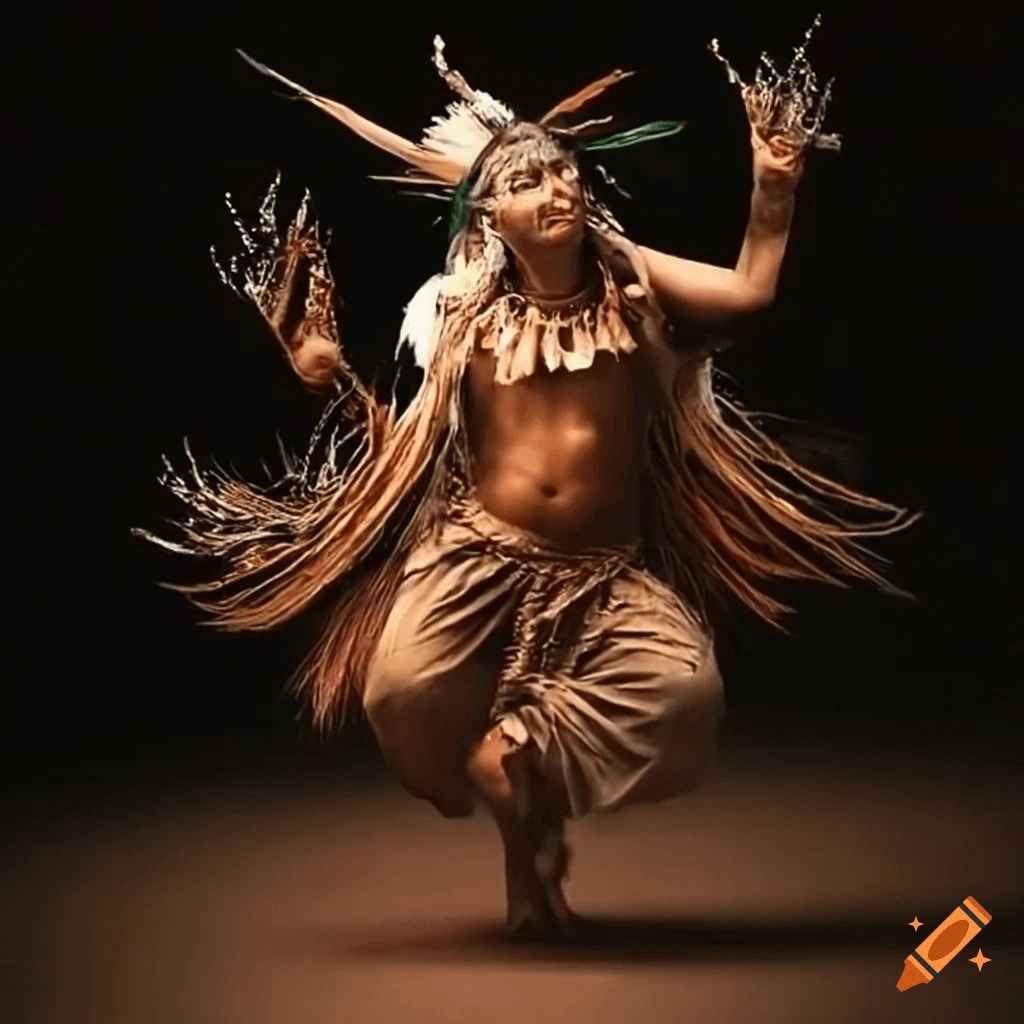
Shamans are renowned in anthropological literature for their ability to continue rhyming or chanting for up to 100 consecutive hours—an achievement beyond the capacity of most modern humans. They accomplish this through singing, a tool often credited to them as an invention that utilizes rhythmic structures. For instance, the word strophe, meaning “verse” in poetry, literally translates to “a turn,” while the word ballare, from which the word “ballad” is derived, means “to dance.” The connection between song, dance, and movement is a clear expression of shamanic ecstasy. By spinning or dancing in circles while chanting, shamans enter an “automatic” state.
Shamans also relied on drumming as a “rhythm regulator.” In fact, the word for shaman in the Eastern Algonquian Penobscot language translates to “drum sound person.” Scholars compare shamanic drumming to the rhythm of a heartbeat, noting that the frequencies of shamanic drumming match the brain’s theta rhythms—EEG waves associated with creativity, extraordinary problem-solving, vivid imagery, and lucid dreaming. Shamans themselves say, “The drum is our horse.” The term shaman, meaning “spirit person,” reflects this process, as the shaman in an automatic state “invites the spirits to enter their body” or “merge with their own spirit.” Mircea Eliade defined shamanism as “an archaic technique of ecstasy,” precisely because shamans discovered practices that allow them to “ride the wave.”
So, if you’ve been looking for theoretical background to support a post I once wrote about the singing techniques of ancient blacksmiths—based on Dr. Nissim Amzallag’s idea in his book “Zamru Maskil”—here it is. This technique was not invented in Canaan but has been used since ancient times for preserving and transmitting knowledge.
-
Dan Russell’s, Shamanism and the Drug Propaganda
New on my bookshelf: Dan Russell’s book, “Shamanism and the Drug Propaganda: The Birth of Patriarchy and the Drug War.” Currently reading. It turns out this is the second book in a “series,” with additional volumes planned, as of 1998. I don't know where they are. However, it took time to figure out that this is not a new book but a reissue, new to kindle/audible. Whatever.
Dan Russell is (was) an independent scholar. I couldn’t find much information about him, but it seems he has an interest in contemporary shamanism—unless this is a different Dan Russell. I found one interview with him, but it doesn’t mention much about him personally, only that his research traces the roots of the modern drug war back to their ancient and unconscious origins. According to Russell, the drug war is a psychological inheritance from ancient times, one that has become a deeply embedded component and sometimes the driving force of modern culture, which is based on power and profit.
Over time, Russell argues, the stories told by ancient cultures were exploited, distorted, and leveraged by forces aiming to create a conformist culture. Modern industrial culture, he claims, depends on erasing conscious knowledge of psychoactive plants. Historical manipulation of archetypal symbols served to destroy the cultural memory of ancient shamanism, leaving only emotions and irrational attitudes dictated by authoritative forces.
The book examines the history and psychology of shamanism and its influence on human culture, drawing on archaeological findings and theories by mythologists such as Mircea Eliade and Carl Jung. According to Russell, as societies transitioned to patriarchal and utilitarian structures, shamanism began to be suppressed, a trend visible as early as classical antiquity and ancient Greece. The roots of the drug war lie in the shift from tribal cultures, where the use of psychoactive plants was central to spiritual and communal life, to industrial patriarchal societies aimed at ensuring control over individual and collective consciousness.
-
South Texas' shortage of sacred psychedelic drug impacts Native American Church
The Native American Church is facing a severe shortage of the peyote plant, which is central to its spiritual ceremonies, due to over-harvesting, land development, and the global rise in demand for psychedelics. The issue is further exacerbated by the expanding market for psychedelic plants used for healing and spiritual purposes. To address the crisis, the church is working to establish a peyote preserve in Texas in collaboration with the Riverstyx Foundation, aiming to conserve the plant under Indigenous management. Additionally, it is seeking a $5 million federal grant to protect peyote in its natural habitat. While the initiative seeks to ensure the continuation of spiritual traditions, it has also raised concerns among members who question the motives behind external philanthropic support. The primary concern is that the philanthropic intentions of the foundation may not align with the values and interests of the Indigenous community. Some members wonder if the foundation is genuinely committed to cultural and spiritual preservation or if it has hidden agendas, such as future access to the psychedelic market or influence over the preserve’s management. This apprehension is rooted in a history of external interventions that have often undermined Indigenous interests, fostering a desire to maintain independent control over the conservation process and decisions about the plant’s and tradition’s future.
-
Filled With 200 Skeletons, Mexico's Sacred Cenote Was A Gateway To The Gods
The “Sacred Cenote” is a water-filled sinkhole and a unique archaeological treasure. Its depths have revealed approximately 30,000 valuable artifacts, including gold, copper, and precious stones, as well as the skeletal remains of at least 200 individuals. Many of the victims were children, highlighting the site’s ritual significance. The artifacts and remains were deposited as ceremonial offerings, based on the belief that the cenote was a “gateway to the gods.” Previously, it was thought that the sacrifices involved primarily young women, but archaeological findings present a more diverse picture, including men and children. Isotopic analysis of bones and teeth from the cenote indicates that the victims originated from various parts of Mexico and even beyond, emphasizing the site’s importance as a pilgrimage destination. The artifacts found there suggest extensive trade networks that reached far beyond traditional Maya regions. The presence of gold, which is typically rare in Maya findings, points to broad cultural connections.
As I have previously written, the sanctification of the cenote and its perception as a connector between worlds are linked to its unique geological formation, characteristic of karst regions like the Yucatán Peninsula. Subterranean acidic waters dissolve limestone over time, creating massive caves that eventually collapse. These sinkholes fill with rainwater and groundwater, often becoming the sole water source for local populations. Beyond their practical importance, the idea of an opening to the underworld was highly compelling to societies with pre-scientific and primitive worldviews. previously.

-
psychedelics are "elephant in the room" in sacred Jewish text
Rabbi Harry Rozenberg—I’m not sure if he can be crowned as a prominent Orthodox voice in psychedelic Judaism, but his name is certainly familiar. He frequently speaks up on every platform available, claiming that psychedelics are an integral part of Jewish tradition. He argues that many stories in the Torah can be interpreted as involving the use of psychedelics to enhance religious and spiritual experiences. Here’s yet another platform where he makes his case: CBS. In the interview, he mentions twice the DMT found in the acacia tree. According to him, “The psychedelic experience is ‘the elephant in the room’ in the Jewish narrative—a central theme that has remained hidden in the scriptures and tradition for many years.” Rabbi Rozenberg operates an organization called Trippy.vc, where he promotes research and legal use of psychedelics. The article also interviews Meir Kay, a social media personality and founder of AhDaMa, who organizes empowerment circles for Jewish men aimed at self-discovery and reconnection with tradition and spirituality. In these gatherings, Kay incorporates holotropic breathing techniques, which allow participants to experience altered states of consciousness, also facilitated by the natural release of DMT in the body.
-
Biblical Poetry as a Shamanistic Technique
Technopheisis, as Dr. Nissim Amzallag discussed, I once defined as the way of using science as an entheogen, as a generator of religious experience, and essentially as a tool for spiritual elevation. But there is a very specific type of technology that demonstrates this technopheisis perfectly—the technology of language—and the way in which it is refined is through poetry. One of the strategies of poetry, which Dr. Amzallag claims was used as a true entheogen, is what he calls “The Song of the Enlightened” ("Maskil"). That is, the spiritual practice of the ancient poets to elevate themselves was to perform wordplay and compose poetry. Through this technological demonstration of language or through the linguistic innovations that emerge, the worship was expressed. This is what is called “Sing to the Lord a new song”. Language is essentially “a word”, "a logos", and through the word, God created the world. When refining the word, one employs the technique of creation, effectively entering the grand circle of “the creators”, becoming participants in creation. This act is equivalent to a sacrifice or prayer. Prayer is essentially a word spoken with enthusiasm, the very experience achieved through the art of the word.
The Song of the Enlightened is essentially a term for a specific type of song, which can be read in multiple ways: both in a synchronous manner and in a “transformed” manner. This involves applying a certain transformation to some of the lines—typically a shift of several verses, symmetry, or structural tricks—and as a result, the song gains an additional layer of meaning beyond its original. This layer often enriches the song but may sometimes even provide a deeper interpretation of it. Amzallag presents this technique of poetry as a mystical tool for serving God, as frequently described in the Bible in terms of song and melody. This is also the title of his book in which he argues these points, “Zamru Maskil” ("sing the song of the enlightment").
The reason it is called Maskil is, as mentioned, because it performs a “switch” (sikul), which Amzallag interprets as “a tying or connecting of things in a way incomprehensible to it”. It might be understood as “rearrange” or “swap”, but the idea is primarily that this process is simultaneously cumbersome and elegant. Through the awkwardness, an elegant and innovative solution emerges—a metaphor for death (awkwardness) and rebirth, which is also an upgrade and refinement of the previous version of life.
The elegant form of resolving the awkwardness is wisdom, and this essentially explains the etymology of the word “Sechel” (wisdom). A delightful wordplay is that by changing just one letter, the word reverses its meaning, and it’s not even a full letter—just a slight nuance. Sechel in its positive sense means wisdom, while Sachal in its negative sense means foolness.
And not only this “switching” of the word but also when swapping letters: Sechel implies a positive result, while Keshel implies a negative result. Alternatively, when the tongue shifts slightly forward from the Sin (i.e a light Shin) to the teeth, it forms Tikhl (associated with failure/Keshel or bereavement/Shchol). In both cases, the minor shift changes the meaning entirely.
The reason I mention the word Tikhl is twofold. Ultimately, I want to connect it to the Psalm Maskil in Psalm 74, which includes the verses: “You shattered the sea with Your might; You broke the heads of the sea monsters in the waters”, which I believe references the myth of the primordial war between the god and the sea monsters, and the act of crushing snail shells in the production of the tyrian purple and blue dyes. This is particularly because “Porarta” (crushed) is a homograph and homophone of the word “Porphyry”, meaning purple. According to Michael Astour, parur means cauldron, referring to a dark color between red and black, as in the verse, “Before Him nations writhe, all faces turn red”—their faces “redden”. Red, in ancient language, was one of the terms for the color purple. In my view, this is the interpretation of the word techelet, from the word tikhl. But I wish to discuss this in another post.
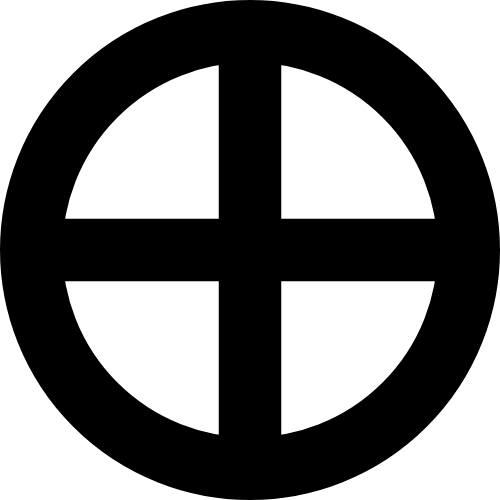
For now, I want to focus on what is called “the solar cross”, and primarily on the symbol of the cross, which in ancient Hebrew script, and even in its earliest form, the Proto-Sinaitic script, symbolized the letter Tav. It is often explained that the “sign” (Tav) described in the New Testament is a cross marked on the forehead, similar to the way slaves were branded in ancient times. That is, this cross is simply a “mark” or “sign”. But just as the other letters represent the first motion of the word they symbolize, it can be said that this cross representing the letter Tav is the first letter in the word Tikhl or Sechel. In other words, the meaning of the letter is this switching, the blending of things, the awkwardness that culminates in wisdom. That is, the last letter in the script system, symbolizing the end—literally—is like the “Omega Point”, a kind of goal to be reached: wisdom. This is the meaning of the solar cross in Gnosticism. The Gnostic cross serves in Gnostic sects as a symbol of secret knowledge.
In the story of the Tower of Babel, God says, “Let us go down and confuse their language, so that they will not understand one another’s speech”. Through the confusion of language, God, ostensibly, caused people not to understand each other’s language. The question is whether the sole meaning of this is that He made them unable to understand one another’s language—or perhaps the intent was to encrypt the language, and the misunderstanding was, in fact, a form of foolishness. Specifically, those who manage to bring order to words are the ones who understand. Poets achieve this through the mixing of words. It is precisely through this blending that they achieve the opposite effect: the antidote to confusion. Poets are the revivers of language because they use “The Song of the Enlightened”.
Particularly fascinating are the letter rearrangements and wordplays used in the story of the Tower of Babel. What the people say to one another is, “Come, let us make bricks and bake them thoroughly”, using the words "Nilbena levenim", The bricks become a substitute for stones ("Levena le'aven"), and the clay serves as mortar. What God does to them is confuse their language using the verb “Navlah” (“confuse”). Here, we see a rearrangement of letters, where changing the order of the letters transforms the meaning of the word. Lavan (white) refers to the color of light, while the burning in fire, through “whitening with light” ("Libun", "Nilbena") results in blackness. Naval, at least according to the Book of Proverbs, refers to a fool—“A foolish child is a grief to his father, and a foolish man does not rejoice his parent”, while proverbs is using the hebrew word of "Naval" and "Ksil". Its opposite is therefore the enlightened "Maskil", the righteous, the wise, who hold onto light ("Or"while fire is "Ur"). As Proverbs states: “The light of the righteous rejoices, but the lamp of the wicked will be extinguished. Pride breeds quarrels, but wisdom is found in those who take advice.” The righteous hold onto light and offer wise counsel, while the wicked’s light dims because they offer malicious counsel.
The process of transmitting knowledge, discovering it, and holding onto it are all etymologically linked to the root “or” (light). Knowledge itself is called “Torah” (instruction), its transmission is called “hora’ah” (teaching), and its possession and use are called “or” (light). As stated in the verse: “For the law ('torah') will go out from me, my justice will be a light ('or') to the nations”, and “The commandment is a lamp, the Torah is light, and reproofs of discipline are the way to life”.
In religious thought, the sun symbolizes the source of life, creation, and wisdom. Immediate examples include Ra in Egyptian mythology and Apollo in Greek mythology, who specifically was both a musician and a prophet. Apollo led the Muses, who were patrons of music, poetry, and dance. As we see in the Bible, too, the sun is a source of wisdom.
The sun brings two energies: light and heat, both of which are associated with wisdom. Amzallag attempts to channel this fact by pointing out that through heating with fire, also called “ur” (light), metals can be inflated and forged. He attributes the wisdom of metalworking to the Edomites, among whom we find the names Korach and Zerah—musicians (the Levites, sons of Korach) and poets (the descendants of Zerah) in the Temple. At the center of the Temple stood the fire altar, with its eternal flame, and the menorah, with its perpetual light. The altar was made of metal (bronze), and the menorah was made of metal (gold). There is also a golden altar. The differences between the metals depend on their placement in the Temple.

Regarding light: refracted light is characterized by a sparkle that appears in perpendicular rays. This depends on the surface shape of the material, the angle of observation, and, of course, exposure to light. Specifically, metallic materials have a natural shine and light reflection, so when light strikes them, it refracts and appears like the shape of a solar cross. This is another reason why this symbol of breaking the order is associated with light and the sun.
The menorah is essentially a “small sun” as it is a source of light. The Bible as a whole is a metaphor for acquiring Gnostic knowledge, a sort of “myth of wisdom” that tries to explain metaphorically that the entire world is a blurred image. To understand what is truly seen, one needs “special glasses,” or that the world is a dark room that requires a special lamp to navigate. Therefore, it was important to provide the target audience of the Scriptures, those who read them and use them for elevation (an entheogen in itself, especially when in poetic form), with imagery of light.
In biblical poetry (and prose), there are psalms constructed with artistic structures. In some cases, there are chiastic parallels. In others, there is a symmetrical structure with seven verses: three pairs of parallel verses surrounding a central verse, known as a “menorah” structure. Sometimes these pairs themselves are chiastic, creating perfect symmetry. Sometimes this menorah structure consists not of seven verses but a multiple of seven—such as 15 (7 + 7 + 1). The important point is that we see numerological and symmetrical structures around the number 7, combining poetry, linguistic tricks, and specific contexts tied to the myth I describe. It aligns with the idea that extensive parts of this mythic narrative are organized in what is called “menorah structure”, including the creation of man, the sin with the Tree of Knowledge, the story of building the Temple in the Book of Kings, and so on. The Book of Psalms itself includes several “Maskil” psalms constructed as menorahs, which were likely used in their chanted reading, as call and response, accompanied by music and dance as a technique for spiritual elevation.
At this point, I return to the wordplay appearing in the context of the Tower of Babel. The poetry was accompanied by music played on an instrument called the "nevel", which rested on the “kislayim”, meaning on their hips and waists. Thus, the wordplay extends to the scenery of the entheogenic scenario of poetry—not only within the poetry itself or its essence.
As a side note regarding the “Sun Cross” symbol and its connection to wisdom through practical technology—specifically metallurgy in ancient times—one might mention Robert Graves’ theory that the Cyclopes were a guild of Bronze Age smiths. According to Graves, their defining feature was a tattoo of a ring or circle on their foreheads, and they worshiped the sun as the source of life energy.
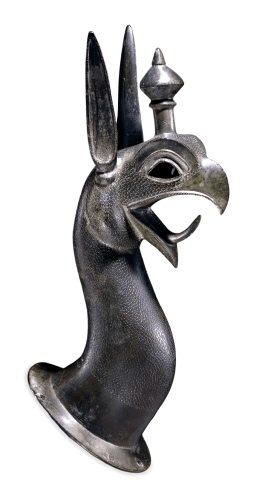
In Nissim Amzallag’s book The Copper Revolution, there is a reference to Claude Frédéric Armand Schaeffer’s work Ugaritica II. Schaeffer, who led the excavation team at Ugarit, describes a depiction of a smith with a symbol resembling the Sun Cross on his head. Unfortunately, I have not been able to access the book myself, but Amzallag claims this depiction exists. Amzallag further suggests that the “Mark of Cain” was essentially a tattoo of the Sun Cross. He also asserts that a protome of a griffin adorned with a copper sphere on its forehead, displayed in the British Museum, inspired the practices of the Telchines of Rhodes. The Telchines, according to him, were another guild of smiths identified by a copper ball strapped to their heads with bands. Does this remind you of tefillin?
In the Egyptian context, we have the Eye of Horus, the Wedjat, considered a symbol of wisdom and protection (similar to the Mark of Cain, and in a different way, tefillin or the High Priest’s frontlet—a form of apotropaic symbolism). The Eye was associated with the Sun God and depicted as a symbol with a curved adornment beneath it, said to represent a falcon’s feather. Why a falcon? Because birds of prey possess extraordinary long-distance vision, and some are nocturnal predators capable of seeing in the dark. Hence, the owl became the symbol of Athena, patron of smiths. Similarly, Amzallag argues that the Edomite deity (whose nature as a deity remains uncertain) was called Kos, a name linked to the owl, the bird also associated with Athena.
Although the owl has a round pupil, its nocturnal vision captured the ancients’ imagination. This ability allowed such creatures to utilize the property of sunlight—vision—even in the absence of the sun. Animals with night vision often have uniquely shaped pupils, like the slit-shaped pupils of felines and, interestingly, snakes—an animal with clear metallurgical associations.
Thus, one could draw a parallel between the Sun Cross and this distinctive pupil shape, functioning as an aperture or diaphragm.
-
Was the Jerusalem temple originally pagan?
A structure spanning an area of 220 square meters, containing eight rooms, has been uncovered in the Jerusalem Walls National Park. The structure includes an altar, a standing stone (matzeva), and even a wine press. In one of the rooms, a mysterious V-shaped carving was found on the floor. A new article published this week in the Atiqot journal by the Israel Antiquities Authority suggests that the structure served ritual purposes during the time the Temple stood on the Temple Mount, just a few hundred meters to the north. It appears the structure was in use until it was suddenly abandoned and sealed off, possibly due to Hezekiah’s reform, which centralized worship in one place—likely the Temple Mount itself. This raises the question: why would there have been multiple sanctuaries in such close proximity?
One hypothesis is that the structure served as a temple for a deity other than Yahweh. Why else would two sanctuaries for the same deity be needed so close to each other? If this is true, it forces us to acknowledge the polytheistic nature of Judah at that time. While it is known from the Bible itself that idol worship occurred in Jerusalem, it is unclear whether this polytheism was a deviation from a monotheistic norm or whether the kingdom started as polytheistic and only later transitioned to monotheism. Below, I present several hypotheses that might suggest the latter scenario.
In parallel cultures, “sacred complexes” were common, both due to the unique topography of specific sites and because these places had multiple patrons. Immediate examples include Delphi, Olympia, and Knossos—all complexes featuring sacred mountains, springs, various altars for different gods, monuments, and social institutions. This doesn’t necessarily mean there was a direct connection between the rituals, but it sets a precedent. Typically, the head of a pantheon was worshipped alongside his consort. For example, in Olympia, there were temples for both Zeus and Hera. Why, then, could there not be one temple for Yahweh and another for his consort, Asherah, in Jerusalem?
Sacred mountains also exist in Israel, and many feature sanctuaries, some with sacred caves and springs. In fact, the combination of a tree, cave, spring, and mountain is common in pagan sanctuaries that were later adapted to monotheism. Examples can be found near the sources of the Jordan River and in the Galilee (e.g., Banias, Mount Meron, and Arbel). What sanctifies such natural features is their distinctiveness in the landscape. These “unique” sites often retained their sacred status in later religions due to continuity from their pagan past. Monotheistic religions sanctified these places with narratives denying their pagan roots, but often the myths surrounding monotheistic figures are based on older, pagan myths. This likely happened in Jerusalem as well, making the discovery of such a temple a potential revolutionary insight.
In the case of Jerusalem, there are several natural phenomena that hint at pagan worship, particularly in the so-called “Holy Basin” area. One example is the Gihon Spring. Evidence suggests that pulsating springs were considered sacred, with beliefs that their pulsations were caused by entities residing within, drawing the water in and releasing it. The Temple Mount features the Foundation Stone, regarded as the “navel of the world,” akin to the omphalos at Delphi. Beneath it lies a cave: the Well of Souls. Let us return to this shortly.
Is there archaeological evidence of activity in these locations predating the Judahite period? In short, no. Due to the sensitivity of the Temple Mount, and the tangible dangers faced by archaeologists investigating the site, no conclusive research has been conducted. The only significant investigation was carried out by Montague Parker, who barely escaped with his life. He followed earlier excavations by Charles Warren in areas like Warren’s Shaft in the City of David and the Gihon Spring, where Bronze Age settlement remains were found. While this doesn’t prove anything definitive, it hints at early activity in a location suspected of prior sanctity.
Parker aimed to uncover the Ark of the Covenant. To this end, he secured access through bribes to excavate the Well of Souls. The limited findings he brought back led some scholars to speculate that the site housed a Jebusite temple predating the First Temple. However, Parker’s presence was discovered, and an enraged crowd nearly lynched him. He escaped by sheer luck, and no one has since dared to explore the idea further. Excavations at the Temple Mount have primarily been destructive, erasing evidence of pre-Islamic or pre-Judahite sanctity. It is possible that deeper evidence remains undiscovered, but such findings are unlikely ever to come to light. Thus, we must focus on what has already been uncovered. For example, some hypothesize that the cave was a Jebusite temple or a sacred burial site. Similar caves have parallels in sacred complexes like Knossos.
In Crete, two famous mountains feature sacred caves. Mount Ida houses the Psychro Cave, where infant Zeus was hidden from Cronus, who sought to kill him. To mask the infant’s cries, a group of dancers called the Kouretes performed war dances in a trance outside the cave. Similar dances appear in other Earth Mother cults, like Cybele’s, though for different reasons. Another notable mountain is Mount Juktas near Knossos, said to be the burial site of Zeus. From a distance, the mountain resembles a reclining man, representing Zeus’ image. However, Zeus is both buried and resurrected—a motif reminiscent of Jesus, possibly hinting at a connection between Knossos and Jerusalem.
On Mount Juktas, a king of Crete, known as the Anax, was said to retreat annually for solitude. This tradition recalls King Minos’ ascent to the mountain to “consult with the gods” The cave temple may have been the entrance to the Labyrinth, underscoring its sanctity. You can read more about the Knossos tradition in Rodney Castleden’s book The Knossos Labyrinth: A New View of the ‘Palace of Minos’ at Knossos.
The Labyrinth, as you recall, housed the Minotaur, where human sacrifices were sent. Those lost, captured, or killed there might still be heard crying for help. Incidentally, human sacrifice is associated with the Kouretes’ dances in the Ida Cave and was practiced in Crete and Jerusalem, particularly in the Valley of Hinnom.
The story of the priest-king who enters the holy of holies once a year to consult with the gods echoes the High Priest’s entry into the Holy of Holies on Yom Kippur. Thus, the Holy of Holies might itself be a cave temple or labyrinthine cave. According to a medieval Muslim belief, souls awaiting Judgment Day can be heard in the Well of Souls, as it is considered an entrance to Hell (Gehenna)—unless one associates the entrance with the Valley of Hinnom. Conversely, the Foundation Stone, situated above the Well of Souls, is regarded as the navel of the earth, a gateway to Paradise. This parallels the omphalos at Delphi, located at the center of the Pythian temple.
The High Priest’s safe return from the Holy of Holies on Yom Kippur was marked by a celebratory festival. This strongly resembles the Kouretes’ trance dances or other Greek processions. Similarly, the Simchat Beit HaShoeva (Water Drawing Celebration) during Sukkot, involving ecstatic dances, commemorated the water libation ceremony using water drawn from the Gihon Spring. Could the spring or its waters, then, not be considered sacred?
In Christianity, sacred springs are associated with the Annunciation of Jesus’ birth by the angel Gabriel to Mary. Similarly, a Crusader tradition associates the Well of Souls with the announcement of John the Baptist’s birth. In Psalm 22, an infant is described as being “drawn from the womb” ("gohi mibaten") Could the Gihon Spring symbolize a birth cave for some deity or a dwelling for a fertility goddess? We cannot know for sure.
This is the context for the theory that the temple near the Gihon Spring in the City of David was a cultic site. This interpolation leads us to speculate that the Gihon Spring is “Yahweh’s birth cave” and that the Holy of Holies is the place where He “ascended to heaven,” much like the Muslim tradition regarding Muhammad and the Foundation Stone.
In conclusion: What is the connection between Minoan culture and worship in Jerusalem? Several researchers, including Beno Rothenberg and Michael Astour in his book Hellenosemitica, have argued for a close connection between Canaan and Crete. Michael Astour claims that the Cretans were actually Canaanites who migrated to Crete, bringing their worship practices to Knossos—a name he posits is a variation of the Hebrew word “Knesset” (assembly). Beno Rothenberg suggests that the Kenites made the reverse journey, perhaps moving from Crete to Edom, and argues that there is a strong link between Yahweh and Minoan worship, as Yahweh is the deity of the Kenites.
From the fusion of these two theories—still speculative and primarily based on fragments of evidence and intriguing but questionable etymologies—it could be inferred that Jerusalem was, in fact, the origin of the worship at Knossos. Consequently, the Temple Mount might be sacred due to its shape, and the Holy of Holies could be seen as the entrance to both Paradise and Hell, as suggested earlier.