
-
Challenging Dan McClellan debunk of the Cannabis in Incense Myth
Dan McClellan is a Bible scholar who publishes videos in which he confronts misinformation about academic Bible and religion research. This time, he tackles the claim that the biblical incense included cannabis. According to McClellan, this claim is based on findings from the temple at Tel Arad and relies etymologically on the similarity between the term "kaneh bosem" and cannabis, as argued by the Polish philologist and anthropologist Sula Benet, and supposedly confirmed by Michael Zohary in his book "Plants of the Bible" in 1982, and perhaps even earlier, allegedly by a 1980 study from the Hebrew University (Zohary and Raphael Mechoulam's place). These claims are controversial and have been rejected by mainstream research. Therefore, he argues, while the idea might be reasonable and plausible, it is not proven. This is the extent of the video.
What McClellan does not mention is that the temple at Tel Arad was probably a temple to Asherah, and that worship of fertility goddesses in the ancient Near East did indeed include cannabis, similar to the worship of Ishtar in Assyria. Cannabis hot-boxing was also included in Scythian rituals and various Indo-European religious practices. The fact that the temple at Tel Arad is dated to the Assyrian period suggests that the worship there was influenced by Assyrian practices. The Bible confirms that Assyria had imperial aspirations in the region during that time, and there was a conflict in Israel between the Kingdom of Judah and the Kingdom of Israel about whether to resist the Assyrians. They even fought over it. Ahaz, King of Judah, sent a proposal of subjugation to Assyria, which proved beneficial for Judah as Assyria did not destroy the kingdom. In contrast, when Hezekiah carried out his religious reforms and abolished Asherah temples, he did so with the intent to eliminate Assyrian influence.
Hezekiah, of course, did other things that prompted Sennacherib to attack Judah. This scenario provides a satisfactory explanation, in my opinion, to infer the likelihood that cannabis was used in the worship of the Judahite Asherah, at least during the days of Ahaz, Hezekiah's father, and Manasseh, his son. It could also possibly extend back to the days of Solomon, as the description of the sinful worship during Ahaz's time (and also in the books of Isaiah and Jeremiah) applies throughout the days of the Kingdom of Judah, and of course during Solomon's reign, who is said to have sacrificed and burned incense on high places. He even seemed to perform something like an incubation (in a hot-box) in the temple at Gibeon (i.e the hill). The high places were those where the altars stood, just as it is written about Ahaz: "He sacrificed and burned incense on the high places, on the hills, and under every green tree". McClellan ignores this.
-
Ancient Yahwism was actually a syncretistic Zoroastrianism
The podcast "Gnostic Informant" interviews Prof. Gad Barnea from the University of Haifa for his new article in the memorial book for Prof. Shaul Shaked. Prof. Barnea is supposed to release a new book on the topic at the beginning of 2025.
Archaeological and textual evidence from the island of Elephantine in Egypt and other regions suggests that the Yahwistic communities of the Persian period had no knowledge of the biblical texts as we know them today. They did not use biblical names, were not familiar with biblical traditions, and essentially, apart from their reverence for Yahweh, had nothing that would identify them as Jews. They were even polytheistic, worshipping Anat and Bethel. There were also temple priestesses, although their roles are not detailed, but the fact is that women participated in the worship.
Contemporary communities in Elephantine, Samaria, and Babylon exhibited a form of Yahwism that we would not recognize today as Judaism. This form is characterized by the absence of biblical figures such as Moses, Abraham, and Noah. It is doubtful whether these figures existed before the exile or before the return to Zion.
The evidence points to significant cultural and religious assimilation with Persian practices, including the use of Avestan terms and the presence of a fire holder (ātašdān) in their temples. In these fire holders, it seems, they conducted the haoma ritual or its alternative, since supposedly Zoroaster despised the use of drugs, although this is unclear and there are differing opinions. Some believe he despised the uncontrolled use of mind-altering substances, as he himself praised the haoma. Therefore, it appears that Jewish temples performed psychoactive incense rituals, raising the question: was this new or not? It probably wasn't new, and the traditional use of mind-altering substances by the Jews likely helped them integrate Persian practices of the conqueror of that era.
Hence, more than being monotheistic, Judaism was syncretistic, incorporating Zoroastrian elements into Yahwistic worship. Thus, Judaism should be seen as a Levantine variation of Zoroastrianism, with all its aspects: the afterlife, the dualism between good and evil, the eternal fire on the altar (atar), etc. There might have been Orphic and philosophical influences over time, but this began under Persian rule.
Therefore, the "Second Temple" in Jerusalem was likely built around the late 5th or early 4th century BCE, under Persian influence. From the "Passover Letter from Elephantine," it can be understood that Passover was a new festival at that time, reflecting more Persian customs than biblical ones. For example, it emphasized the full moon, as was common in ancient Eastern cultures.
Yahwism at that time was still in its developmental stages, interwoven with Persian and Hellenistic religious expressions of the period. It was only later that this form of Yahwism evolved into what we recognize today as Judaism.
-
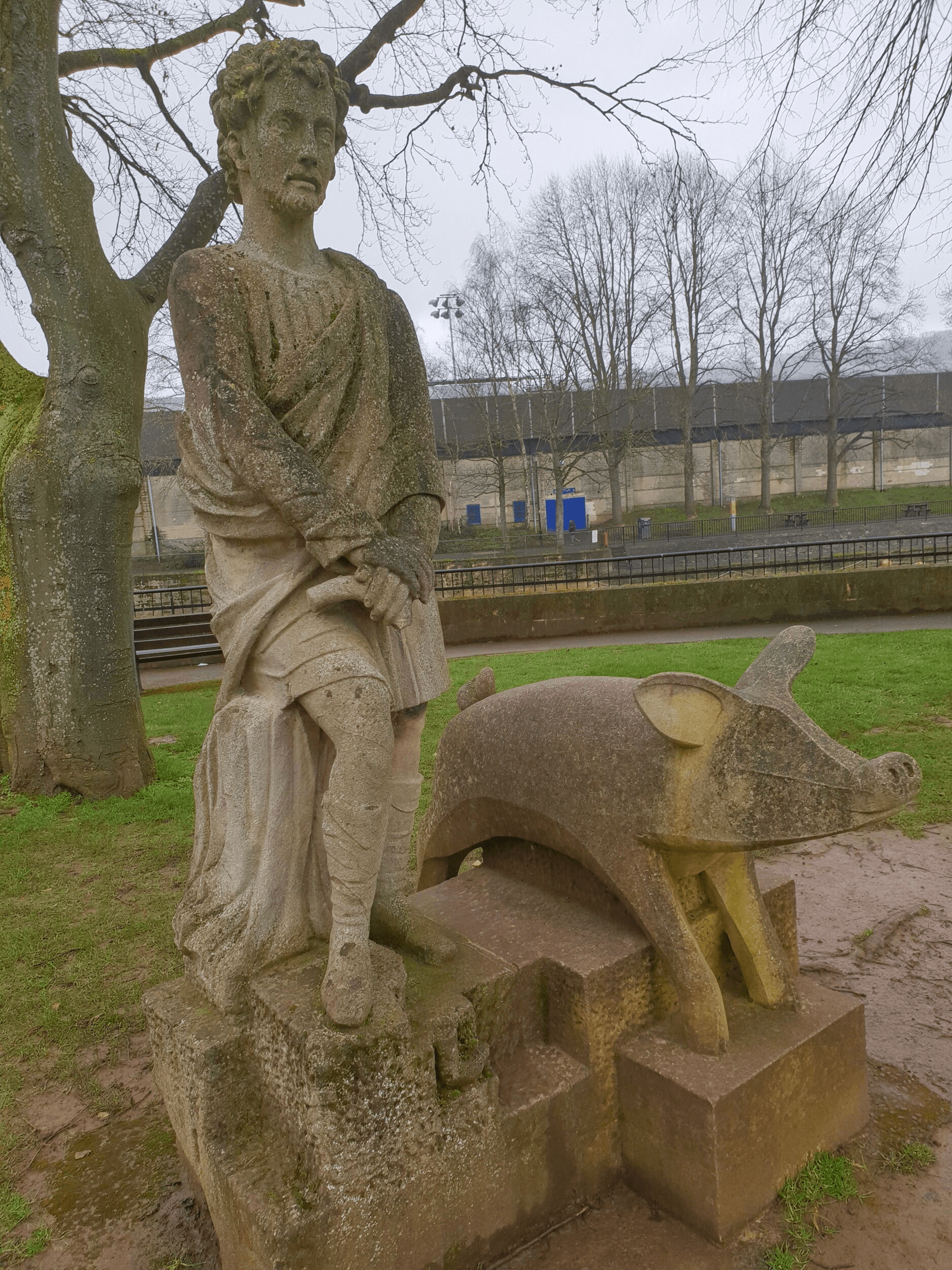
King Bladud myth as a psychedelic reference
King Bladud is a legendary king who supposedly ruled Britain in the ninth century BCE. Of course, there is no historical record documenting Britain during this period, and the closest thing to history are various medieval chronicles of the kings of Britain, although none before the 12th century mentions the pre-Roman era. Therefore, the only source for the story of this king is Geoffrey of Monmouth's book. Geoffrey of Monmouth's credibility is questionable, and it is unclear how much of his "original" material, that is, what was not previously published, is based on real sources, folklore, or simply his invention, and it is unclear what his interest was. Perhaps his interest was simply part of propaganda, giving or appropriating various fragments of stories that form the foundation of other nations' mythologies to the British. There is no way to know.Bladud is mainly famous for two things: founding the city of Bath and attempting to fly. Stories claim that he contracted leprosy and was exiled. He found refuge as a pig herder, and by observing them, he noticed that they wallowed in hot mud and thereby what seemed to be sores on them disappeared. He decided to try it himself and indeed was cured. As a token of gratitude, he created a magical spring at that place. Later, he became king and turned the spring into a temple for the healing goddess Sulis. Bladud was a magician, and in this capacity, he attempted a flying spell. He did manage to fly until he had an accident. He crashed, was injured, and died.
Since then, the spring and the temple beside it became a pilgrimage site for the sick, who saw bathing in the spring and worshiping at the temple as a remedy for healing. This is according to the story, which, as mentioned, has no historical documentation. Historical documentation begins when the Romans, upon conquering Britain, attributed the worship at the site to the goddess Minerva. The place became a Roman bathhouse, and a Gorgon statue was installed there. Since then, any bathhouse has been called Bath, after the city established at the site.
Minerva is the counterpart of Athena, the goddess of wisdom. There is a known myth about the Gorgon who was seduced by Poseidon, the god of springs. The two had relations in Athena's temple, and the enraged Athena cursed the Gorgon and turned her into a monster that turned anyone who looked at her into stone. Later, she helped kill her using a mirror-shield she gave to the hero Perseus, causing her to look at her own reflection, turn to stone, and thus he could cut off her head. Her blood became a poison, which in some uses could also bring back life.
A poison capable of reviving is known from myths as a substance used in initiation rites and mysteries where a rebirth experience occurred. Rebirth rites were considered revelations of hidden truths and the attainment of supreme wisdom.
It can be noted in passing that Haoma is called duraosha in Persian Gathas literature, which in Avestan means "death-repeller" or "death-averter". On the other hand, a word-play can be interpreted as "waste of wisdom", explaining the dual nature of Haoma, whatever it may be.
Various sun deities often symbolized healing and rebirth. Such deities include the Greek Apollo, the Egyptian Ra, and even the Indo-Persian Mithra. In those periods, these three gods were embodied in the Roman god Mithras, whose mystery religion, Mithraism, involved a similar rebirth cult. Sulis, the goddess originally worshiped at the Bath temple, is likely named after the sun, which is called "Sol" in Latin, "Sowilo" in Proto-Germanic, and "Suli" in Proto-Celtic. This leads some scholars to think that Bladud's healing from leprosy, which in Egypt and the Bible symbolized rebirth, is actually a metaphor linking him to a sun deity, and perhaps he is a personification of a sun god in general.
In Welsh, Bladud's name means "Lord of the Wolves." Blaidd is wolf, and iudd is lord. As mentioned, at some point, Apollo the sun god became associated with the wolf and took on a chthonic nature. This explains Bladud's association with the spring, one that springs from the ground. A change in consciousness was considered in ancient times as an experience related to chthonic phenomena such as incubation in caves. Wolves were considered guardians of the earth's entrances. We all know Cerberus, the underworld guardian and servant of Hades. And perhaps Bladud is not a personification of a sun god but rather a personification of an underworld god.
To conclude the myth of the flying Bladud who crashed and died, it is necessary to refer again to rebirth experiences that are usually associated with flight. Birds were symbols of the soul's journey during death or near-death experiences. Failed flight serves as a metaphor for the use of mind-altering substances that result in destructive outcomes, either death or madness. Meaning: the myth of Bladud, again, attempts to describe the treacherous nature of mind-altering substances that can lift you high but can also bring you down in sorrow to the depths.
-
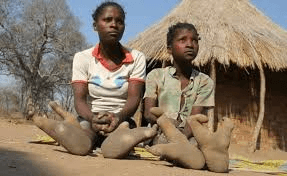
The way genetic disorder is believed to be a god's grace
The Doma (or Vadoma, or Wadoma) are a tribe living in Zimbabwe's Zambezi Valley. They are characterized by their isolation from surrounding tribes, leading them to marry only within their own tribe. This practice of close kin marriages and the resulting limited genetic pool has led to several genetic deformities, the most prominent being ectrodactyly, a condition where the middle toes are missing and the outer ones are turned inward. They usually have two or three toes, resembling ostrich feet. This condition may make running difficult and necessitates walking barefoot, but it gives them a significant advantage in climbing trees. Consequently, they view it as an advantage, even a blessing. Their reluctance to marry outside the community is driven by a desire to preserve this advantage within the tribe.
Their ability to climb trees, especially tall and complex ones, and the fact that this ability was "granted to them" through a disadvantage turned advantage, has led to the development of several myths explaining their uniqueness. They have two founding myths. The first tells that their ancestors were bird-like creatures who came from another planet called Liitolafisi and established a colony on Earth. They married Earth's women and passed on the special feature of their feet to their descendants. The second myth states that their ancestors originated from the baobab tree itself. Upon descending from the baobab tree, they had to adapt to life on the ground and thus became upright, which forced them to hunt and gather the fruits of the land. In both cases, these myths aim to portray the genetic deformity as an inherently non-human trait present within them.
-
Why Manichaeans had fondness with red mushrooms
R. Gordon Wasson writes on his "Soma: Divine Mushroom of Immortality" pages 71-73 about the fondness Manichaeans had to mushrooms, red ones, and hence, Amanita Muscaria aka Soma, he suggests. Wasson credits St. Augustine, citing his "On the Morals of the Manichaeans", when he condemns those who eat mushrooms. The original word in Augustine's is "boletus", Wasson argues that "In imperial Rome boletus was the name applied to what we call the genus Amanita, including both the edible and the toxic amanitas". He also credits 11th century Chinese official Lu Yu as writing the Manichaeans "What they eat is always the red mushrooms" and "consider urine as a ritual water".
The identity between the two mushrooms is questionable, he refers his own book "Mushrooms, Russia and history". His logical conclusion is through the mention of urine and red mushrooms, that the Manichaeans used A. muscaria. Note that porcini mushrooms aka King Bolete (which were very popular in Roman cuisine) are growing next to the A. Muscaria and has similar habitats and seasons. Confusion between those two, or exchange, is plausible, plus the fact that the color of the Boletus is brown, and the colors in ancient cultures were not one-to-one unequivocal, so it may be a description for a brown mushroom as red.
Wasson argues that the mycophobic attitude toward mushroom eating is due to this St. Augustine's writing, or at least it influences St. François de Sales and Jeremy Taylor condemning it.
-
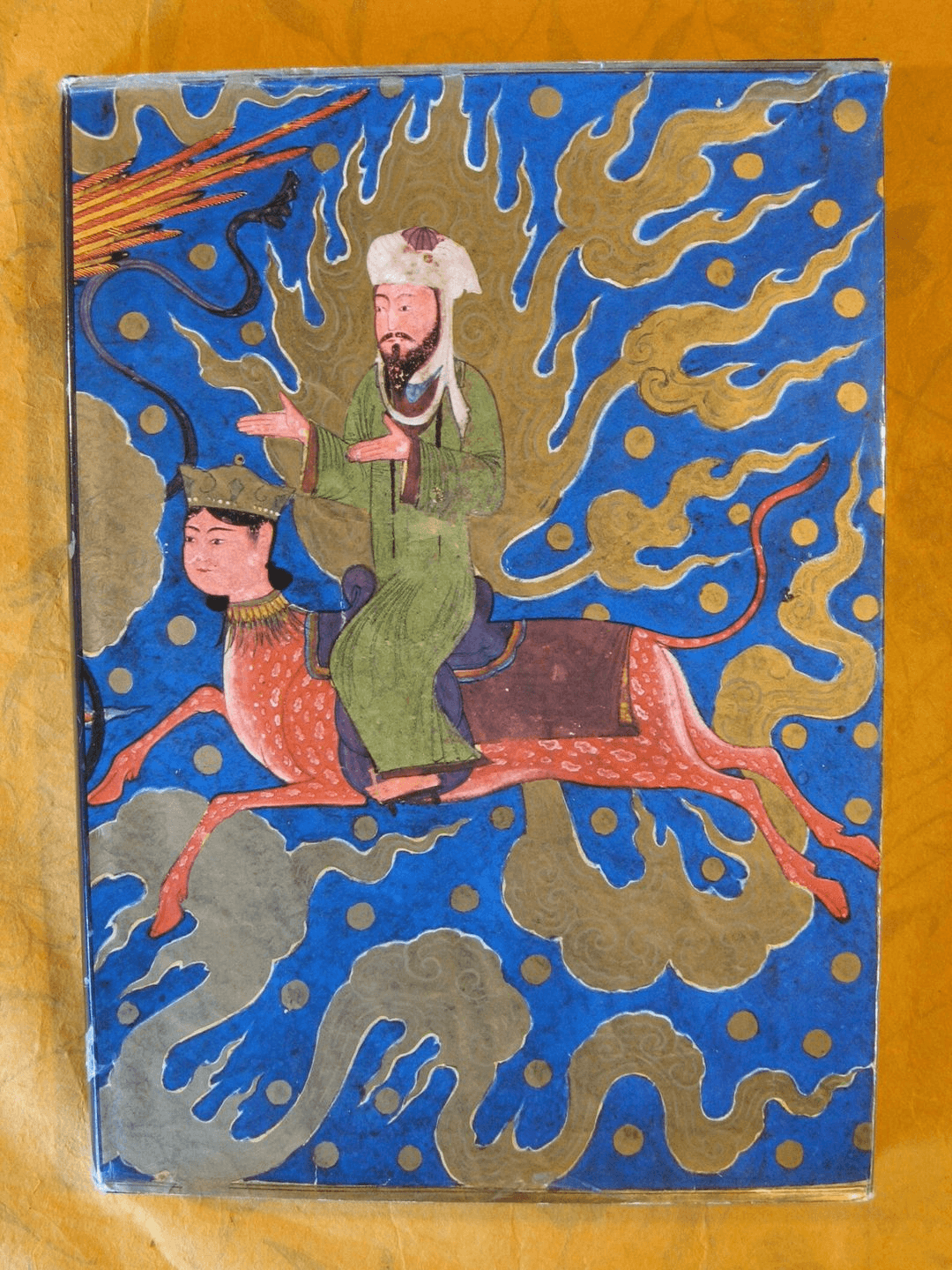
al Burāq as Amanita muscaria
The Mi'raj-Nameh is a text written in the 15th century in Khorasan, commissioned by Shah Rukh, the son of Timur. The text draws inspiration from the 17th sura of the Quran and describes the night journey of Muhammad (hence its name, Mi'raj. The name of the night journey is Isra and Mi'raj). According to tradition, Muhammad arrived at the farthest mosque on a miraculous creature named Al-Buraq (البراق) and, accompanied by the angel Gabriel, ascended to the seventh heaven. This is the first time ever that the Prophet Muhammad is connected with this farthest mosque on the Temple Mount, which is called today Al-Aqsa. The manuscript is written in the eastern Turkic dialect of the Chagatai Khanate and in its writing style, it contains artistic Uyghur calligraphy and is filled with illustrations, some of which are influenced by Buddhist visual traditions. Therefore, it is not surprising, or perhaps it is, that Al-Buraq is illustrated as a red horse with white spots, resembling an Amanita muscaria mushroom, which belongs to Central Asian folklore. Carl Ruck also claims that the Uyghur Manichaeans were known for their fondness for red mushrooms, including Amanita.
-
The Origin of Lag BaOmer
Today we celebrate Lag BaOmer. Lag BaOmer is a mysterious jewish holiday. There is no commandment in Jewish law to celebrate this day, and in fact, until recent generations, it was not the festival it has become recently. Secular Jews certainly did not celebrate it, and there was no defined "order" for how it was celebrated. Even great religious authorities do not know its origin, and the customs associated with this holiday are inconsistent. This leads to the assumption that it is an artificial holiday that gained political significance since the establishment of the State of Israel, charged with the "heroic" karma infused by Zionism. This, of course, is not accurate.
Elchanan Reiner helps clarify this in his article "Joshua is Rashbi, Hatzor is Meron: On the Typology of a Galilean Foundation Myth" (2012). Reiner claims that the 18th of Iyar (the date of Lag BaOmer) is the festive day of Joshua bin Nun, a foundational hero of the Galilee. In truth, it is not clear if it is the 18th, 17th, or even the 14th of Iyar. What is clear is that this story has a strong folkloristic background, and it was never a national holiday. It is relevant only to the Galilee and only to those familiar with the religious and cultural history of this region. The Galilee is filled with sites that attribute themselves to milestones in the founding story of Joshua as described in the Bible. One of these is Mount Meron, where according to ancient traditions, either he was buried or there was the event of "the sun standing still at Gibeon".
For example, the place where Joshua was buried is said to be on a volcano. Are there volcanoes in the Galilee? We know there are many extinct volcanoes in the Golan, but the Golan is not the Galilee. However, it turns out that on Mount Arbel, there are remnants of basalt and volcanic ash. It is unclear if our ancestors were geologists who knew about this, though it is very tempting to think they did. Perhaps the mountain became sacred because it was an extinct volcano. In any case, the midrashim (rabbinic literature) describe that "Gaash" (hebrew for volcano) means an earthquake. This region of the Galilee suffers a lot from earthquakes; in fact, the power of God (and any pagan thunder god) is in earthquakes. The midrash describes how an angel was angry and stomped on the ground after Joshua's death, and the earth quaked. The angel's footprint is still present today at Karnei Hittin, in what became the shrine of Nabi Shu'ayb. The Druze attribute the footprint on the stone to Moses. However, Reiner shows how medieval traditions firmly claimed that Joshua bin Nun and his comrades like Caleb ben Jephunneh are buried there. It is likely that because of this tradition regarding "converts" who joined the people of Israel, like the Kenizzites, the tradition that Jethro and the Kenites are buried there is based. Anyway there are other traditions about Joshua's burial place, and one tradition of interest to us is Mount Meron.
It is needless to say that near the cave at Nabi Shu'ayb, there is also a spring. The spring plays a crucial role in the myth of Meron. In Meron, it is testified, there were water celebrations. On the 17th of Iyar, it is written in the Torah that Noah's flood occurred. It was believed that the spring in Meron emerges on this day. For this purpose, they circled the spring seven times, as a fertility charm. Note, there were no fire celebrations. According to Reiner, the fire celebrations are a late development from the 17th century, an invention or revival of a concealed tradition by the Kabbalists in Safed, who claimed that burning clothes at the grave "is a great virtue for Rabbi Shimon bar Yochai". But there is no source for this. On the other hand, the water ceremony has a source, and this source is likely very ancient, and from a pagan origin.
Water ceremonies for fertility purposes are known from various mythologies, including the Bible and Talmud. In the midrashim, attempts were made to wrap such water ceremonies in the guise of righteous and miracle workers praying to God, like Honi the Circle-Drawer, but these stories are essentially a Jewish adaptation of folklore tales about religious leaders conducting fertility ceremonies. These fertility ceremonies took place at pilgrimage sites to temples of the gods about whom these myths were told. These places were identified as the locations of the mythical stories.
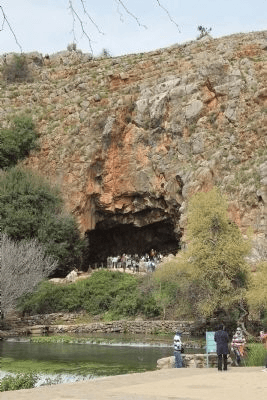
For example, in Caesarea Philippi (Banias), there is a cave from which the Banias spring was believed to originate. This myth is also found in Midrash Rabbah, where it is said, "The Jordan river emerges from the Cave of Pamias and flows into the Hula Lake". This cave is called "Pan's Grotto". Pan is a pastoral fertility god who lived in desolate places, and a cave with a spring was considered his embodiment. In Caesarea Philippi, it is described in the New Testament how Jesus gave Peter the keys to the kingdom of heaven. Peter himself is named after the rock from which the spring emerges. The place is called "Galilee" because a "galil" or a "gilgal" in hebrew is a description of the ritual circling ceremony of a holy place, as we described above how they circled the spring in Meron. Generally, in the Torah, there is a myth about a water source emerging from a rock, like Marah, waters of Meribah, Miriam's Well, etc. All these elements contain ancient foundations that go back to the Neolithic period.
Pan, as mentioned, is a fertility god depicted as guarding flocks and considered a satyr, a man-goat. The German linguist Hermann Collitz suggested in 1924 that his origin is shared with the Vedic god Pushan, a sun god. Worship of a pastoral and protective deity was a common feature of the religious traditions of ancient Indo-European peoples, and in these traditions (and of course not only them), fertility was attributed to the sun. Joshua is such a solar hero, a man by whose word the sun stood still, a man said to be buried in a place associated with the sun, Timnath-heres (Heres = Sun in ancient hebrew). This scenario of sun, spring, cave (and also sacred trees) fits well with the worship of Joshua's figure. It is only fitting to see Mount Meron as a substitute for the worship on Mount Hermon, or perhaps a competing worship. We also see in the Bible quite a few times where these two mountains are compared: "North and south, you created them, Tabor and Hermon rejoice in your name". The north is the name of Hermon, the place where Baal established his palace. Therefore, the south is the equivalent of "Tabor", which is the biblical name for Mount Meron. Mount Tabor has been considered since the third century CE as the place where the Transfiguration occurred, and some claim it is Mount Meron (William Hendriksen).
What is the meaning of the migration of this cult site between Arbel, Hermon, and Meron? In ancient pagan cults, there are precedents for the migration of worship under various circumstances, including political ones. It is possible that at some time, the water worship was not possible in Banias and therefore moved to the nearby peak, Meron. And perhaps because the Christians appropriated Banias, the Jews, who did not want to worship a place identified with Jesus, moved it. Elchanan Reiner shows how the figure of Joshua evolved into various local heroes named Joshua, the last of whom was Jesus. After Christianity became the state religion of Rome, the Jews did not want to name their local hero after Jesus, so they concealed the memory of Joshua the local hero in the mythical figure of Rabbi Shimon bar Yochai, making Jesus and Rashbi essentially incarnations of the same figure.
There are also precedents for dual identifications. As mentioned, Reiner shows how Joshua's grave is identified once in Arbel with what is now Nabi Shu'ayb in Karnei Hittin, and once on Mount Meron. Joshua's grave also has other contenders in areas that are not in the Galilee, in Samaria there are at least two such places, in Kifl Hares near Ariel and in Timnath near Neve Tzuf. The multiplicity of these "maqams" was not created solely for political reasons. Reiner speculates that the artistic freedom of the local inhabitants to live the biblical story as if it happened in the region where they lived, led to this. It is not a competition between places, but the actualization of the biblical story that over time became a tradition as if the story indeed happened in that place. Specifically, Joshua was the founding hero of the Galilee, so various settlements in the Galilee tried to actualize the story in various ways.
-
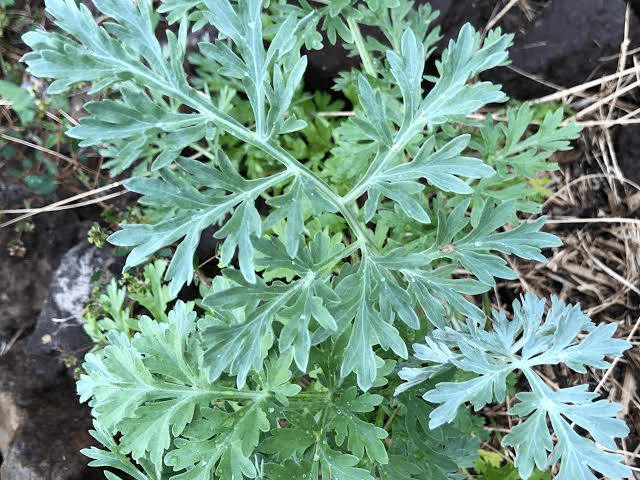
Artemis and Artemisia
The historical association of wormwood is linked to various gynecological uses in ancient medicine. It was used to treat various menstrual problems such as dysmenorrhea and menstrual irregularities, including the absence of menstruation (amenorrhea), as well as aiding in childbirth and treating inflammations such as endometriosis. Therefore, this is also what gave it its name, artemisia, being a plant that provides medicine to women encountering menstruation for the first time. Artemis was the goddess who protected these women.
The additional association of women and fertility in particular, and of Artemis in general, with childbirth is rebirth. In various fertility rituals, it was customary to drink poison in order to induce intoxication and reach states between life and death, thus being reborn. Certain poisons were known as particularly intoxicating, and as such, wormwood and hemlock served as a nickname for poisonous seasoning herbs (hemlock) and intoxicating ones (wormwood) – according to Chaim Rabin (1976). Because of its bitter taste, and according to Persian, wormwood was called "especially bitter taste," absinthium, ἀψίνθιον. This bitter taste also later gave the wormwood, which is infused in water, the name absinth.
Wormwood contains a poison called thujone. Thujone is a terpenoid with antimicrobial activity that acts on the nervous system. If taken in moderate doses, it stimulates uterine activity as described above. On the other hand, if taken in excessive doses, it acts in an exaggerated manner on the nervous system to the point of abnormalities such as confusion, hallucinations, and of course, intoxication.
Obviously, the ancients did not know what thujone was, but in artemisia trees and specifically in juniper (or thuja) trees, there is a high concentration of thujone. Thujone is Greek for "Disinfection", θυία. During the offering of sacrifices, the Greeks would burn these trees whose smoke had a pleasant smell and is believed to be create a high. In this way, they would purify sanctuaries and drive away spirits. The tree sacred to Artemis is the cypress, the cousin of the juniper, but probably not for that reason. There is no evidence that the Greeks did not know how to distinguish between juniper and cypress, although it is tempting to think so. In Greek mythology, the cypress is associated with death and mourning, and therefore, they would plant it in cemeteries. However, there is a folk tradition that evil spirits dwell in cemeteries, so it is only logical that they would use the tree that drives away spirits. Moreover, the use of juniper and its products is known in Buddhism as a means of exorcising spirits. Juniper is considered a sacred tree in Tibet and is called Lha-shing Shukpa, it is usually planted to be a dwelling place for guardian deities.
Another thing common to juniper and wormwood. In Tibet, juniper is used to create wooden covers of Buddhist manuscripts called Lak-shing. Dioscorides reported that wormwood repels moths, so ink spiced with rue was commonly used to write texts so that moths would not eat the Papyri. In both cases, this material was used for the preservation of manuscripts, perhaps because of a side effect of thujone.
Notes:
"Uninvited Guests: Traditional Insect Repellents in Estonia used Against the Clothes Moth Tineola bisselliella, Human Flea Pulex irritons and Bedbug Cimex lectularius" by Renata Sõukand, Raivo Kalle and Ingvar Svanberg (2010) approves that both the juniper and the wormwood used for repels moths in Estonian folklore.
the tibetian juniper use info was taken from "Ethnobotany of Juniperus polycarpos C. Koch (Cupressaceae) in the Himalayan cold desert of Union Territory of Ladakh, India" by K Dorjeya & A K Mauryab (2019)
-
The Molekh as an explanation to the Zeus and co myths
Sacrificing human offerings in Canaanite religion, especially offerings to deities like Baal, was a custom intended to ensure divine favor (article). The Carthaginians, descendants of the Canaanites, practiced child sacrifice. Classical sources describe the ritual sacrifices to Baal Hammon, where children were offered during crises to avert disasters or ensure victories.
This practice is archaeologically supported by the discovery of Tophet sites, burial grounds containing charred remains of children. Discoveries were made in eight Carthaginian settlements, in Tunisia, Sicily, and Sardinia. The remains included infants aged from a few weeks to one year. They were cremated, and their ashes were placed in urns used as jars, buried in the ground. In Carthage alone, more than 20,000 such jars were found. It appears they were all sacrificed in the same manner: placed on their backs on a pyre of oak branches in the open air before the fire was lit. Exactly as described in the Binding of Isaac. And not for nothing. The Binding of Isaac is a text clearly intended to counter the prevalent custom that also existed in Israel. The Bible contains many prohibitions on child sacrifice, as in the books of Leviticus, Deuteronomy, and Jeremiah. Josiah, Jeremiah's contemporary and the one in whose time the Book of Deuteronomy was "found", instituted a religious reform. One of the things he did was to defile the Tophet in the Valley of Ben-Hinnom, in order to abolish the custom.
It should be noted that in Carthage, where a variety of infant ashes were found, remains of lambs were also found. It is suggested that in some cases indeed, human sacrifice could be replaced by lamb sacrifice, but as time went on, human sacrifice was preferred over lamb. In the remains dating to the founding of the city, the ratio between human and lamb sacrifices is in favor of lambs, but towards the Roman conquest, very few remains of lambs were found. The Romans forbade human sacrifices, and thus, in a forced manner, the custom of sacrificing lambs returned, what is called in research "Neo-Punic Tophet". Against this background, we should understand the finding of the ram caught in the thicket.
In Carthage, more than 6,000 inscribed stelae were also found on the graves of infants, containing vows of parents, mostly fathers, who vowed in exchange for their request to Baal to heed their voice. From the inscriptions, it appears that the word "mlk" was the designation for this type of sacrifice, considered a gift or "offering". The recipients were Baal Hammon, also called "Adon" (Lord), and his consort, Tanit. There were several types of offerings: Mlkt, which is an offering for a female, Mlk-Bl for a human sacrifice, and Mlk-Amr for a cattle sacrifice.
In contrast, traditional Jewish commentators interpreted the name Moloch differently. Some linked it to Milkom, the "Baal" of the Ammonites. Some linked it to the worship subsidized by royalty. Some even argued that it was called that because kings themselves used to sacrifice their children, as documented in the Bible.
An unexpected reinforcement comes from the Church Father Eusebius in his book "Praeparatio evangelica", where he quotes the Phoenician priest Sanchuniathon, who recounted that it was a custom for kings to sacrifice their sons in times of trouble. The custom is reminiscent of the myth about El who had a beloved son with his nymph wife Anobret (or Anat Rabat, lady Anat), which was called "Iedud", meaning "only begotten" (i.e "the only", or "the beloved"). In times of trouble, the god had to dress his son in royal garments, prepare an altar, and sacrifice him. El was a king who, after his death, deified and manifested in the star of Saturn.
This story explains a few things. Firstly, why Isaac is called "yachid" (only), even though he wasn't Abraham's only son. The reason is that the son chosen to serve as a human sacrifice was called "yachid" in Phoenicia, as argued by Sanchuniathon. Secondly, Greek myths begin to make sense. Like the myth of Cronus, whom Sanchuniathon argues is the Greek counterpart of the Phoenician god El, who devoured his children. Also, Saturn did the same, as the Roman counterpart of Cronus. Similarly to Cronus, whose son Zeus rebelled against him after being saved from being eaten, Baal the son of a El, is described as having expelled his father. Baal is also called Adon, reminiscent of the Phoenician god Adonis.
In the Greek myth, Adonis is considered the son who was saved from his father who wanted to kill him. The father discovered that his son was born from an illicit affair. The mother tried to keep it secret but eventually it was revealed? The father pursued her and sought to kill her, she turned into a tree, the father cut the tree, and from the tree, which symbolizes the pregnant belly of the mother, Adonis was born. We see a recurring motif of a father who killed his son, whether by burning or by slaughter, but the son returns to life.
Such a myth obviously also reminds us ultimately of Jesus. What Judaism did was to unite the father and son, El and Baal, and therefore abolish the narrative in which the father killed the son and the son returned to life. There is no process here where the son becomes the father through rebirth, but there is continuity between them because they are one. In practice, Christianity doesn't say anything different from Judaism if we adopt the trinity approach.
-
Indo European Horse Worship
By the first millennium AD, Christianity had spread throughout most of Europe, leaving paganism primarily in the far north, where Christians had yet to reach. At the turn of the millennium, they had managed to penetrate Scandinavia and Russia, leaving the Baltic coast as the only remaining pagan stronghold. The Teutonic Order's Crusades between the 12th and 14th centuries converted them as well, but by the 11th century, they were still pagans, while the Scandinavians had already converted.
A new study by researchers at Cardiff University found, based on biomolecular analysis of horse remains and strontium isotope analysis of tooth enamel, that despite their conversion, the Scandinavians continued to trade with the Baltic pagans and provided them with horses for their burial rites, which were prevalent in the pagan world since the Iron Age. Among the reported uses of horses were: halving or quartering, beheading, skinning, burying alive with all riding equipment, burning, and more.
The horse cult originated in Indo-European cultures, and many cultures of this origin revered horses. Horses were considered emblems of various fertility gods, and as part of this association, also of rebirth and therefore of the afterlife (death during life, known as a altering of consciousness). Pagans were buried with horses, and in some cases where bodies were burned, they were burned with their horses. Sometimes, when the deceased was truly important, he was buried with his chariot. Horses were believed to lead the dead to the underworld, and the passage to the afterlife also involved altering of consciousness, hence the need for intoxicating drinks. These drinks were made from fermented mare's milk.
An example of an Indo-European fertility god was Poseidon, who was therefore associated with horses. The horses' volatile nature and tendency to run amok also made them a symbol of fits of rage and mood swings. Poseidon was like that too. It is said that when he had fits of rage he would strike the ground with his trident and cause storms at sea, hence he also became the god of the sea. Freyr and Freya were also such fertility gods. Their father was Njord (Njörðr), the god of the sea. These gods were all part of the Vanir group of gods. The word Vanir is derived from the Proto-Indo-European word for "love", "desire", "connection" or "friendship", wenh. Some believe that this is also the origin of the word wóyh, meaning "to wrap" or "to embrace", a word that has evolved to describe the climbing plant, the grapevine. Or perhaps this nickname for wine is because it was used as an aphrodisiac, or as a mediating tool in social gatherings. To this day, it is customary to drink wine at gatherings.
Horses were also used for warfare, and their rage is one of the sources of the berserker. Warriors who got drunk to get battle frenzy tried to imitate horses. Berserker warriors often participated in sea raids. Horses were used for divination, analyzing both their internal organs, of course, and their behavior in general. One of the main uses of divination was to answer the question of when the right time to go to war was.
In Celtic mythology, horses symbolized the connection to the land and represented its fertility. Therefore, they were used as a totem, and were incarnated in the figure of Rhiannon riding on a white horse. Rhiannon is actually a personification of the Celtic fertility goddess Epona, whose name is derived from the Celtic word for horse, Epos. Rhiannon is etymologically related to the Celtic words for both maiden (rhiain in Welsh) and queen (rígan in Old Irish), and this hints at the practice of hierosgamos, the sacred marriage of Celtic kings, who, as Gerald of Wales tells us, had sex with a white mare during their coronation, and immediately afterwards they slaughtered and ate her.