
-
Terence McKenna Might Have Been Right About the Stoned Ape Theory
A new study suggests that psilocybin mushrooms may have played a significant role in the evolution of human consciousness, supporting Terence McKenna's "Stoned Ape" theory. The research was conducted by two Peruvian scholars, Jehoshua Macedo-Bedoya from the National University of San Marcos in Lima and Fatima Calvo-Bellido from the Pontifical Catholic University of Peru.
"The hypothesis that psilocybin mushrooms may have intervened as a factor in the evolution of human consciousness, whether as catalysts for mystical experiences or as drivers of cognitive processes, raises profound reflections on the ancient interaction between humans and their environment… The origin of human consciousness is one of the greatest questions facing humanity, and the material collected suggests that psilocybin may have contributed to its early development… These effects allowed humans to transcend basic perception and embrace creativity, introspection, and abstract thinking… At the brain level, psilocybin affects various areas such as the prefrontal cortex, the hippocampus, and the anterior cingulate cortex. These effects have been linked to changes in memory, decision-making, and retrospection, which has sparked interest in therapeutic applications, particularly in the treatment of mental disorders such as depression and anxiety. From an evolutionary perspective, it is proposed that the ingestion of psilocybin could have contributed to improved visual abilities and reproductive success in communities that used these mushrooms". via.
-
Rationalizing the Minotaur myth
According to Greek mythology, King Minos of Crete had a labyrinth at Knossos. He would place unlucky victims in the labyrinth to be killed by the Minotaur, a half-man, half-bull monster. Although this might seem entirely unrealistic, there is evidence that the origin of this myth may be connected to the historical Minoan civilization.
First of all, from the moment the palace was discovered, Arthur Evans, who unearthed it, noted that it was complex and reminiscent of a labyrinth. The palace was built as a large and highly intricate structure, with dozens of rooms, corridors, staircases, and winding passages. For someone entering the palace for the first time, it was easy to get lost within the convoluted structure. This complexity could have been perceived as a "labyrinth" by those unfamiliar with its layout.
Secondly, Evans also discovered frescoes of bull-leaping in the palace. It appears that a form of bullfighting took place within the palace complex, possibly in the central courtyard. There is evidence of bull sacrifices in crypts off to the side of the courtyard. This suggests that bulls were captured after some form of "riderless rodeo" and then sacrificed. However, there were also instances where the captors failed to capture the bulls and were gored to death.
Does the fact that Minos's enemy, Theseus, who united Attica, lived hundreds of years after the peak of Minoan culture suggest that the Greeks found a mysterious and deserted ruin that was still considered sacred by the locals, and thus made an interpolation, perhaps inaccurately, projecting it back into an earlier time? (source)
-
Newly found 12,000-year-old burial may belong to a female ‘shaman’
In Çemka Höyük, located in southeastern Turkey near the Tigris River, a 12,000-year-old burial site of a 25-year-old woman was discovered. The grave was covered with a stone slab, and along with her were found remains of animals, including the skull of an aurochs, leg of a marten and a partridge wing. These findings suggest that she might have been a shaman. The aurochs skull is considered unusual for a burial from the Pre-Pottery Neolithic period. The aurochs was seen as a symbol of power or authority, and its presence in such a burial hints that the woman was a leader. The fact that she was buried under a stone slab also suggests this. The question remains whether she was a religious leader. This aligns with the shamanic tradition known to us, but it is unclear whether such terms can be applied to a culture 12,000 years old, which predates the period in which research recognizes such social structures.
-
Homo naledi theory refuted
Last year, a research team led by Lee Berger made a surprising claim: Homo naledi, an ancient species of humans with a brain size one-third that of modern humans, engaged in intentional burial practices and created symbolic markings in the Rising Star cave system in South Africa. This claim, which gained widespread attention through articles and even a Netflix documentary, sparked significant interest but also considerable controversy, particularly due to the lack of peer review and the limited brain capacity of Homo naledi.
Researchers from George Mason University, led by Kimberly Foecke, published an article in the journal PaleoAnthropology in which they refuted Berger's claims. Foecke and her team pointed out that the evidence presented for burial practices was insufficient and that the methodologies used by Berger's team were not reliable enough. Foecke's team was unable to replicate Berger's findings using standard soil testing, raising doubts about the possibility that Homo naledi actually buried their dead.
-
The Hidden Connections Between Purification Rituals in Judaism and Greek Mythology
Asclepius (Aesculapius / Ἀσκλήπιος) is considered in Greek religion as the god of medicine, or rather as the god of purification, both spiritual and physical. He is regarded as the son of Apollo from a mortal woman who underwent deification by the intervention of Zeus, similar to Dionysus. Like Dionysus, he was also saved from death after being born in an unnatural way after his mother's death. In Greek mythology, this is considered being born twice, and thus he was born and then reborn, or "born again". This makes him the patron of the rebirth experience, a code for reaching a higher state of consciousness, after which a person becomes a "new person".
The connection to medicine is likely found in the myth about the education of Asclepius. He learned to use the blood of the Gorgon, which could both kill and heal. He was so skilled that he knew how to revive using her blood. This concept of the ambivalence of the Gorgon's blood and healing through immersion in sacred springs is also seen in the cult of the goddess Sulis-Minerva/Athena. In any case, the implication is clear: medicinal drugs, especially those with psychotropic effects, can kill or intoxicate in the wrong dosage. But in the right dosage, they have an anesthetic effect and are therefore used as anesthetics. They are typically used during childbirth, either to numb the mother during the pain or, alternatively, to induce labor (such as ergotamine produced from ergot).
Nevertheless, Asclepius is somehow considered purely a god of medicine and not of consciousness transformation. The rod of Asclepius, regarded as a symbol of medicine, is wrapped with a snake for the same reasons mentioned: snake venom in low doses can be a medicine (for example: theriac), and in other doses, it kills. The snake itself, which sheds its skin, symbolizes renewal. Therefore, Asclepius is also considered the patron of skin diseases, and by analogy, we also see in the Bible how leprosy sufferers are healed through the shedding of skin (which flakes and underneath grows new skin). The purification process of the leper is very similar to the cult of Asclepius, which includes immersion and purification, isolation, sacrifice, and eventually "rebirth". It turns out that the purification process of a Nazirite (i.e., mantis) is similar and includes purification, isolation, sacrifice, and "rebirth". The similarity between a leper and a Nazirite is because both in Judaism encounter "corpse impurity."
The reason I mention the Nazirite: part of the healing process involves incubation. Incubation means a ritual process where one enters a place of solitude, then closes off the senses, and through meditation, reaches a "fourth" state of consciousness, something that is neither dreaming, wakefulness, nor sleep. Before reaching this state, one must undergo purification, both physical and spiritual. Physical purification is through immersion, usually in a sacred spring (a type of ritual that later became the Christian sacrament). Spiritual purification involves relaxation, hypnosis, or what is called enkoimesis (ἐγκοίμησις) – anything that neutralizes daily distractions, helping one think of nothing. In Athens, there was a temple to this god called the Asclepion, situated near a cave with a spring. The cave is significant because incubation processes were typically performed in caves. Shamans known as "iatromantis" (Ιατρομάντης) would go to seclude themselves in caves as part of incubation processes, where they would prophesy and receive messages from the gods to relay to humans. One of these iatromantis was Parmenides, according to Peter Kingsley, who was thus a priest of the god Apollo.
-
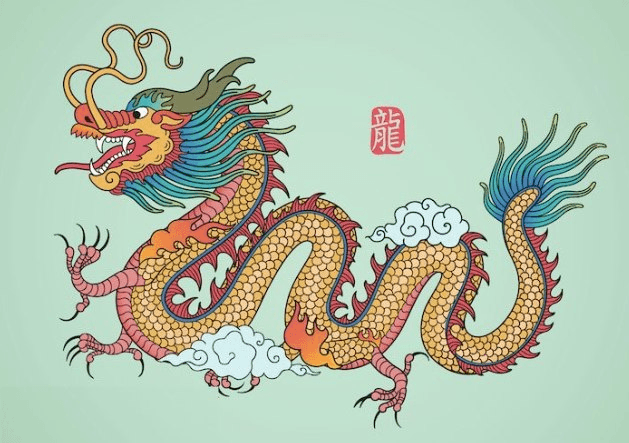
The origin of the myth about the war against the seven-headed dragon
In my opinion, the origin of the myth about the war against the seven-headed dragon is the encounter between the Indo-Europeans and the Chinese, and the question of who is worthy of using psychedelics and what the appropriate result of using them is. The victory over the dragon and the war against it is, as mentioned, a description of the inner struggle within a person while using aids given to him by the gods to become like them. The question is whether it is worthy to become like them, to what extent is it worthy, and how much should one strive for it, who is capable, for what purpose, and when.
In "Western" cultures (meaning Indo-European and Semitic), in most cases, the one who fights the dragon-snake is ultimately the one who rises above all the gods, and for this victory, he sits on his throne. In most cases, it involves a miraculous weapon that he used, sometimes it's lightning, as he is a storm god, in other cases, it's a bow and arrow or another weapon unique to the war hero (or war god). The victory over the snake-dragon ultimately brings about cosmic order and removes the threat to its stability.
The snake symbolizes wisdom. The river also symbolizes knowledge and wisdom that came directly from the gods. The gods sit at the top of the mountain, on the snowy peaks. The snow melts and becomes the river's stream. Alternatively, the gods sit deep within the earth and spring fountains that, in turn, become lakes. The snakes sit at the mountain tops and guard the rivers, or alternatively, they sit deep in caves and guard the tree roots or those same springs that emerge from the earth's depths. In both cases, these are waters that threaten to flood the world, and what the snakes do is prevent them from doing so. They serve as the dam; they are essentially plugging the hole through which the stream passes, so the protection they provide is actually something positive. But on the other hand, it's also something negative because they block the person. This is probably the explanation for the attitude difference towards the dragon between the East (China, for example) and the West (Indo-Europeans). In the East, the dragon is a symbol of protection and luck.The gods sit at the top of the mountain. Every culture has its mountain. Seven rivers flow from the mountain into seven seas that surround seven continents. The number seven repeats, as mentioned, because it symbolizes cosmology and astrology, spirituality, and the power of life in humans, in the chakras, and in the seven circles of consciousness. We will soon reach the point where, when talking about divine wisdom and abundance, we're essentially talking about consciousness. Usually, these guardians have many heads, likely because the head symbolizes authority and wisdom, which are essentially the same things; to lead, you need to be wise, and the head is the seat of thought. The guardians don't have to be snakes but rather monstrous, like Cerberus, who is a hound dog. You can liken the guardian's role to a door, which only those who have the key to it can pass through and approach eternity. The key is a magic spell or password, which is usually some mantra or just a eureka that breaks the thought pattern (in a positive sense). Whoever attains it manages to touch eternity. Eternity is where the gods reside, immortality. In other words, all this talk about rivers, snakes, and battling snakes is essentially a metaphor for an inner struggle in the human soul when consuming the elixir of immortality that can also kill him or drive him mad. We've already talked about this here several times.
Since we started with images from the Eastern world, let's illustrate this with Hindu myths. In India, there are two races of gods: the Devas and the Asuras. Among the Asuras exists a race of snakes called Nagas. A snake named Vasuki, who is the king of the Nagas, is said to have been used by the gods as a rope to churn the sea of milk and produce the Amrita, the elixir of immortality. During the churning, Vasuki emitted a strong poison that threatened the world, but Shiva drank the poison and saved the world, thus earning his famous blue neck. This is nothing but a chain around Shiva's neck. Shiva sits in a meditative pose at the river sources in the mountains, preventing them from flooding the world, using his hair as a dam. He allows only one stream of water to pass his body, the Ganges River. This dam also appears in another myth, in the Rig Veda. There, a snake named Vritra sits and blocks the river waters. Only Indra's victory over the snake, using his lightning weapon, saved the world and restored its vitality. Before Indra embarked on his mission, he drank Soma. Amrita (अमृत) is considered one of the synonyms for Soma, which is also made from milk. In one of the Hindu scriptures, the Vishnu Purana, the struggle between the Asuras (of whom the Nagas were part) and the Devas (of whom Indra was part) is described, regarding the right to use this elixir of immortality.
The question is who is worthy of possessing this power and what are the limitations of the power it grants to its holder. As mentioned, Indra's victory and appropriation of the Soma constitute the argument that man is worthy of adhering to the gods and using the tools given to him (or rather created for themselves, and he heroically managed to obtain them) to draw closer to them and become them. This idea that man should engage in spiritual work to become a god himself has seeped into all religions. If we define man's attempt to adhere to his deity and become endowed with divine qualities as a "Promethean effort," Western religions can be characterized as "Promethean". Prometheus was a figure who took the risk of bringing fire from the gods to man, representing man's effort to acquire divine knowledge and power. Eastern religions cannot be described in this way. In these religions, you do not aspire to become a "divine" person but rather strive to be a "human" person. Everything belongs to the domain defined for it; man must act according to his role and place. Therefore, the "dragon" is indeed worthy of admiration, but its role is mainly to guard the world against chaos, not to embody chaos itself when provoked.
By the way, the story of the river that flows out of Eden and splits into four heads in Genesis 2 is actually another version of the multi-headed serpent. A river is shaped like a serpent, and river branches sometimes look like a serpent's tongue. Although there are only four heads in the Bible, in Hinduism, there are seven rivers that flow from the mountains, bringing divine abundance and flowing into seven seas. Because of this, serpents are considered water monsters.
-
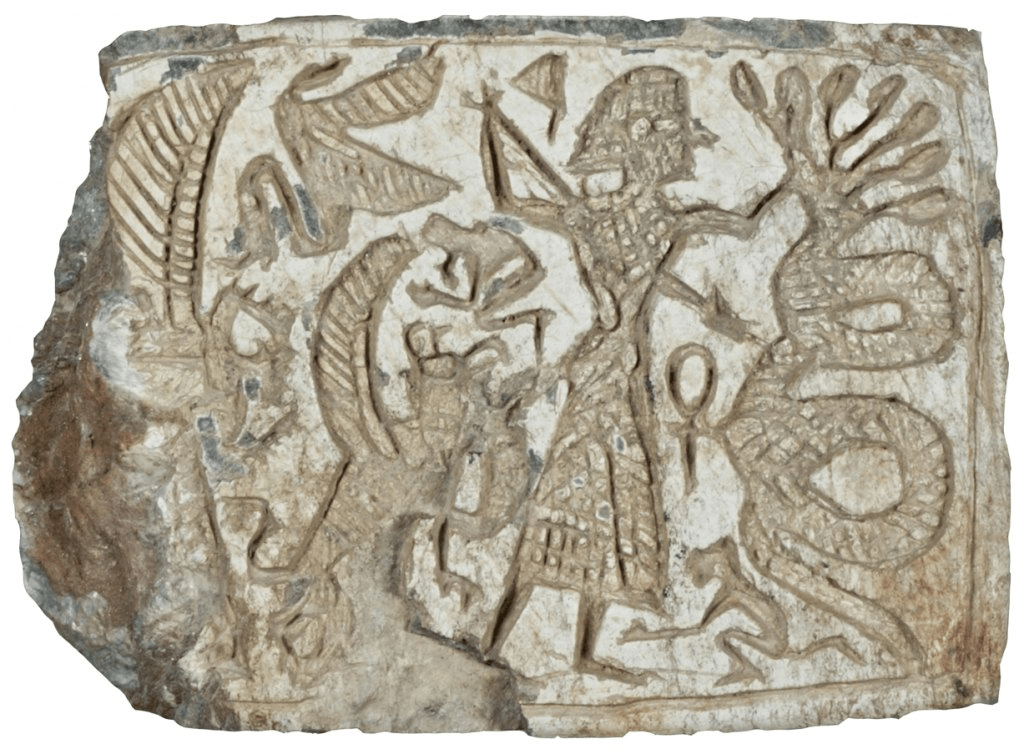
Mastering the Seven-Headed Serpent
About two years ago, a small seal from the eighth century BCE was found at Tel Hazor, excavated in the acropolis of the site. The seal depicts a scene of a warrior fighting a seven-headed serpent, along with other hybrid creatures such as a griffin, a winged scarab, and a winged cobra. Professor Christoph Uehlinger of the University of Zurich is now publishing a scholarly article on the matter, suggesting that it should be linked with Heracles and his battle with the Hydra, or more accurately, with the Canaanite edition of a myth that spread from Babylon to both Greece and Canaan via Ugarit, and also reached the Bible.
The myth of the seven-headed serpent traveled through various cultures and periods throughout history. It first appears in Mesopotamia in the third millennium BCE, where the war god Ninurta is described as having killed a seven-headed serpent, along with other monsters. The myth spread northwest to Ebla, where it was associated with the storm god Haddu. The slaying of the serpent was the act that stabilized his reign. Later, in Ugarit during the second millennium BCE, another storm god, Baal, is described as fighting alongside Anat against the sea serpent Tunnan (i.e biblical Tannin) or the Leviathan. These images can be found in the Bible, such as in Psalm 74, "You broke the sea by your strength; you shattered the heads of the sea monsters in the waters. You crushed the heads of Leviathan…". Eventually, the myth reached Greece, where Heracles fought the Hydra. And of course, in the New Testament, a "great red dragon, having seven heads and ten horns, and seven crowns upon his heads" appears in the sky (Revelation 12:3).
In the Talmud, in Tractate Kiddushin 29b, it is told that Rabbi Acha bar Yaakov came to visit the city of Abaye, and Abaye instructed the townspeople not to host him, so that the only place left for him to sleep would be in the study hall alongside a demon that appeared as a seven-headed serpent. The serpent attacked Rabbi Acha, but Rabbi Acha, in his righteousness, managed to kill it through prayer, with each bow killing another head.
-
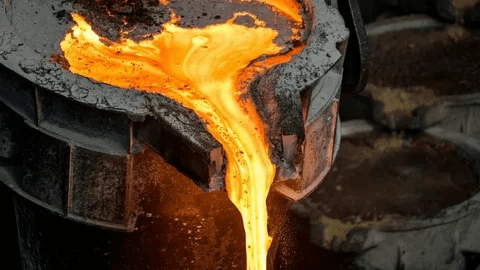
The Soma preperation as copper melting simulation
I am currently reading the book "The Copper Revolution" by Nissim Amzallag. It's one of the best and most mind-blowing books I've read. In short, the book argues that the origins of religion lie in humanity's amazement at natural phenomena of heat and wind. Through this form of observation, ancient chemistry was born, enabling humans to exploit natural resources, essentially earth and rock, to extract materials for toolmaking and building. Thus, the art of blacksmithing, forging, and smelting was discovered—the idea that a certain process can change the material and its form, mostly through heat, but not exclusively. The essence that constitutes the material without form or form without the material was defined as God, and the methods to achieve, extract, and interact with it were considered divine experiences.
The professional terminology of these arts became the etymological foundation of all things related to religion—from Cain (קין), in the sense of the art of smelting, giving rise to words like acquisition (קניין), zeal (קנאות), and violin (כינור). Through the word Melech (מלך), meaning the remains of melted material left at the bottom of the furnace (Amzallag calls this "furnace residue", derived from the round shape formed upon collision with the floor), which gave rise to words like monarchy (מלוכה), angel (מלאך) in the sense of a messenger, and craft (מלאכה). And finally, nesekh (נסך), meaning the smelting and casting of metal, gave rise to words like prince (נסיך), miracle (נס), and snake (נחש). A snake, for example, is the trail of molten metal solidifying in its free path. Moses' staff was supposedly a shapeless copper ingot when it touched the hot coals, turning into a snake when the molten metal moved slightly away from the fire.
As part of the explanation of the spread of religions through the idea of metallurgy, an explanation is provided on the Indian religion, which developed from a supposed conflict between the Indo-European Aryans and the local culture known from Sumerian sources as Meluhha, a supplier of copper and tin. It seems that entities described in the Mahabharata epic (whose names also signify words for snake and copper, such as नाग, Naga, hybrid serpent-like creatures, with one of their kings called नहुष Nahusha, son of Ayus, the Indo-European word for metal—compare Aes in Latin) reflect this conflict, which likely wasn't a physical war, as there are no archaeological evidences of a violent and sudden disappearance of the Indus Valley culture, but rather a change in the nature and purpose of soma. Here lies the great surprise: the method of preparing soma and its essence, Amzallag argues, is a symbolic resemblance to the copper extraction process. Starting from its pressing, done as metal is pressed in forging, through the fact that the preparation process resembles the metal purification process in Indian alchemy, and concluding with the plant extraction by crushing, transitioning from solid to liquid state, mimicking the creation of molten metal in the smith’s furnace, allowing shape transformation and essentially making the metal eternal (permanently recyclable).
-
Modern Religious Druidry and the controversy over psychadlics
A new book, "Modern Religious Druidry", delves into the academic study of the neo-pagan Druidic movement, Druidry. It includes an entire chapter on the internal Druidic controversy regarding the necessity and legitimacy of using psychedelic drugs to enhance the spiritual experience. Proponents argue that ancient Druids also used such substances. This claim is also controversial from a scholarly perspective, and the portrayal of Druidry in Sky and Amazon Prime's series "Britannia" is somewhat misleading.
In the series, Druids are depicted as easily engaging in human sacrifice, necromancy, open sexual relationships, acceptance of gender fluidity, and extensive use of psychoactive plants and mushrooms despite the physical and mental health risks portrayed. The argument is that this image is culturally biased because it is reported by Romans, and the Druids, having rejected written records, could not explain themselves or their actions. All that remains is a mocking depiction by a culture that saw itself as superior to the 'barbarians'.
Regarding health issues: contemporary Druids strive to use only substances considered "safe" in the psychedelic renaissance, such as psilocybin mushrooms or Liberty Caps, from a health and addiction perspective. However, some prefer to avoid such shortcuts and focus on more traditional spiritual work "the hard way," like religious empowerment ceremonies, various purification rituals (sauna or more accurately sweat-lodges, smoke purification, fire-walking, and other practices borrowed from indigenous cultures worldwide), drumming rituals, singing, dancing, meditation, guided imagery, mindfulness, etc.
Google Books has the first chapters of the book, including the chapter on psychedelia, fragmented. The summary I wrote here is based on a short skim of what I found
-
Juukan gorge finding confirming 47,000 direct link
A rock shelter is the archaeological term for a natural cave formed by the karst dissolution of rocks by water. These caves serve as protected spaces with easy access and were used by prehistoric humans both for habitation and as centers for ritual activities.
In Western Australia, there are many iron ore deposits, most of which are located in the Pilbara region. Specifically, in an area called the Hamersley Range, 80% of all the iron ore in Australia is mined, including at a mine called Brockman 4. The mine is managed by Rio Tinto, the second-largest mining company in the world. In 2020, the company received approval to expand the mine, and as part of the expansion, it encroached on an area called Juukan—a canyon area that contains such rock shelters. The canyons cut through a mountain called Mount Brockman, which the local Aboriginal people call Jukarinya.
In one of these canyons, there is a cave considered one of the earliest evidence sites of Aboriginal presence in Australia, dating back more than 47,000 years. The cave is called Juukan 2. Today, the area is inhabited by the Puutu Kunti Kurrama people (aka PKKP), who are considered the owners of the site. The encroachment into this area was not only a violation of their sovereignty but also an affront to their culture and religion—the place is considered sacred and symbolizes their spiritual connection to the land.
On May 24, 2020, the company detonated one of the quarries, and as a result of the explosion, the cave was destroyed. This was considered a national scandal; despite the legal approval, the action did not respect the agreement to preserve Aboriginal heritage.
In 2014, scientific excavations began at the site in collaboration with the local people, and although the site was not restored after its destruction, research continues with rescue efforts. The findings from the site, which are now being published, indicate continuous habitation and genetic links with the tribe currently living there. The site revealed ancient human hair, tools, various artifacts, and animal remains. The findings show that people were adept at living in the desert and continued to use the cave even during the last Ice Age. Among the artifacts were items such as a piece made from a kangaroo shinbone, which had ochre on it, suggesting ritual or ceremonial use. Additionally, resin from the spinifex grass (Triodia) was found, likely used as an adhesive. This resin was used to attach blades to wooden sticks, serving as spears, and the plant itself was used as a fuel source, with the smoke being used for communication purposes.
Juukan was the name of a tribal leader who was born on the mountain several generations ago. His daughter is the one who named the cave (the gorge) after him. The daughter is still alive, at least she was alive at the time of the explosion that destroyed the cave. It is not known what happened to her since then, but it turns out that the members of the tribe did not tell her about the incident for fear of her health.