
-
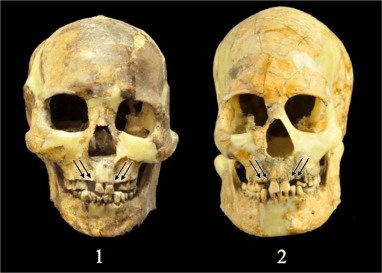
Ancient Aesthetic: The 4,800-Year Tradition of Tooth Extraction in Taiwan's Austronesian Culture
A very unique body modification practice in Taiwan, among the ancient population, involved the deliberate extraction of healthy front teeth for aesthetic reasons, as it was considered beautiful, or as a sign of bravery, or because removing them now would prevent them from decaying later. This practice has existed for at least 4,800 years and continues to this day among Austronesian populations, suggesting that the original inhabitants of Taiwan were Austronesian and that their migration patterns might be traceable. However, while today it is mainly practiced among women, the discovery reveals that it was once common among men, or at least equally prevalent among both men and women.
-
Washing with sacred cow urine
Gomez is a term in Middle Persian that refers to the urine of a cow, bull, or sheep, which was used in religious and purification rituals in Zoroastrian ceremonies. Gomez was considered a powerful purifying agent in Zoroastrianism and played an important role in rituals meant to cleanse people, clothes, or objects from impurities, especially those resulting from contact with the dead or other contaminating substances.
Gomez was used in purification rituals where different parts of the body were washed to remove impurities. It was part of ceremonies like the Barashnum, a long and complex purification ritual specifically performed for those who had come into contact with the dead.
Gomez does not necessarily have to come from a cow. It is generally derived from cows because they are considered pure animals, and five products from them are regarded as sacred and are used in religious rituals: milk, yogurt, butter, urine, and dung. Even dung is used for purification and for making sacred fires. However, as mentioned, Gomez can be made from the urine of any pure animal, such as sheep.
Scientifically, there is evidence supporting the idea that urine can purify. Urine contains ammonia, which is a natural disinfectant with antibacterial properties. Ammonia can kill bacteria and other microorganisms, which could explain the use of cow urine for purifying objects and people in certain rituals. Urine was also used in Ayurveda for similar purposes, such as disinfection and treating infections.
Bathing in urine was not unique to the Persians. The Hindu Puranas state: "One should bathe in cow urine, sustain oneself on milk, move with the cows, and eat after they have eaten. This is known as 'Govrata'. By doing this, a person will be freed from sins within a month. He will reach the world of the cows and enter heaven."
Saint Sturm, a disciple of Boniface who founded the Fulda Monastery in the 8th century, described the bathing rituals of the Slavs as "smelly," and they remained smelly even after bathing. It might have been slander, but it turns out that in the Slavic language, there is a connection between the word for urine (моча, mocha) and the word for soaking (мочить, mochit). Additionally, the Slavic word for "washing" (мыть, myt') may be related to the Sanskrit word for "urine" (mutra, मूत्र), and possibly even to the Gaelic word for urine (mún).
There is a claim that the Romans also washed their clothes in urine, or at least used it in what is known in English as "fulling" (from the Latin Fullo), where they washed the dirt and grease from wool during its processing. The water used for this process was called "foot water" in Hebrew and was often mixed with nitrum. These "foot waters" were forbidden from being brought into the Temple "for the sake of dignity", and they preferred to use another basic substance to "soak the nail/tziporen to make it strong", which was likely a type of bleach known for whitening fabrics.
-
Water cult in the Andes
Archaeologists have uncovered the skeletal remains of four people (two children, a teenager, and an adult) who were buried in the Viru Valley of Peru about 3,800 years ago, millennia before the Incas flourished in the region. The skeletons were positioned lying on their sides and appear to be facing a mountain. Remains of funerary offerings, such as stone pendants and shells, were found alongside them. The structure where the skeletons were found was built with curved walls made of river stones held together by clay plaster. It seems to be a temple, and if so, it may have been associated with a water cult. This is suggested both by the building materials and by the fact that, in Andean cosmology, mountains are the only source of water, as the area is extremely arid, with the rivers being the sole source of water, and almost no rain falling (rain shadow deserts).
-
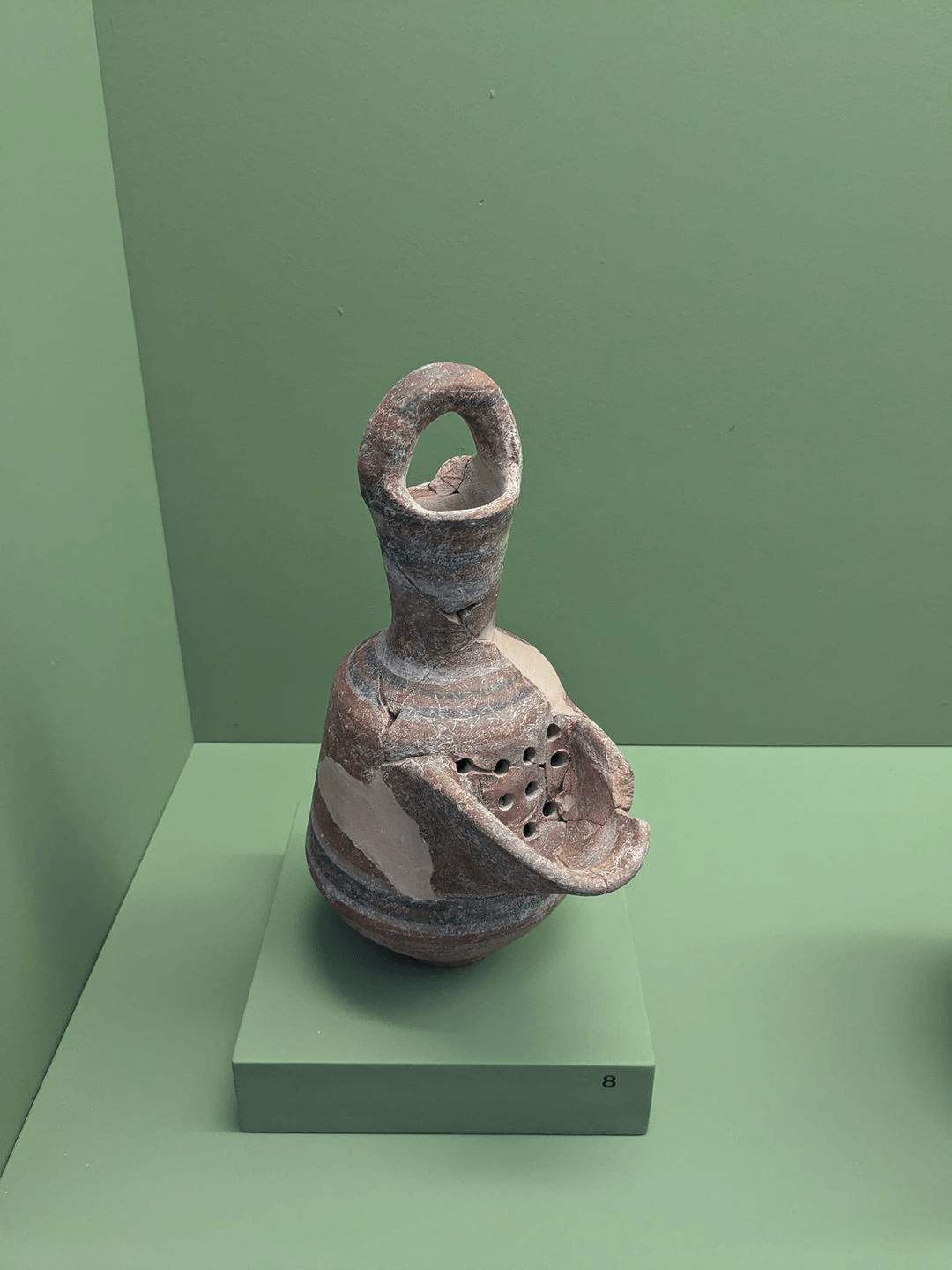
A Philistine beer jug
A Philistine beer jug, Khirbet Qeiyafa. The Iron age 2a, 10th century BC. On display at the Museum of the Biblical Lands, Jerusalem, from the collection of the Israel Antiquities Authority.
Most of the vessels found in Khirbet Qeiyafa maintain the Canaanite tradition. The very small number of Philistine-type vessels recovered from the city which was located on the border between Judah and Philistia, supports the opinion that the inhabitants were not Philistines.
-
Caves as Doors of Perception #2
Once again, Professor Ran Barkai presents, this time with a more concise and comprehensive lecture, where he expands slightly on the logic behind his theory:
According to the worldview of indigenous cultures, caves were considered liminal spaces, gateways to the underworld, from which abundance flows. In these cultures, shamans could enter altered states of consciousness to connect with the underworld and solve problems.
Humans during the Paleolithic period in Europe entered caves because they discovered that this was a way to alter their consciousness. They didn't have intoxicating plants available, as they lived in Europe. So, they would either ascend to high places or enter caves—this was their method of communicating with the "lord" of the earth. There is a model suggesting that ancient people believed in three worlds: the upper world, our world, and the underworld. Mountain climbing was the way to connect with the upper world, while entering caves was a way to connect with the underworld. This means that they entered caves not out of curiosity, necessity, or chance, but with deliberate intent, for a specific purpose. And that purpose was communication. It wasn't enough for them to merely enter a cave; they had to go to the deepest part of it and leave a mark there. Sometimes that mark was a painting, but other times it was simply a handprint. The reason they wanted to go as deep as possible was the belief that the deeper they went, the more intimate the connection. They took advantage of the fact that the deeper one goes into a cave, the less air there is. And with less air, there is less oxygen, and with less oxygen, there is hypoxia. This effect was intensified when they lit fires, as the fire itself consumed oxygen, further depleting the air. Hypoxia led to altered states of consciousness.
A surprising piece of evidence was found in Pinwheel Cave, California, four years ago, establishing a link between altered states of consciousness and caves, when researchers discovered a mural of a Datura flower in the cave. In Europe, the paintings were mostly of large animals like mammoths, bison, and horses, as well as handprints and geometric patterns.
In correspondence with him, Prof. Barkai said: "Here is an archaeological background to my thoughts, seemingly unrelated, but in my opinion very related"
-
Caves as Doors of Perception
Professor Ran Barkai from Tel Aviv University researches the connection between humans and caves in terms of altered states of consciousness. Barkai argues that in the distant past, caves served as "transformative arenas" where humans experienced unique states of consciousness, caused by oxygen deprivation due to the use of artificial light deep within the caves. He views caves as "doors of perception" that allowed people to communicate with the universe and address challenges during times of distress, using psychedelic experiences to expand awareness and create solutions.
The phenomenon of oxygen deprivation is known as hypoxia, which occurs in confined spaces, places without air circulation, high altitudes, and also in deep areas. This is especially true when fire is involved in the process, as it consumes the already scarce oxygen in the air and emits carbon monoxide. At the stage when hypoxia symptoms begin to appear, beyond headaches and dizziness, confusion, fainting, and especially euphoria also occur. This is because the body reacts by increasing dopamine secretion.
In this lecture (hebrew), first a doctoral student of Professor Barkai and then Professor Barkai himself will present on cave incubation and the cave paintings that, according to their claims, were created under the influence of intentional cave hypoxia.
-
A Scottish provenance for the Altar Stone of Stonehenge
A new study suggests that the Altar Stone at Stonehenge contains a rock formation found in northern Scotland (called the "Orcadian Basin"), rather than in Wales as previously believed. This means that instead of a 220 km journey, it traveled over 750 km to reach its location. While some of the bluestones did indeed come from Wales, this particular stone did not.
-
Trance, posture, and tobacco in the Casas Grandes shamanic tradition
In the Paquimé culture of Casas Grandes in Chihuahua, Mexico, tobacco was smoked in a posture known as the "Tennessee Diviner" (TD posture), to achieve altered states of consciousness depicted in the unique iconography found at the site. This posture is not unique to the Casas Grandes culture but is part of a broader ritual practice observed in other cultures. The posture involves standing, sitting, or lying in a specific way, positioning the body to allow for concentration and the induction of trance experiences. This particular posture is designed to influence the body's response and is often accompanied by rhythmic drumming or the use of rattles, combined with the use of substances like tobacco to enhance the experience. Together with the setting, it produces a consistent and reliable experience of "soul flight" or gaining insights into the future.