
-
Devil's Caves in Finland
In Finland there are several caves called "Devil's Caves". It is said that shamans used to hold ceremonies there in which they communicate with "mountain elves", "invisible fairies" and "great lords" to find the causes of the illnesses of the people they treated, and of course to cure them. A new study tries to prove the method and explain the essence of the messages they received from the cave. And the reason: acoustic tricks, or rather, an interpretation of the same acoustics that are obtained as a result of the natural structure of the cave. “The phenomenon is caused by a standing wave between the smooth parallel walls, generating a tone at the natural frequency of the cave, 231 Hz, that stays audible for around one second after sharp impulses, such as clapping, drumming or loud bangs. Tones vocalised in the cave near the 231 Hz frequency are amplified and lengthened by the cave”.
-
The Mysteries of the Enaree: The Androgynous Shamans of the Scythians
Who were the Anarya – the Scythian shamans who were born male, castrated, behaved as women, abstained from heterosexual sex, underwent initiation through passive anal sex, and engaged in fortune-telling while soaking in a cannabis vapor bath?
It is not for nothing that it mentions the Kdeshim in the Asherah temples. The Anarya worshiped the Scythian snake goddess Artimpasa, who in the Lake Azov region was also known by her name "Astara" (Ασταρα) or more correctly with name dervied drom the "Ashtoret". According to Scythian mythology, it was believed that the androgynous nature of the Anarya (which they therefore born like this) originated due to a curse placed by the goddess Artimpasa on those responsible for the destruction of the temple of Ashtoret in Ascalon in the seventh century BCE. Ashtoreth herself was seen as an androgynous deity associated with vegetation and fertility, with the power to turn men into women and women into men.
The Sumerians in the cult of Inanna, the Phrygians in the cult of Cybele, and the people of Ephesus, the Megabyzoi in the cult of Artemis, all had androgynous eunuch priests – probably due to a cult with identical characteristics.
-
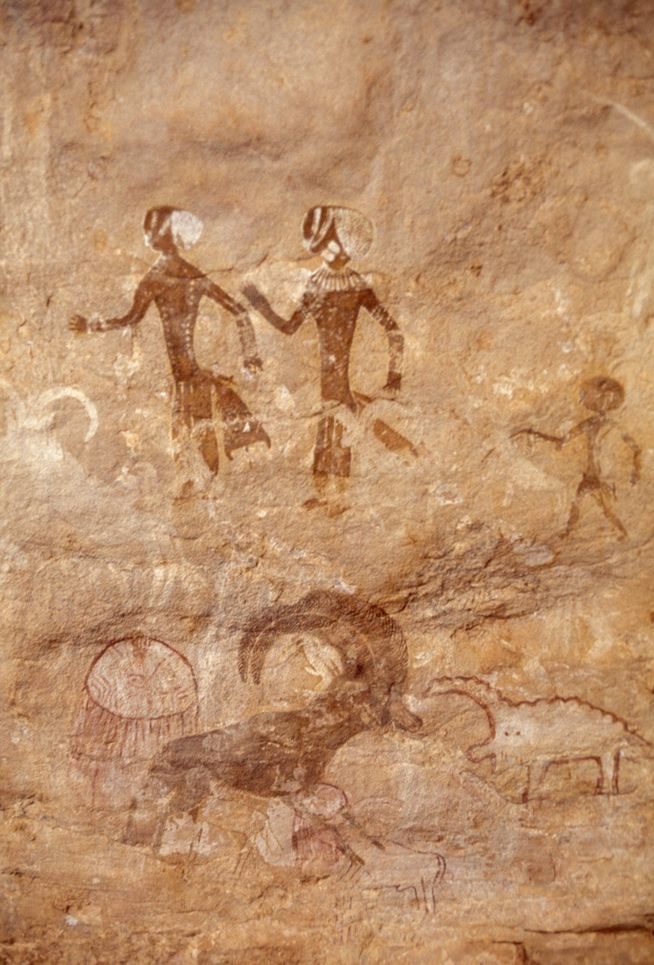
Does the round head actually symbolize the shape of the acacia tree?
The worship of Artiodactyls animals among the ancient societies probably came about because they shit a lot, and there are fungi that treat the animal dung to reproduce. These fungi are called "coprophilous" because they wait for their hosts to excrete them in the feces (which becomes fertilizer) and thus spread their spores. The mushrooms are called Panaeolus, some of them contain psychoactive alkaloids such as psilocybin.
Before the Sahara Desert became a desert in the 8th millennium BC, while it was a fertile savannah rich in vegetation, it was inhabited by groups of hunters who, inspired by these mushrooms, drew paintings on rocks in a style that gave this period the nickname "the period of the round head". This name was given because the figures of the people were like dancers with mushroom-shaped heads, who supposedly perform a ritual ceremony before going hunting.
The claim is that this ceremony was a worship of the sacred animals, precisely because they shit sacred mushrooms. Henri Lotte, the ethnographer who studied these paintings, also suggested that they were figures of aliens, an idea that gave Erich von Daniken the idea for "Chariots of the Gods". But because it is a weak arguement, the psychedelic hypothesis is also sufficient. The credit for the psychedelic hypothesis can be given to the Italian researcher Giorgio Samorini.
I already wrote about the mushrooms in poop here a few months ago. The more interesting thing is that one of the more famous paintings is of a shaman with a bee head. In Tassili n Ajjer in the Sahara, paintings with red ochre were found that were drawn with a stick of acacia wood (btw, the pigment produced by the acacia is also red)
Hymenoptera family (bees, ants) especially love the acacia tree, and acacia honey is considered premium honey. In general, the Hymenoptera have a symbiosis with the acacia trees, they protect the acacia from pests and the acacia provides them with food.
The acacia itself is present today in a relatively small population in the Sahara, but there is evidence that during the time of the Sahara as a savannah, the acacia was so widespread that it was quite dominant in the local flora. And accordingly, the local fauna had wild animals that are not found in the desert today, but then there is evidence from the rock paintings themselves that they were present. One of them is the deer.
It turns out that the deer still exists in the deserts to this day – the Arabian deer (Gazella arabica), and especially the acacia deer (Gazella acaciae) of which a very few population remains today in the Yotvata area, which its diet is based on acacia leaves. What is also special about acacia trees, is that its seeds are infected with the larvae of beetles called Bruchidius spadiceus. If these seeds are eaten by deer, the parasitic larvae die in the deer's stomach and when they are excreted the seeds are ready to germinate. Meaning, deer also have a symbiosis with the acacia.
The deer, and in general the Antilopinae family, became a symbol. Whether for fertility, or whether in their affection, it turns out, for psychoactive plants. Now, the question is, according to the findings: if in the Sahara, and consequently in ancient Egypt, a psychedelic cult took place. If there was a population of deer and acacia trees. If there was a direct connection between these two things – doesn't that say something about the nature of worship there? Does the round head actually symbolize the shape of the acacia tree?

round head? -
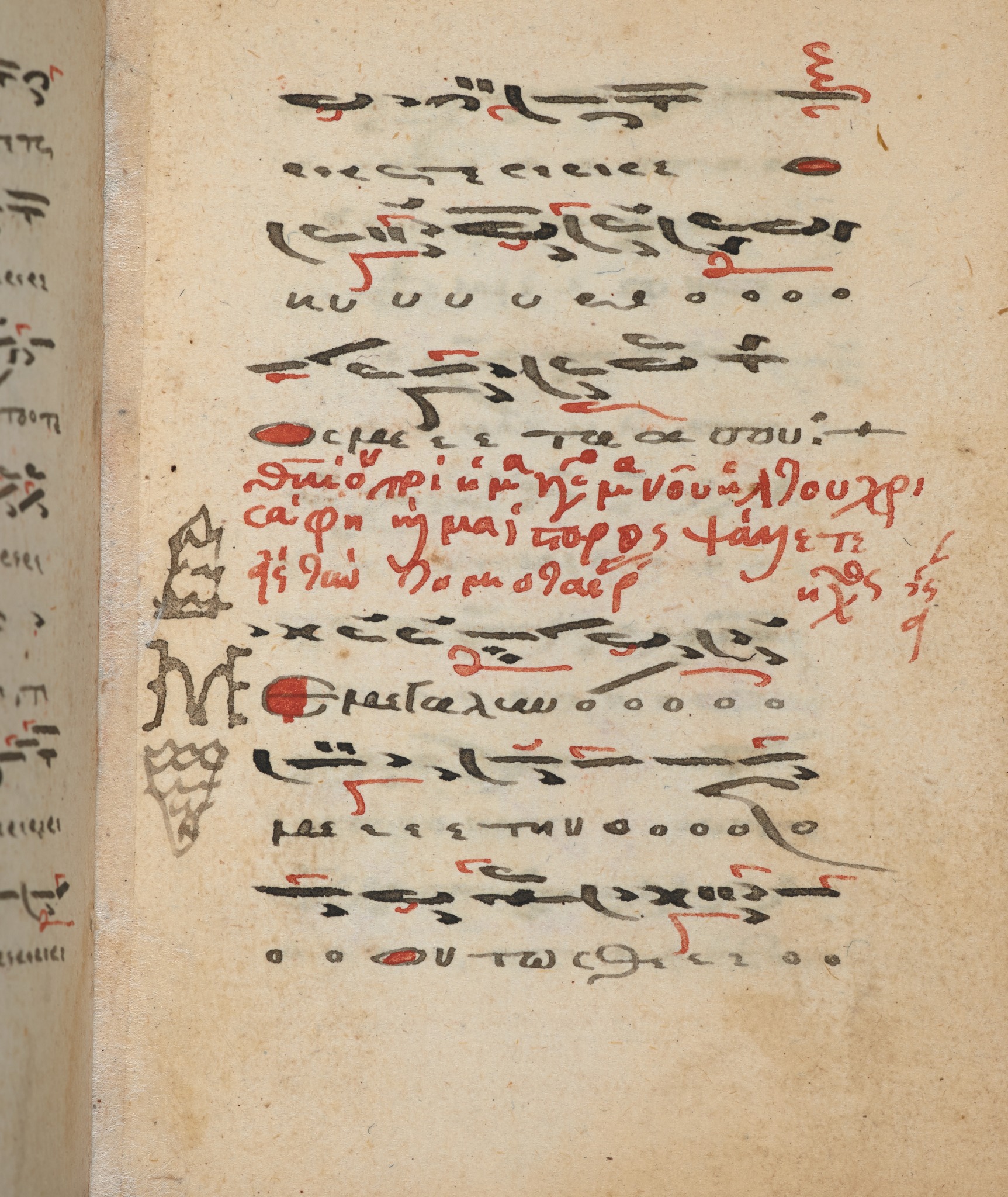
High on vermilion
Already in prehistoric times, finds of cinnabar were discovered in the graves of shamans. It turns out that the shamans adorned themselves with clothes dyed with the pigment developed from this gem, Vermilion, and perhaps even inhaled it. The inhalation of this powder is known to us from ancient China. No matter how poisonous it is, the Chinese were crazy enough to use all kinds of substances that you wouldn't think of, just because they have virtues to strengthen chi energies of something. why? Cinnabar is a mineral, or gemstone, that is a compound of mercury and sulfur. It turns out that one of the side effects of mercury poisoning is damage to the body's central nervous system, which sometimes also manifests itself in damage to behavior, memory, hallucinations and delirium. They probably tried to reach these situations.
The Chinese had a legendary mixture, which was used for religious and medicinal purposes. As part of the religious needs, toxic minerals were used for an ecstatic experience. The mixture was called the "powder of the five stones" "Wu Shi San" (五石散), which, in parallel with the feeling of disconnection from reality, also created hyperthermia and therefore the "powder walkers" had to immerse themselves in ice baths and eat cold food in order to moderate their body heat. That's why this powder was also called the "cold food powder" "Han Shi San" (寒食散). To this day among Daoism, red is considered a sacred color, the cinnabar itself symbolized the power of vividness and immortality, and we see immortality is associated among the Chinese to any high state of consciousness, or as something that has a positive effect on memory and creativity.
Just as mentioned previously, the cinnabar powder that is used as a pigment is called vermilion. In ancient times, cinnabar was the main source of mercury, and because the pigment is red and the cloak (chlamys, χλαμύς) of Hermes was red, this substance is associated with divine wisdom, and the tool by which the world was created. That means, everything in the world is made of mercury, and everything can be created from mercury. That's why the alchemists who believed in Hermes Trismegistus often experimented with it.
In the Bible, the vemilion is called "Shashar" (ששר) and the prophets Ezekiel and Jeremiah condemn King Shalum ben Josiah, who painted the walls of his palace red, as the Babylonians used to do. So we see a royal use of cinnabar. And in fact, just as the purpura (scarlet/crimson pigment wool from which the Toga was colored) and the porphyry (purple stone from which royal statues were sculpted) were allowed in the late Roman period and in the Byzantine Empire only for the emperors, so it turns out that vermilion was too allowed only for them. In ancient Rome at the time of the triumphs, the faces of the victors were painted this color, to resemble Jupiter, whose statue on the Capitoline Hill was painted with vermilion. After the use of vermilion was limited it was only in administrative use, the emperors would use red ink made from it, in which the Holy Scriptures and various ecclesiastical documents were also written.
The connection with Babylon and the Shashar brings up another theory related to states of consciousness. We see how Jeremiah calls Babylon "Sheshach". Supposedly, we argued, that Shashar is a code name in Hebrew for the word Babylon, but who knows if it is not because of the graphic similarity between Shashar (ששר) and Sheshach (ששך), and perhaps it is just a spelling error and a copy by a writer who did not understand what the connection is between them?
Ezekiel and Jeremiah condemn Shalum ben Josiah who painted the walls of his palace with "Shashar", a red color, like the Babylonians. Jeremiah, on the other hand, twice prophesies about Babylon, and calls them "Sheshach". In both cases the prophecy comes in the context of wine and drunkenness (therefore red, like rage bulls running amok). Once (in chapter 25) "a cup of heat", and once (in chapter 51) as "a cup of intoxicating gold". Is it because the effect of the Shashar, brings about high states of consciousness like the wine?
PS the sons of prophets in Kings and Samuel books, are described as those who would strip off their clothes during prophecy. And perhaps because they also sniffed substances that caused hyperthermia…
One of those who are described as having spread out during prophecy was Saul. Saul is also described as having lost his mind. The person who wrote the book of Samuel was not a psychiatrist, he was indeed a religious man who believed in spirits and demons, and they usually lived in plants or minerals. If Saul's mind was lost, it could be because he drank something that affected his personality, or wore something that caused him this due to exposure to a toxic substance over time. For example: the Roman emperors were said to have suffered from lead poisoning. Various heavy metal poisonings were usually among nobles and upper class people who had the means to use elite tools, such as glass, metal, jewelry, makeup, and clothing with color pigments that sometimes included toxic substances.
-
The Hanukkah holiday as a conversion of the Apollo cult
In the first and second chapters of 2 Maccabees it is told about a letter sent by Judah the Maccabee and the elders of Jerusalem, which explains why the festival of fire is celebrated on Hanukkah and instructs the people of Alexandria to celebrate it as well on this date. According to the inscription, this is a holiday that was supposed to be celebrated in Sukkot, and was celebrated every year on the days of the Second Temple, since the days of the building of the Temple by Nehemiah. In order not to break the tradition, they held it as soon as they could, and this moment is the 25th of Kislev month. The holiday is called "Holiday of Sukkot and the fire", in memory of the event in which the fire of the Temple was lit for the first time on the altar of the Second Temple. This is the same fire that came down from heaven in the days of Solomon and in the desert, and Jeremiah in his honor and by himself stored the fire in a secret place. The fire is called "Nephty" (equivalent to the modern "Neft", petrol) , a word that is an abbreviation of the word "Niftar" which means "purified".
The second Temple, it is said in the Book of Haggai, was founded at the end of the "ninth month", i.e. at Kislev. However, two things happened in December: Herod was enthroned by the Romans as reported by Josephus, and the dedication of Herod's temple took place. Herod, who wanted to make propaganda for his rule, actually appropriated to himself two holidays that were celebrated during this period, the foundation of the temple in the days of Haggai and the dedication of the house in the days of the Hasmonean dynasty. By appropriating this holiday, he actually tried to force forgetting the glory of the Hasmonean house and attribute it to the Temple that he supposedly built himself. For this purpose he founded a holiday, and even a new custom. In the first century, a testimony appeared by the Roman satirist Persius Flaccus who referred to Hanukkah and testified to a holiday founded by Herod called the "Days of Herodes", "Dies Herodis".
It turns out that Herod adopted a practice that was common in Roman times, winter fire festivals that were usually celebrated as part of the sun worship – the Saturnalia festival. This holiday incidentally became the birthday of the invincible Sun God (Sol Invictus), which became Christmas. Herod adopted this custom of lighting candles in order to light in honor of the sun god. At the same time, the Julian calendar also began to be introduced, and thus the birthday of the sun god on the 25th of the month, merged with another holiday celebrated on the 25th of the month.
In the worship of the Saturnalia, they lit candles on the altar of Saturnus and sent each other gifts of wax candles. The candles are meant to be lit in the early hours of darkness that occurs during the shortening winter days, or as mentioned to symbolize the birth of the sun. The fact is that until Herod's time we did not find any evidence that candles were lit in Judaism, and it was only in his time that House of Hillel and Shammai started talking about the matter.
In Chapter 1 of the Mishnah in Tractate "Avodah Zarah" it is told about two holidays of the Gentiles "Kalanda and Saturnalia". In they accompanied Gemara (Babylonian Talmud) 8:1, it is explained that "Kalanda is 8 days after a period, Saturnalia is 8 days before a period." The same thing is also written in Yerushalmi Talmud, "Kalanda [after] a period of eight days, Saturnalia [before] a period of eight days". Kalanda is the beginning of the month of January, "Kalende Januariae". The so-called "period" is supposedly a holiday that takes place 8 days before the Kalenda and 8 days after the Saturnalia.
Immediately after that in the Babylonian Talmud it is written about the Equinox: "As the first Adam saw a day that was getting shorter and shorter, he said, "I afraid that since I sinned, a dark world be got for me and it returns to chaos and confusion, and this is the death that was fined on me from heaven. He stood and sat eight days in fasting and prayer. Since he saw the period of Tevet and saw a day that lengthens and goes away, he said that maybe it is just the routine of the world. He went and did eight good days. For the next year he made those days festival. He appointed them for the sake of heaven and the Gentiles appointed them for the worship of the idolatory". That is, Adam established these holidays for 8 days each, in memory of his fears and joys before and after the period. And somehow it rolled into Gentiles.
This story came to explain how the Jews adopted a custom practiced by the Gentiles and related to the decrease and increase of light, and why the Jews actually mark the winter holiday by lighting candles.
Everything and more could be found in an hebrew article written by Prof. Moshe Benovitz from the Schechter Institute in Zion magazine, booklet A of the year 2003. -
P.D Newman's "Theurgy – theory and practice"
Theorgy is a practice through which one works on God. Unlike magic, the practitioner does not force God to act and does not manipulate him, it is not that God lacks man's action and through it man corrects him (as some of the ancient religions claimed in the act of sacrifice), but simply theorgy is a concept according to which the divinity's dimensions have an echo in the man and he serves as a pole in a full spectrum that God lives in the other pole. Through the theurgy man is actually transcends and connects to the divine in him, and through this he helps the divine to do what is necessary.
In other words, magic is programming the divine computer and making it do things it was not capable of, theorgy is pushing the buttons on the divine robot to make it do things it was designed to do. And what the divine robot is destined to do is the divine union (hieros gamos). The theurgy helps him to do this. In the ancient religions this theurgy was a simulation of human mating. In mysticism this theurgy was through prayer and saying holy names. In alchemy, theurgy was through the combination of different elements that would perform their natural action while touching each other. In all cases the goal is the same – from a practical point of view there is an effect of human actions on the divine world, but from a spiritual point of view there is an ascension of the soul to the upper world through the rituals.
Theurgy was a concept that arose for the first time among the late Neoplatons, the disciples of Plotinus who tried to transcend themselves towards the Absolute One. But it turns out that this thing was not only invented in the "Chaldean Oracles" (a Neoplatonic treatise) in the second century, but has its foundations already in ancient Greece, in Homeric thought and in Thracian shamanic rituals, through which the practitioners sought to descend to the underworld and return alive from it. What is called in Greek mythology Katabasis (κατάβασις) – this is what P.D. Newman claims in his new book that is released this week (my confession: I have not read the book yet, this is what I understand from the summary).
-
John Marco Allegro's "The Dead Sea Scrolls and the Christian Myth"
John Marco Allegro was invited in 1953 to join the international team established to study the Dead Sea Scrolls in Jordan. He was the only secular researcher on the team, while most of the other researchers were learned Catholic priests.
The fact that he was religiously unusual was the first crack in his relations with his friends. The second crack was when several years had already passed and he criticized the fact that none of the secrets of the scrolls had leaked out, and for what reason. So he decided to take action and independently publish passages that he deciphered from the scrolls. The other researchers criticized him for this, claiming that the passages were full of errors and careless translation. Allegro also deciphered the copper scroll and believed that it was a map to a real treasure, he went looking for this treasure and did not find it, to the mocking voices of his colleagues. In the end they kicked him out of the team.
Allegro's resentment towards them only grew when he insisted that they were misinterpreting the Dead Sea Scrolls, and were trying to line up with the body of information known to them and with what he claimed was a false myth of the beginning of Christianity. In the meantime he wrote his famous book "The Holy Mushroom and the Cross", which claimed that Jesus was not a real person but only an image of a spiritual ideal. This created an ambush that forced him to resign from his academic positions, effectively making him an officially anti-establishment researcher.
At this point, when he was already outside the establishment, he wrote another anti-establishment book called "The Dead Sea Scrolls and the Christian Myth". This research actually summed up his work. He claimed that the Essenes were actually a type of shamans who preserved medical knowledge they supposedly received from the fallen angels, which combined a way of life for self-purification and transcendence, which was later known as Gnosis – it is closer to the original Torah, while orthodox Christianity was a distortion due to a misunderstanding of the message of Jesus. Jesus himself was not a real person, but merely a symbol or embodiment of the sage who founded this stream, the Teacher of Righteousness. And maybe not an incarnation at all but simply a distorted reflection of the real life of the Teacher of Righteousness, who was eventually executed and this is the source of the myth of Christ's crucifixion.
The book was originally published in 1979, Allegro was then, as mentioned, outside the establishment, and claimed that there was one big conspiracy designed to prevent the public from knowing what is really in the scrolls from the dead sea. In fact, anything that could undermine the myth about the truth and mission of Jesus according to the orthodox text, is canceled and put away. One of the most famous is that Allegro also claimed that the scrolls of Moses Wilhelm Shapira from the 19th century were not forgeries but authentic like scrolls from the Judean Desert. It is likely that they were also rejected out of the same motivation.
In the 2000s, a campaign to clear Allegro's name began. It began with a book published by his daughter Judith Anne Brown in 2005, books written by Jan Irvin in which he tried to discredit the credibility of Gordon Wasson who led the crusade to excommunicate Allegro and even (Irvin) acquired the rights to his books. In 2009, he reissued The Holy Mushroom and the Cross, enlisting Carl Ruck to write a long 30-page introduction that does little to restore Allegro to his lost glory as the father of the entheogenic theory of Christianity. Two years ago the book on "The Dead Sea Scrolls and the Christian Myth" was re-released, last year an audio book of "The Holy Mushroom and the Cross" was released, and this week an audio book read by Mike Cooper is released.
-
Menorah worship in ancient middle east
Another excellent past post by Nitzan Hamburg, from January 2002.
The menorah is considered by many to be a distinct Jewish/Israeli symbol. The pattern of the menorah, in my opinion, represents the burning bush: "It [the menorah] is like the sight that Yahweh showed Moses, so he made the lampstand" (Numbers, 8:4), since Moses says about the burning bush "this great sight". Likewise, it can also be linked to the ancient worship of trees as the reincarnation of the tree of life. Dr. Yigal Ben-Nun suggested that the menorah is the image of the God Yahweh, and I add that in the event of the burning bush, Moses indeed hides "his face, because he is afraid, he looks at God". When tried to understand if the menorah is indeed an original Israeli symbol as they claim, I found several very ancient examples from different regions: Jiroft, Khafajah, Cyprus, Acre etc., some of which are also literally imprinted as a tree with six branched branches.
Bonus: Raanan Eichler in thetorah.co.il magazine claims that the description of the staff of Aaron as a decorated tree indicates a connection with the Asherah (although the tree is identified sometimes as the almond…)
-
Yosef Leib's "Cannabis Hassidis"
The Hassidim's fondness for the Alcoholic beverages for the purpose of elevating the soul and joy in the service of God is well known, and it turns out that they also used to smoke for the same purpose.
Among the Great Rebbes, the use of tobacco was widespread – both in the form of smoking and in the form of sniffing, and they attached great importance to tobacco smoke itself, they called it "the elevation of the soul". Rabbi Gershon of Kitov, the brother-in-law of the Baal Shem Tov, envied him and said "I wish I had a heaven feeling like what the holy Baal Shem Tov achieves when he smokes one pipe".
In fact, to this day, smoking is common among Hassidic people even though this is considered a "criminal" sign, and of course long before they knew that it was unhealthy (on the contrary, in the book "Maaseh Toviyyah", tobacco is actually considered a cure for respiratory diseases).
However, the Hassidim encouraged smoking because they saw it as an action of "saving soul sparks", a well-known Hasidic principle in which spiritually uplifted people are permitted and even required to associate with sinners in order to bring them to repentance, and sometimes it is even permitted to engage in actions that are in the gray area as long as there is something in them to do with restoring lost sparks.
This attitude was common among Kabbalists in the generation before Hasidism, such as David Moshe Vali, a student-friend of the Ramchal who wrote "The secret of that weed that you suck for smoke in the mouth with a tube is a bad thing that was invented for the devil to harm people… and here is also the way of hoiliness that exiles among them, doing their stuff to deceive them… therefore you will see many righteous smoking the Tobacco and raise its fume".
The ecstatic enthusiasm was frowned upon in the eyes of the religious establishment, because it was meant to undermine its status, change orders and sometimes even contradict instructions. Indeed, we see the Gaon of Vilnius, the head of those who opposed Hasidism, condemning them for their habits of drinking and smoking.
Yoseph Needelman-Ruiz deals with the subject in his book that came out about 15 years ago, "Cannabis Chassidis". He believes that if marijuana had been known in those times, its consumption would also have been encouraged (and probably even today this is desirable).
-
Noah Whiteman on the evolutionary origins of psychedelics
Noah Whiteman who wrote the book "Most delicious poison", wrote it in general about poisons and their evolution. In an article in Time magazine he focuses specifically on psychedelic substances and their evolutionary origins