
קטגוריה: english posts
-
The Lasting Impact of Tobacco on Human Bones
Archaeologists from the University of Leicester examined human remains buried in Britain between the 12th and 19th centuries, revealing the profound impact of tobacco on bones. Tobacco leaves leave traces on the bones of smokers, traces that not only last throughout their lives but also remain for hundreds of years after their death. Now, it…
-
Citrus = apple?
Is the "tappuach" in the Song of Songs actually referring to the etrog? In the Aramaic translation of the Song of Songs, the verse "As an apple tree among the trees of the forest, so is my beloved among the sons" is translated as, "Just as the etrog is lovely and praiseworthy among barren trees…".…
-
Saliva spit wine, an outcome of duplication of a gene AMY1
A new study conducted by the University of Buffalo and the Jackson Laboratory (JAX) reveals how the duplication of a gene known as salivary amylase (AMY1) helped shape human adaptation to starchy foods, leading to a dietary shift from non-starchy to starchy, or even starch-rich, foods. The duplication occurred in two stages: the first following…
-
Child slave for the Alcohol industry of late bronze age
In the Early Bronze Age, there was high demand for goblets and pottery in the Kingdom of Ebla, mainly due to feasts where alcohol was consumed. To meet the need for increased production of these vessels, the kingdom began employing children from the age of seven in workshops as a cheap and easily controlled labor…
-
The Numerology Behind the Number of Bulls Sacrificed During the Festival of Sukkot and the hidden greek connection
Sukkot is a unique festival, not only because it lasts seven days but primarily due to its distinctively abundant sacrificial offerings compared to other festivals. While on a typical holiday, one or two bulls, a ram, and seven lambs are sacrificed, sometimes with a single goat for sin offering, on Sukkot, each day’s sacrifice is…
-
Insights from Raqefet Cave and the Natufian Era
Professor Dani Nadel researched Raqefet Cave for years during the first decade of the 2000s, yielding numerous findings on the burial practices at the site. He published these in a series of articles, the latest of which appeared in 2018 and reports on stone mortars found alongside Natufian graves, bearing signs of beer production. These…
-
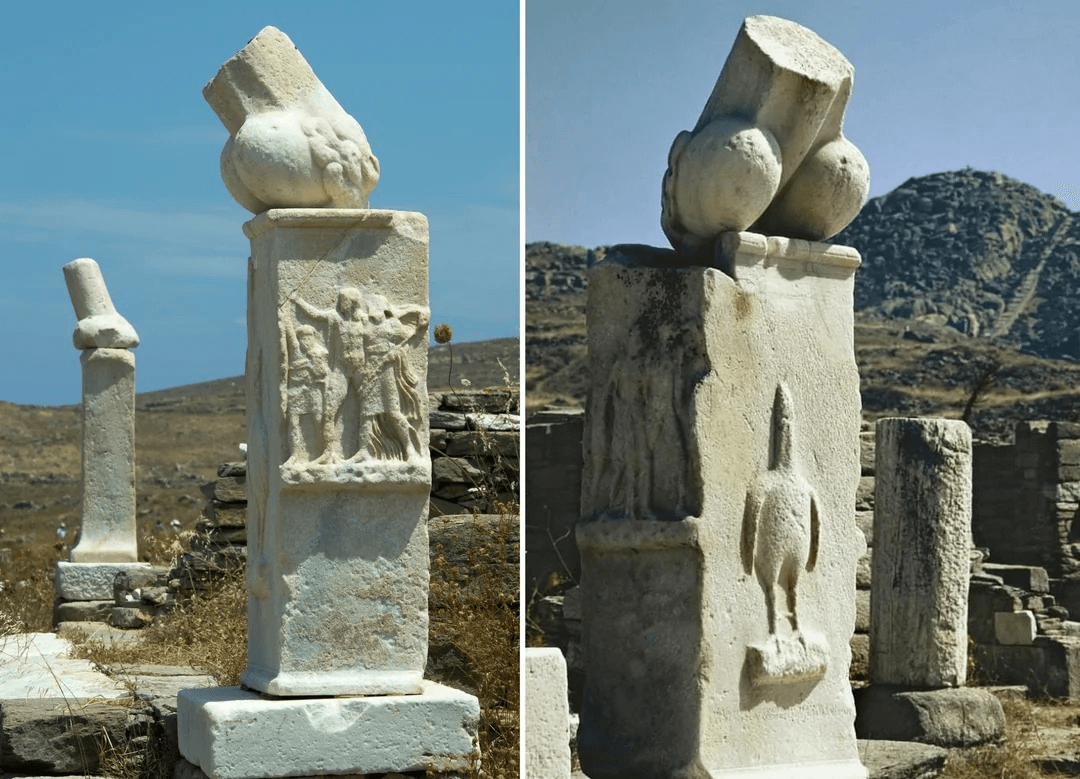
The phallic statues of Stoibedeion
The Stoibedeion is an ancient monument on the island of Delos in Greece, dedicated to the fertility god Dionysus. The Stoibedeion consists of a rectangular platform on which stood a statue of Dionysus, flanked by two figures portraying the Papposilenoi—representations of Silenus, the mentor and tutor of Dionysus (Pappos = like "papa," father). Silenus is…
-
Ancient Christianities and the role of magic
A new book by Paula Fredriksen deals with the first 500 years of Christianity. Chapter 7 focuses on pagan practices within early Christianity and the struggle against them. It describes Christian exorcism rituals that, from the outside, might have appeared similar to pagan ones. This ritual often involved commands directed at demons and healing through…
-
coca plant arrived to Europe in the early 1600s
Traditionally, it was believed that the coca plant first arrived in Europe in the 19th century, brought by explorers and traders who carried samples from North and South America. Spanish colonizers were familiar with the plant as early as the 15th century, but it did not become a significant trade commodity in Europe until the…
-
Ancient Phrygian Sacred Sites Uncovered at Midas Castle
During excavations at the Midas Castle in Eskisehir, Turkey, archaeologists uncovered remnants of structures from the Phrygian period, dating back to approximately 800 BCE. The findings include ancient ovens, an open hearth, and rock-carved basins—all serving as evidence that the site was used for ceremonial events, such as ritual feasts and animal sacrifices. Additionally, a…