
-
Zeev Ben Aryeh's "Goddess Culture in Israel"
In the absence of VOD on Israel's Yom Kippur, I would like to recommend something that would fill your few dead hours. Last year, Zeev Ben Aryeh published a masterful book in my view, "Goddess Culture in Israel", which includes both theoretical background and a guided tour of various Natufi sites, dolmens, megaliths and much more in Israel. The book deals, as its name suggests, with a theory (based on Mircea Eliada) about the matriarchal and shamanic history of primitive man, and the interpretation of nature that led to the creation of the initial religious symbols. Later, Zeev Ben Aryeh published another book relevant to our group: "The Gods Are Coming", about the process of urbanization, the establishment of religion and the creation of the gods. highly recommend.
-
New discoveries off Egyptian coast reveal ‘treasures and secrets’
Two magnificent temples were uncovered in an Egyptian city that sank under water and was discovered in 2000. The city was a port city of Greek mercenaries called Thonis-Heraklion which is now 7 km from the modern coast of the Mediterranean Sea and 20 km east of Alexandria.
The sinking happened as a result of an earthquake and tsunami following it in the second century BC, which caused the so-called "liquefaction" of the ground. The city gradually sank, and the coastline gradually encroached on the submerged land until in the fifth century they already covered all the remains of the city.
It is about two temples, one larger for the Egyptian god Amun and the other more "modest" for Aphrodite. The temples were found in the area of the southern canal of the city, where huge blocks of stone collapsed from the collapsing buildings during the liquefaction. Beneath them, divers found underground structures dating back to the fifth century BC.
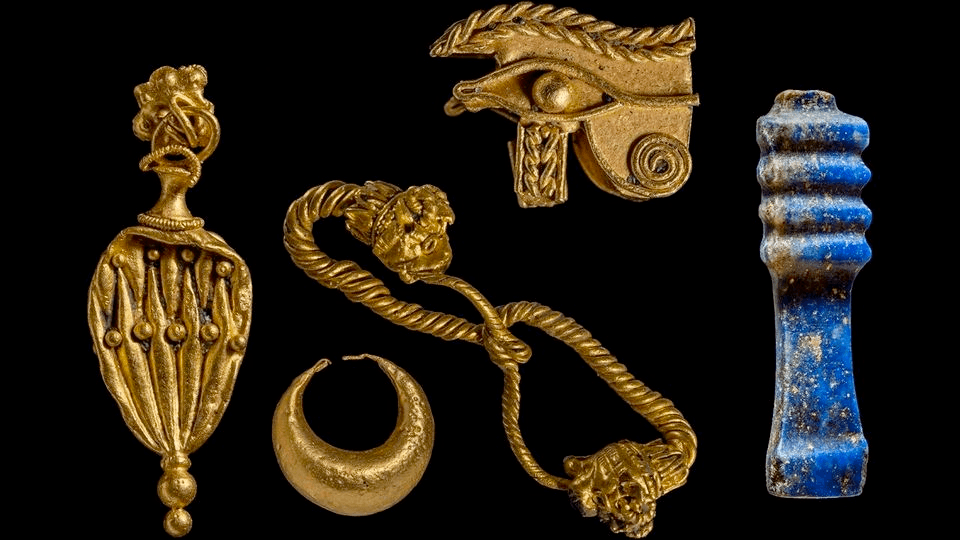
In the Temple of Amun, ritual vessels made of silver, gold jewelry and alabaster containers were found that were used to hold perfumes and ointments. Also found was a Djed pillar made of blue lapis-lazuli stone (considered by some researchers to be the biblical sapphire). Imported bronze and ceramic objects as well as a cache of weapons were discovered in the temple of Aphrodite. This indicates: a. On the prestige of the temples at that time, and thus on the prestige of the city in its glory days. B. On the Greek grip back in the pre-Hellenistic period (sixth century BC). It is likely that the Greeks arrived there as mercenaries intended to protect the city as the forward port of Egypt at that time, as experts in naval warfare.
-
Bronze Age hexagonal 'pyramid' not like anything 'found before in the Eurasian steppe'
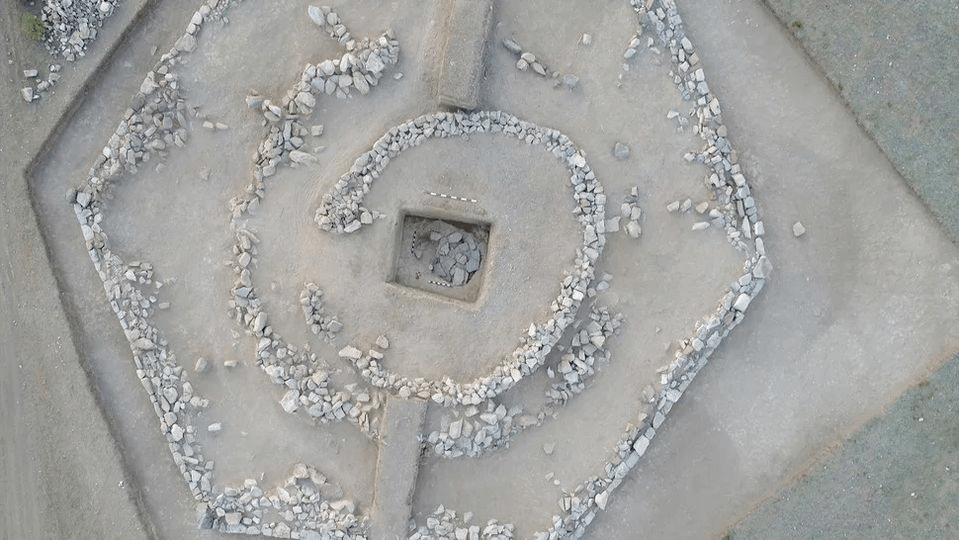
A 3,800-year-old hexagonal pyramid with a height of 3m and a diameter of 13m, which was used as a burial site was discovered in eastern Kazakhstan. The outer walls of the pyramid are decorated with petroglyphs, or rock art of various animals, including camels and more importantly, horses. Horse bones were discovered outside the pyramid and it seems that the place was a religious center of an horse-worshipping religion (like many peoples of the Asian steppe in ancient times). Various jewelry and various pottery were also found.
-
Yom Kippur Abracadabra
It seems that the sons of the prophets and the priests in the temple were nothing more than experimenters of primary chemistry, whose miraculous reactions caused them to adore certain materials and give them a mystical meaning. That is, everything that religion is based on is primitive science, which because it was discovered mostly by chance, without recording the way to reproduce the experiment, the scientists of that time perceived it as a supernatural phenomenon if they could not explain it in a logical way. Kind of "any technology is advanced enough – it's indistinguishable from magic"
Because of the amazement of the prophets and priests at the chemical properties of salt, they worshiped salt and gave it a cosmic meaning – salt covenant. Whoever does not keep the covenant, whoever violates it, is expected to be destroyed by salt, as happened to Sodom, as happened to everything in the Jordan Valley and the more you go south on the map, the hotter, desolate and saltier it is. The salt is considered to be a melting and burning substance, obviously not referring to table salt but to much more esoteric salts.
The salt was used daily in worship. Every sacrifice included salt, every taste of meat was charged with its saltiness. The salt was also part of the ingredients of the incense, and not just any salt, but "Sodomite salt" which is described as extremely strong salt (Hullin tractate 105b) that is dangerous to the eyes. There is no reason to think that it is not an Sodium hydroxide. The rest of the incense ingredients were different oils, as oils have acids in them. Resin is an acid and Cyprus wine is also an acid. It is clear that if you put them with even a tiny amount of Sodom salt, it "raises smoke" (Keritot tractate 6a). It is A-B of acid and base.
Now let's think about the situation. When the priest performs the chemical experiment and mixes all the ingredients, he says, "Squeeze well, shake well", because "the voice is beautiful for perfumes" (quote). It may be that the voice really is beautiful for perfumes, I don't know, but think of the crazy professor talking to himself, of a dervish who enters To trance in the act. This was the situation: a careful experiment including all the small nuances that make it successful.
One of the rituals that included a more massive use of those oils and salts was the "order of service" (Avodah) on Yom Kippur. As part of it, the high priest incensed the drug offering. In some cases at his own risk. It is often reported about high priests who died upon entering the Holy of Holies, of course it is reported about quite a few people who burned incense and died – members of the Korah sect, Nadab and Abihu. It is not impossible that the strange fire that killed them was a chemical experiment that went wrong, a work accident, following the ignition of some hydrogen that was emitted into the air as part of an unwanted reaction, or sulfur that exploded in their faces.
Assuming that the order of service included a number of chemical experiments, it is not impossible that the scarlet-dyed tongue of wool will turn from red to white as happens when bleach is used, that the salt of Sodom could, as mentioned, be blinded or that a priest would burn as part of his duties, and even that the scapegoat would disintegrate half way from the cliff to the abyss because even then the body would half melt from the many substances that were applied on him.
The scientific tradition was preserved among the Jewish elite even after the destruction of the Temple. Some of the sages are described as excellent scientists (such as Rabbi Joshua). Science and wisdom then involved religion, so probably religion at that time was a form of Jewish hermeticism. We of course meet Mary the Jewess, who was an alchemist known as the gold of Hermeticism. It is worth remembering that the Yom Kippur ceremony is associated with the Holy of Holies, the place where Aaron's staff is kept. Over the years, the staff became both the symbol of pharmacists (the staff of Asclepius) and the symbol of chemists (the staff of Hermes).
All's Well that the Fasting is Well!
-
how to test a medieval flying ointment on yourself
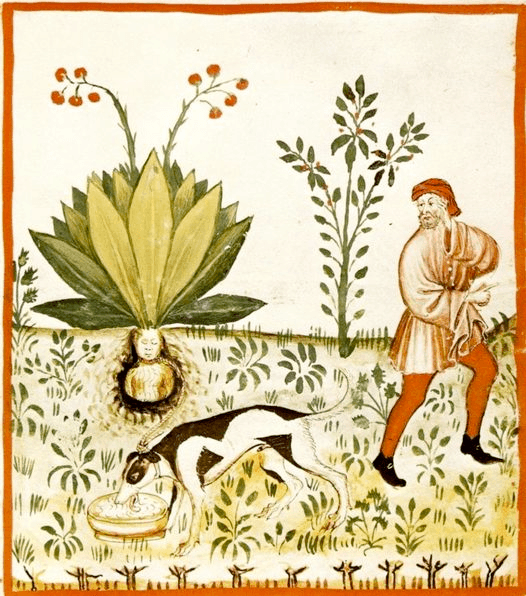
"University of Göttingen philologist Erich-Will Peuckert revealed in a 1960 interview that he and some friends had tried out a flying ointment recipe from the sixteenth-century book Matica naturis (substituting pork lard for the baby's fat); they passed out for twenty hours, and each experienced similar heavy metal nightmares" (Berries: A Global History by Heather Arndt Anderson. From the Edible series by Reaktion Publishing. p. 35)
-
Ecstasy is not fun
In common parlance, among the many who have not experienced ecstasy, ecstasy is fun, and I am frequently asked why I do not reach for mushrooms every night. But ecstasy is not fun. Your very soul is seized and shaken until it tingles. After all, who will choose to feel undiluted awe, or to float through that door yonder into the Divine Presence? The unknowing vulgar abuse the word, and we must recapture its full and terrifying sense…. (R. Gordon Wasson, The road to Eleusis)
-
Deposition, modification, and reutilization of human remains at Marmoles cave
In a natural cave in southern Spain called Cueva de los Marmoles at a depth of 370m and an altitude of 900m, human bones were found that underwent decoration in the Neolithic period starting from 4000 BC. Decoration such as a sharpened tibia bone that was used to scrape things, a skull cup, etc. It is not clear for what purpose exactly but these findings are consistent with discoveries at other cave sites in the south of the Iberian Peninsula, indicating a common pattern of human remains that were buried, and later reshaped for food and tool making. This is probably a type of dead worship, things known from other parts of the world.
-
ancient whittled logs could be the earliest known wooden structure
Rarely preserved logs have been discovered in Zambia and the fact that they appear to have been processed at a basic level that allows a cabin to be built from them, suggests that hominins used wood technology much earlier than we think, as early as 476,000 years ago. Although it is not the earliest tree found, it is the earliest structure. Was there a "Wooden Age" before the "Stone Age"? Was there another intelligent ape that preceded Homo sapiens? Maybe. And for what purpose was this cabin used?
-
The prophets were shamans and the prophecies were trip reports
The first evidence of monasticism was in India of the Vedic period around 1000 BC. In the Vedic tradition, there was a concept called personal redemption, "moksha" which was the way out of the cycle of life and death called "samsara". The strengthening of the philosophical trend among the religions in India, caused a decline in the status of the religious priests who perform rituals related to group redemption, and thus the emphasis became more and more personal. People, even from classes other than the "book classes" began to search for the Moksha themselves and this was the background for a large movement of nuns called "Samana". The "Samana" believed that through asceticism and meditation it is possible to reach a state of mind with which one can reach the Moksha and discover that our soul is part of the eternal being, or rather find the Brahman within the Atman.
This eastern development did reach the West at some stage, and according to various traditions, some Greek sages traveled to India and all kinds of other centers of knowledge such as Babylon and Egypt to study there, undergo an apprenticeship and transfer the knowledge to the West. But in truth this transition of philosophy, or mysticism, is not necessary because in Greece there was another type of hermit-wanderer-sage. It appears that this spiritual tradition has a common Indo-Aryan origin, and it developed from the time when these religions were shamanic, when what those shamans were looking for was an effective and proven way to connect with the world of spirits.
In Greece these shamans were called Iathromantis. They would perform different practices that would bring them to different states of consciousness. Practices such as incubation, seclusion and self-observation. It is said about the early Greek philosophers who were like this, such as Parmenides. A famous Iathromantis was Epimenides who is considered to have founded the Orphic religion.
And not only among the Greeks did such traveling teachers exist. Among the Thracians, for example, there were traveling preachers who led a celibate life and were called "Ctistae". They were priests of the religion of tribes that lived in Mysia in Asia Minor. Some of the religious commandments were the prohibition of meat, and the consumption of sacred foods in their eyes such as honey and milk. They worshiped the beech trees (buch), something that remains in Eastern European folklore to this day. Admiration of trees was also common among the Druids who adored the oak tree, but also among the Greeks, the oracle at Dodona was interpreted according to the rustling of the leaves in the oak grove. Of course, the worship of the oak is also reported among the Israelites in the Bible, as for example the prophetess Deborah who was a type of such an oracle.
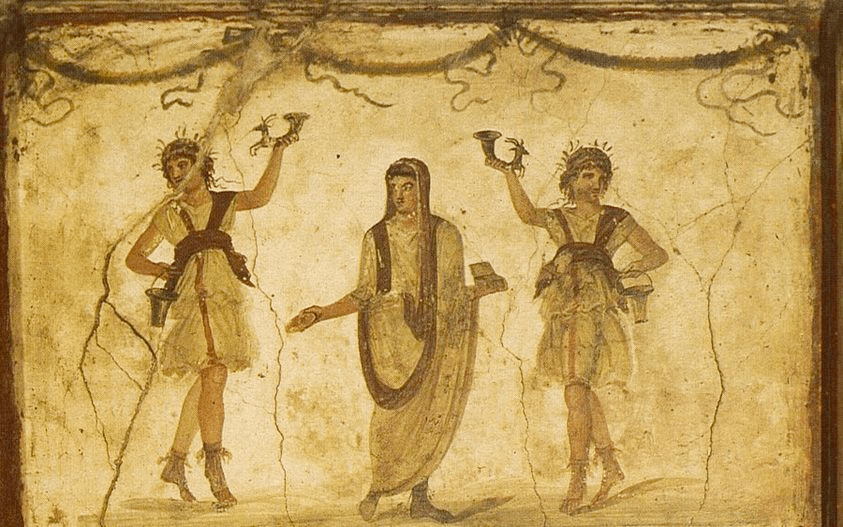
Among the Ctistae there was another type of monks known as Kapnobatai, meaning "the ones who walk in the smoke". Their religious worship included a smoke bath in which they got stoned, this was their way of changing consciousness and this is one of the first evidences in ancient literature of the use of psychoactive substances, in Posidonius. Herodotus, on the other hand, who preceded him by several centuries, reported that such worship was also practiced among the Scythian tribes that lived north of the Black Sea. In any case, from the Thracians in Asia Minor, the Mysteries of Cybele and Dionysus, which also included purification with smoke and the use of psychotropic materials, were brought to Greece and Rome.
Flavius Josephus and Philo compared the customs of the Thracian monks to those of the Essenes in the Judean desert. So it is likely that the Christian monks have foundations rooted in sects of the Judean desert that combined Hellenistic asceticism with the Jewish faith. If you look carefully, you can also see such elements among the movement described in the Bible "sons of the prophets" which included Elijah, Elisha, Shmuel, Ahijah the Shilonite, etc. They are all some kind of shamans, wandering teachers, healers and ancient scientists. The most similar thing between the sons of the prophets and the Christian monks is the practice of calling their leader "father" and colleagues in the group "brothers". Later in Christianity this type of monasticism was called "Coinobion". The monks were called "Coinobites". This is how the Pythagoreans lived, as mentioned in the original, a group of his guru and his disciples.
In ancient times, a type of divine man was born, "Theos Aner". Heroes who became gods used to be given such a touch of people who were blessed with virtues reserved for gods. Augustus tried to present himself as one. Apollonius of Tyana who was such a man of God became the prototype of Christ, who was probably presented as such because it was the language best understood by the Greeks on the northern shores of the Mediterranean. The stories of the martyrs, the Christian hagiography, developed from an earlier genre that described the plots of those men of God.
One of the most revered prophets who lived this lifestyle is the prophet Jonah. In the three monotheistic traditions it has a special place. In Judaism he is considered the prototype of Messiah son of Joseph, in Christianity he is considered a prefiguration of Jesus and in Islam he is considered Dhu'l-Nun, one of the most faithful prophets of Allah and one that Muhammad himself admired and tried to imitate. Jesus also compared himself in the New Testament to Jonah. One of the most revered Sufi monks was given this nickname of Jonah and was called Dhu'l-Nun al-Masri. He is also commemorated in the Zohar book as the prototype of the character of the "Tayya", the Arab guide who is the mentor of the Messiah and is identified in the Jewish tradition with the prophet Elijah.
Bonus: Why did the prophets walk around naked? It turns out that it was because they had hyperthermia from the drugs they took. The phenomenon is also known from ancient China, there is a drug called "the powder of the five stones" or "the powder of the cold food" that after taking it they felt that they have to take the clothes off. A somewhat far-fetched comparison, but assuming that the sons of the prophets were also interested in Dead Sea minerals and psychedelic drugs, they may have had this knowledge.
Bonus 2: What did the prophets eat? The Pythagoreans were vegetarians and avoided eating meat. The Orphs were also avoided. And also the Manichaeans, who preferred to eat fruits and vegetables that "held light". According to Philo, the Essenes were vegetarians. In general, Judaism teaches to be vegetarian. God's original commandment to man was to eat only plants (Genesis 1:29) and only after the flood did he allow them to eat meat. It turns out that the matter of kosher comes to prohibit the eating of any type of meat except for certain, "clean" animals, but only on the condition that they have undergone a sacred slaughtering ceremony (that would make them kosher), which not many people know how to do except for very certain people, at very certain moments (in ancient times meat was only eaten as part of religious ceremonies). And because there are not many of them, then there is no one to slaughter and therefore the Jews will not eat meat anyway. Regardless, a man named Edmond Szekely published a book he claimed to have found in the Vatican library called "The Gospel of Peace of the Essene" (possibly a forgery), in which he claims that vegetarianism is a teaching of Jesus himself, who was an Essene. According to him, Essenes had a vegetarian diet based on intermittent fasting and gathering sprouts and wild plants.
-
Henna as a sacred plant
The henna plant (Lawsonia inermis) was considered sacred in ancient cultures. It is considered a protection from the evil eye, so in Mesopotamia they would put it on before getting married*. In Egypt, the mummies were embalmed, for some reason related to the dead ceremony. Maybe so that the henna would protect the soul, or maybe simply because they wanted to make up the mummy before it reaches the world of the dead so that it would be beautiful. In Egypt they would make-up and paint their nails with Henna. The Egyptians also saw henna as an antiseptic preparation and would dye their hair with henna to cure ringworm – so in the Ebers Papyrus. Maybe that's why Muhammad used to dye his beard, to cure some eczema or something like that. who knows.
It is amazing that this trick was also used to decorize Persian horses. It was believed there that henna strengthens the fur and skin of the horses. The henna stuck to the skin and would color the fur even after it was shed or replaced with the season. They mainly dyed the tails, because it was believed that with stronger hairs, the tail would be longer and shinier. Light or sparsely furred horses would color not only in the tails but from their midline around the body, all the way to the hooves. They believed that the henna would protect the horses from sunburn and from what today is called skin cancer, which it turns out was affecting animals without fur.
* Contrary to what people think, it turns out that they used the henna against the evil eye and not to mark the bride before the wedding for the purpose so that the groom would know that he was under the canopy with the one who was betrothed to her, in order to avoid a case like that of Jacob and Leah.
** In the Bible, henna is called "Kofer". In the Song of Solomon it is mentioned twice. It can be noticed that the mercy seat in the Tabernacle was, as I recall, red like henna. In the Book of Deuteronomy (25:8, also 32:43) there is a clear connection between atonement and the color of the red blood and it appears that the atonement is in the name of the blood of the victim, "Include one male goat as a sin offering to make atonement for you". Therefore, Yom Kippur is named after the blood of the slaughtered goat. It also turns out that Noah's ark was applied from inside and outside width Kofer (henna). What is not clear is the etymology of the word "kofer" in Exodus 30 of the meaning ransom. The half the shekel was a ransom, although it is emphasized that it was "memorial before the Lord, making atonement for your lives", so perhaps because of the analogy between atonement and the red mercy seat.