
תגית: Human Evolution
-
A new spin on the “Stoned Ape Hypothesis”
The "Stoned Ape Theory" was first proposed by ethnobotanist Terence McKenna in 1992. It suggests that the use of psychedelic substances, such as psilocybin mushrooms, played a key role in the rapid cognitive development of early human ancestors. According to McKenna, psilocybin helped early hominids enhance abstract thinking, creativity, and expanded consciousness, which ultimately led…
-
Saliva spit wine, an outcome of duplication of a gene AMY1
A new study conducted by the University of Buffalo and the Jackson Laboratory (JAX) reveals how the duplication of a gene known as salivary amylase (AMY1) helped shape human adaptation to starchy foods, leading to a dietary shift from non-starchy to starchy, or even starch-rich, foods. The duplication occurred in two stages: the first following…
-
Terence McKenna Might Have Been Right About the Stoned Ape Theory
A new study suggests that psilocybin mushrooms may have played a significant role in the evolution of human consciousness, supporting Terence McKenna's "Stoned Ape" theory. The research was conducted by two Peruvian scholars, Jehoshua Macedo-Bedoya from the National University of San Marcos in Lima and Fatima Calvo-Bellido from the Pontifical Catholic University of Peru. "The…
-
The Complexity of Intelligence: Beyond Brain Size and Body Ratio
Brain size is not the sole measure of intelligence, nor is the ratio between brain size and body size. What determines intelligence is not a single factor like meat consumption or social group size, but rather a more complex interplay of social, technological, and evolutionary parameters. The takeaway is: next time someone tells you that…
-
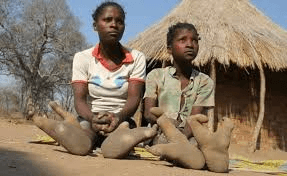
The way genetic disorder is believed to be a god's grace
The Doma (or Vadoma, or Wadoma) are a tribe living in Zimbabwe's Zambezi Valley. They are characterized by their isolation from surrounding tribes, leading them to marry only within their own tribe. This practice of close kin marriages and the resulting limited genetic pool has led to several genetic deformities, the most prominent being ectrodactyly,…
-
ancient human diet was based on 80% plants, especially root vegetables
You probably think that the ancient human diet was based on a paleo meat-based food. Right? A new research shows that his diet was based on 80% plants, especially potatoes (in a pre-domesticated version) and a variety of root vegetables
-
When did humans start burying the dead?
A few months ago, a controversial study was published that predates the early burial to another human race, which is not Homo sapiens, but Homo Naledi, and dates back to 300,000 years ago. As mentioned, the study is controversial. The earliest evidence so far points to the Middle Paleolithic period. There is evidence of burial…